

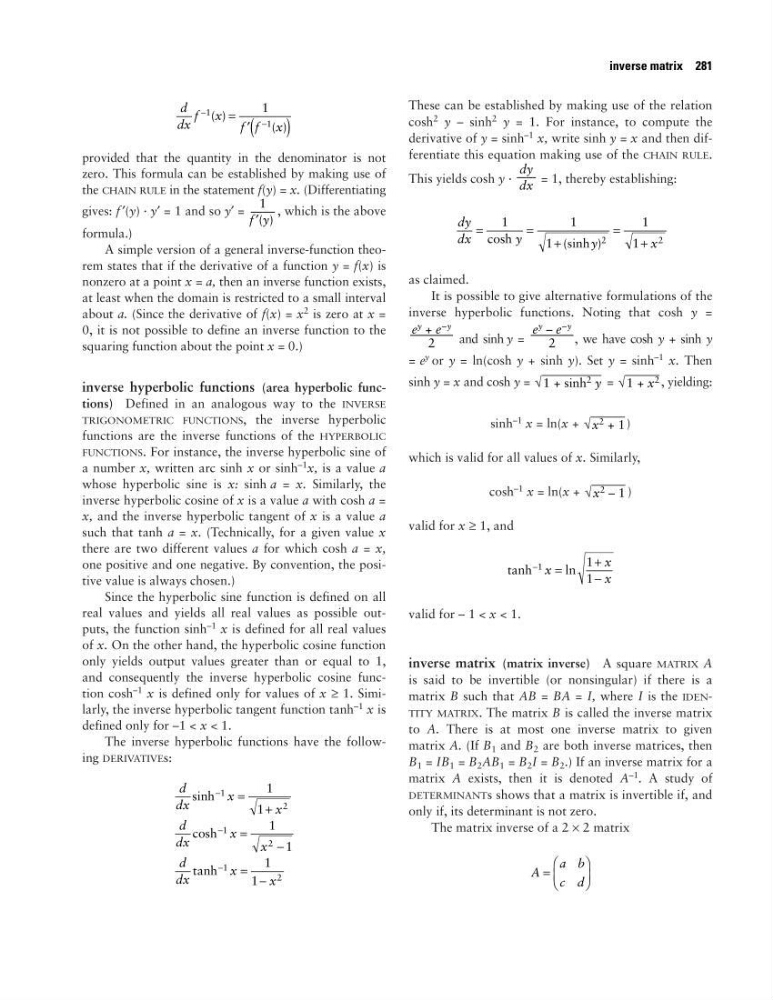
provided that the quantity in the denominator is not
zero. This formula can be established by making use of
the CHAIN RULE in the statement f(y) = x. (Differentiating
gives: f ′(y) · y′ = 1 and so y′ =
, which is the above
formula.)
A simple version of a general inverse-function theorem states that if the derivative of a function y = f(x) is
nonzero at a point x = a, then an inverse function exists,
at least when the domain is restricted to a small interval
about a. (Since the derivative of f(x) = x
2 is zero at x =
0, it is not possible to define an inverse function to the
squaring function about the point x = 0.)
inverse hyperbolic functions (area hyperbolic functions) Defined in an analogous way to the INVERSE
TRIGONOMETRIC FUNCTIONS, the inverse hyperbolic
functions are the inverse functions of the HYPERBOLIC
FUNCTIONS. For instance, the inverse hyperbolic sine of
a number x, written arc sinh x or sinh
–1 x, is a value a
whose hyperbolic sine is x: sinh a = x. Similarly, the
inverse hyperbolic cosine of x is a value a with cosh a =
x, and the inverse hyperbolic tangent of x is a value a
such that tanh a = x. (Technically, for a given value x
there are two different values a for which cosh a = x,
one positive and one negative. By convention, the positive value is always chosen.)
Since the hyperbolic sine function is defined on all
real values and yields all real values as possible outputs, the function sinh
–1 x is defined for all real values
of x. On the other hand, the hyperbolic cosine function
only yields output values greater than or equal to 1,
and consequently the inverse hyperbolic cosine function cosh
–1 x is defined only for values of x ≥ 1. Similarly, the inverse hyperbolic tangent function tanh
–1 x is
defined only for –1 < x < 1.
The inverse hyperbolic functions have the following DERIVATIVEs:
These can be established by making use of the relation
cosh
2 y – sinh
2 y = 1. For instance, to compute the
derivative of y = sinh
–1 x, write sinh y = x and then differentiate this equation making use of the CHAIN RULE.
This yields cosh y ·
= 1, thereby establishing:
as claimed.
It is possible to give alternative formulations of the
inverse hyperbolic functions. Noting that cosh y =
and sinh y =
, we have cosh y + sinh y
= e
y or y = ln(cosh y + sinh y). Set y = sinh
–1 x. Then
sinh y = x and cosh y =
=
, yielding:
sinh
–1 x = ln(x +
)
which is valid for all values of x. Similarly,
cosh
–1 x = ln(x +
)
valid for x ≥ 1, and
valid for – 1 < x < 1.
inverse matrix (matrix inverse) A square MATRIX A
is said to be invertible (or nonsingular) if there is a
matrix B such that AB = BA = I, where I is the IDENTITY MATRIX. The matrix B is called the inverse matrix
to A. There is at most one inverse matrix to given
matrix A. (If B 1 and B 2 are both inverse matrices, then
B 1 = IB 1 = B 2 AB 1 = B 2 I = B 2 .) If an inverse matrix for a
matrix A exists, then it is denoted A
–1 . A study of
DETERMINANTs shows that a matrix is invertible if, and
only if, its determinant is not zero.
The matrix inverse of a 2 × 2 matrix
A
a b
c d
=
⎛
⎝
⎜
⎞
⎠
⎟
tanh
ln
−
=
+
−
1
1
1
x
x
x
√x
2 – 1
√x
2 + 1
√1 + x
2
√1 + sinh
2 y
e
y – e
–y
––––
2
e
y + e
–y
––––
2
dy
dx
y
y
x
=
=
+
=
+
1
1
1
1
1
2
2
cosh
(sinh )
dy
––
dx
d
dx
x
x
d
dx
x
x
d
dx
x
x
sinh
cosh
tanh
−
−
−
=
+
=
−
= −
1
2
1
2
1
2
1
1
1
1
1
1
1
––
f ′(y)
d
dx
f x
f f x
−
−
= ′ ( )
1
1
1
( )
( )
inverse matrix 281
zero. This formula can be established by making use of
the CHAIN RULE in the statement f(y) = x. (Differentiating
gives: f ′(y) · y′ = 1 and so y′ =
, which is the above
formula.)
A simple version of a general inverse-function theorem states that if the derivative of a function y = f(x) is
nonzero at a point x = a, then an inverse function exists,
at least when the domain is restricted to a small interval
about a. (Since the derivative of f(x) = x
2 is zero at x =
0, it is not possible to define an inverse function to the
squaring function about the point x = 0.)
inverse hyperbolic functions (area hyperbolic functions) Defined in an analogous way to the INVERSE
TRIGONOMETRIC FUNCTIONS, the inverse hyperbolic
functions are the inverse functions of the HYPERBOLIC
FUNCTIONS. For instance, the inverse hyperbolic sine of
a number x, written arc sinh x or sinh
–1 x, is a value a
whose hyperbolic sine is x: sinh a = x. Similarly, the
inverse hyperbolic cosine of x is a value a with cosh a =
x, and the inverse hyperbolic tangent of x is a value a
such that tanh a = x. (Technically, for a given value x
there are two different values a for which cosh a = x,
one positive and one negative. By convention, the positive value is always chosen.)
Since the hyperbolic sine function is defined on all
real values and yields all real values as possible outputs, the function sinh
–1 x is defined for all real values
of x. On the other hand, the hyperbolic cosine function
only yields output values greater than or equal to 1,
and consequently the inverse hyperbolic cosine function cosh
–1 x is defined only for values of x ≥ 1. Similarly, the inverse hyperbolic tangent function tanh
–1 x is
defined only for –1 < x < 1.
The inverse hyperbolic functions have the following DERIVATIVEs:
These can be established by making use of the relation
cosh
2 y – sinh
2 y = 1. For instance, to compute the
derivative of y = sinh
–1 x, write sinh y = x and then differentiate this equation making use of the CHAIN RULE.
This yields cosh y ·
= 1, thereby establishing:
as claimed.
It is possible to give alternative formulations of the
inverse hyperbolic functions. Noting that cosh y =
and sinh y =
, we have cosh y + sinh y
= e
y or y = ln(cosh y + sinh y). Set y = sinh
–1 x. Then
sinh y = x and cosh y =
=
, yielding:
sinh
–1 x = ln(x +
)
which is valid for all values of x. Similarly,
cosh
–1 x = ln(x +
)
valid for x ≥ 1, and
valid for – 1 < x < 1.
inverse matrix (matrix inverse) A square MATRIX A
is said to be invertible (or nonsingular) if there is a
matrix B such that AB = BA = I, where I is the IDENTITY MATRIX. The matrix B is called the inverse matrix
to A. There is at most one inverse matrix to given
matrix A. (If B 1 and B 2 are both inverse matrices, then
B 1 = IB 1 = B 2 AB 1 = B 2 I = B 2 .) If an inverse matrix for a
matrix A exists, then it is denoted A
–1 . A study of
DETERMINANTs shows that a matrix is invertible if, and
only if, its determinant is not zero.
The matrix inverse of a 2 × 2 matrix
A
a b
c d
=
⎛
⎝
⎜
⎞
⎠
⎟
tanh
ln
−
=
+
−
1
1
1
x
x
x
√x
2 – 1
√x
2 + 1
√1 + x
2
√1 + sinh
2 y
e
y – e
–y
––––
2
e
y + e
–y
––––
2
dy
dx
y
y
x
=
=
+
=
+
1
1
1
1
1
2
2
cosh
(sinh )
dy
––
dx
d
dx
x
x
d
dx
x
x
d
dx
x
x
sinh
cosh
tanh
−
−
−
=
+
=
−
= −
1
2
1
2
1
2
1
1
1
1
1
1
1
––
f ′(y)
d
dx
f x
f f x
−
−
= ′ ( )
1
1
1
( )
( )
inverse matrix 281