

elementary row operations on the two matrices
simultaneously. Reduce A to an identity matrix.
The second matrix produced is the inverse
matrix to A.
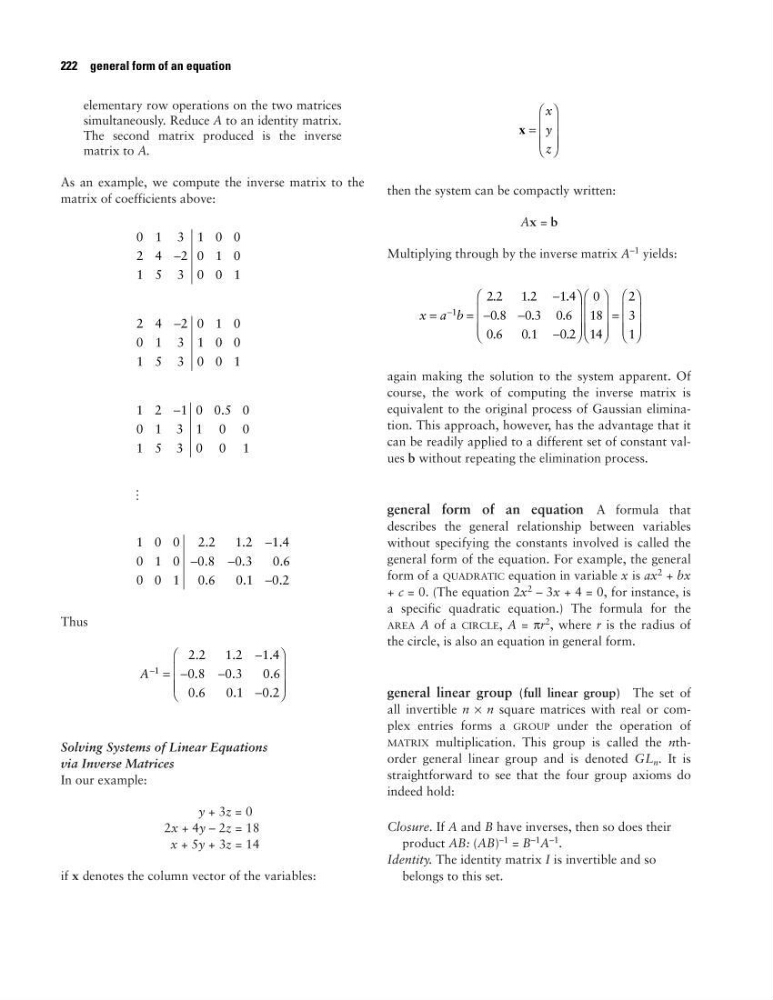
As an example, we compute the inverse matrix to the
matrix of coefficients above:
Thus
Solving Systems of Linear Equations
via Inverse Matrices
In our example:
y + 3z = 0
2x + 4y – 2z = 18
x + 5y + 3z = 14
if x denotes the column vector of the variables:
then the system can be compactly written:
Ax = b
Multiplying through by the inverse matrix A –1 yields:
again making the solution to the system apparent. Of
course, the work of computing the inverse matrix is
equivalent to the original process of Gaussian elimination. This approach, however, has the advantage that it
can be readily applied to a different set of constant values b without repeating the elimination process.
general form of an equation A formula that
describes the general relationship between variables
without specifying the constants involved is called the
general form of the equation. For example, the general
form of a QUADRATIC equation in variable x is ax
2 + bx
+ c = 0. (The equation 2x
2 – 3x + 4 = 0, for instance, is
a specific quadratic equation.) The formula for the
AREA A of a CIRCLE, A = πr
2 , where r is the radius of
the circle, is also an equation in general form.
general linear group (full linear group) The set of
all invertible n × n square matrices with real or complex entries forms a GROUP under the operation of
MATRIX multiplication. This group is called the nthorder general linear group and is denoted GL n . It is
straightforward to see that the four group axioms do
indeed hold:
Closure. If A and B have inverses, then so does their
product AB: (AB)
–1 = B
–1 A
–1 .
Identity. The identity matrix I is invertible and so
belongs to this set.
x a b
=
=
−
−
−
−
⎛
⎝
⎜
⎜
⎜
−1
2 2 1 2
1 4
0 8 0 3 0 6
0 6 0 1
0 2
.
.
.
.
.
.
.
.
.
⎞ ⎞
⎠
⎟
⎟
⎟
⎛
⎝
⎜
⎜
⎜
⎞
⎠
⎟
⎟
⎟
=
⎛
⎝
⎜
⎜
⎜
⎞
⎠
⎟
⎟
⎟
0
18
14
2
3
1
x =
⎛
⎝
⎜
⎜ ⎜
⎞
⎠
⎟
⎟ ⎟
x
y
z
A − =
−
−
−
−
⎛
⎝
⎜
⎜ ⎜
⎞
⎠
⎟
⎟ ⎟
1
2 2
1 2
1 4
0 8
0 3
0 6
0 6
0 1 0 2
.
.
.
.
.
.
.
.
.
0 1 3
2 4 2
1 5 3
1 0 0
0 1 0
0 0 1
2 4 2
0 1 3
1 5 3
0 1 0
1 0 0
0 0 1
1 2 1
0 1 3
1 5 3
0 0 5 0
1 0 0
0 0 1
1 0 0
0 1 0
0 0 1
2 2
1 2
1 4
0 8
0 3
0 6
0 6
0 1 0 2
−
−
−
−
−
−
−
.
.
.
.
.
.
.
.
.
.
M
222 general form of an equation
simultaneously. Reduce A to an identity matrix.
The second matrix produced is the inverse
matrix to A.
As an example, we compute the inverse matrix to the
matrix of coefficients above:
Thus
Solving Systems of Linear Equations
via Inverse Matrices
In our example:
y + 3z = 0
2x + 4y – 2z = 18
x + 5y + 3z = 14
if x denotes the column vector of the variables:
then the system can be compactly written:
Ax = b
Multiplying through by the inverse matrix A –1 yields:
again making the solution to the system apparent. Of
course, the work of computing the inverse matrix is
equivalent to the original process of Gaussian elimination. This approach, however, has the advantage that it
can be readily applied to a different set of constant values b without repeating the elimination process.
general form of an equation A formula that
describes the general relationship between variables
without specifying the constants involved is called the
general form of the equation. For example, the general
form of a QUADRATIC equation in variable x is ax
2 + bx
+ c = 0. (The equation 2x
2 – 3x + 4 = 0, for instance, is
a specific quadratic equation.) The formula for the
AREA A of a CIRCLE, A = πr
2 , where r is the radius of
the circle, is also an equation in general form.
general linear group (full linear group) The set of
all invertible n × n square matrices with real or complex entries forms a GROUP under the operation of
MATRIX multiplication. This group is called the nthorder general linear group and is denoted GL n . It is
straightforward to see that the four group axioms do
indeed hold:
Closure. If A and B have inverses, then so does their
product AB: (AB)
–1 = B
–1 A
–1 .
Identity. The identity matrix I is invertible and so
belongs to this set.
x a b
=
=
−
−
−
−
⎛
⎝
⎜
⎜
⎜
−1
2 2 1 2
1 4
0 8 0 3 0 6
0 6 0 1
0 2
.
.
.
.
.
.
.
.
.
⎞ ⎞
⎠
⎟
⎟
⎟
⎛
⎝
⎜
⎜
⎜
⎞
⎠
⎟
⎟
⎟
=
⎛
⎝
⎜
⎜
⎜
⎞
⎠
⎟
⎟
⎟
0
18
14
2
3
1
x =
⎛
⎝
⎜
⎜ ⎜
⎞
⎠
⎟
⎟ ⎟
x
y
z
A − =
−
−
−
−
⎛
⎝
⎜
⎜ ⎜
⎞
⎠
⎟
⎟ ⎟
1
2 2
1 2
1 4
0 8
0 3
0 6
0 6
0 1 0 2
.
.
.
.
.
.
.
.
.
0 1 3
2 4 2
1 5 3
1 0 0
0 1 0
0 0 1
2 4 2
0 1 3
1 5 3
0 1 0
1 0 0
0 0 1
1 2 1
0 1 3
1 5 3
0 0 5 0
1 0 0
0 0 1
1 0 0
0 1 0
0 0 1
2 2
1 2
1 4
0 8
0 3
0 6
0 6
0 1 0 2
−
−
−
−
−
−
−
.
.
.
.
.
.
.
.
.
.
M
222 general form of an equation