

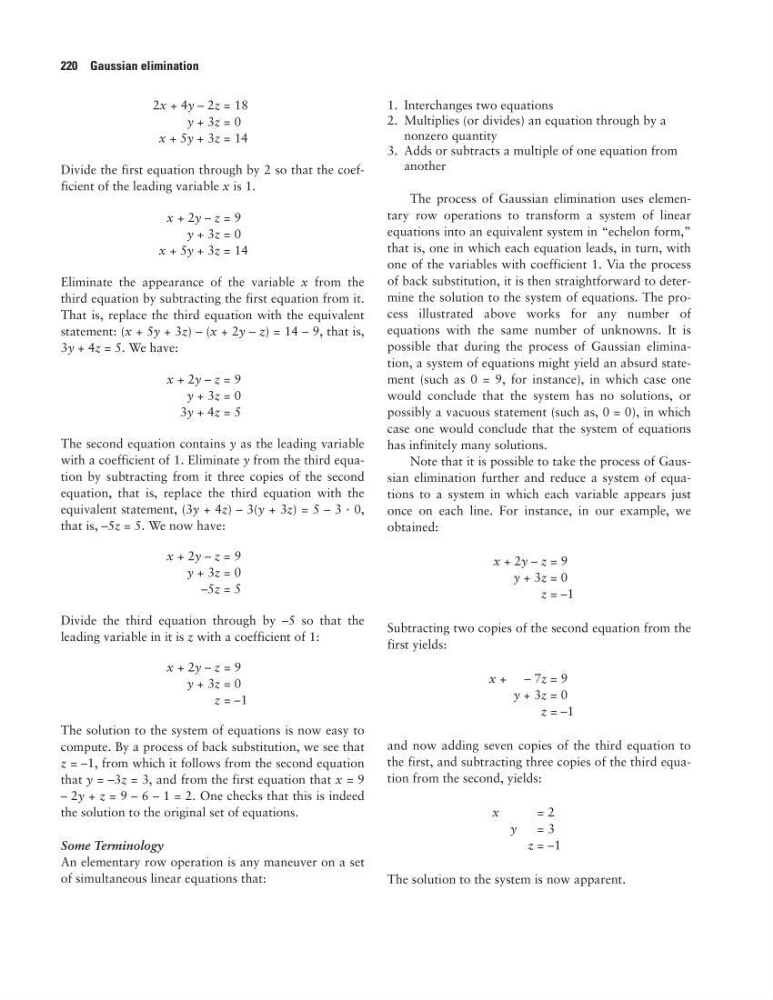
2x + 4y – 2z = 18
y + 3z = 0
x + 5y + 3z = 14
Divide the first equation through by 2 so that the coefficient of the leading variable x is 1.
x + 2y – z = 9
y + 3z = 0
x + 5y + 3z = 14
Eliminate the appearance of the variable x from the
third equation by subtracting the first equation from it.
That is, replace the third equation with the equivalent
statement: (x + 5y + 3z) – (x + 2y – z) = 14 – 9, that is,
3y + 4z = 5. We have:
x + 2y – z = 9
y + 3z = 0
3y + 4z = 5
The second equation contains y as the leading variable
with a coefficient of 1. Eliminate y from the third equation by subtracting from it three copies of the second
equation, that is, replace the third equation with the
equivalent statement, (3y + 4z) – 3(y + 3z) = 5 – 3 · 0,
that is, –5z = 5. We now have:
x + 2y – z = 9
y + 3z = 0
–5z = 5
Divide the third equation through by –5 so that the
leading variable in it is z with a coefficient of 1:
x + 2y – z = 9
y + 3z = 0
z = –1
The solution to the system of equations is now easy to
compute. By a process of back substitution, we see that
z = –1, from which it follows from the second equation
that y = –3z = 3, and from the first equation that x = 9
– 2y + z = 9 – 6 – 1 = 2. One checks that this is indeed
the solution to the original set of equations.
Some Terminology
An elementary row operation is any maneuver on a set
of simultaneous linear equations that:
1. Interchanges two equations
2. Multiplies (or divides) an equation through by a
nonzero quantity
3. Adds or subtracts a multiple of one equation from
another
The process of Gaussian elimination uses elementary row operations to transform a system of linear
equations into an equivalent system in “echelon form,”
that is, one in which each equation leads, in turn, with
one of the variables with coefficient 1. Via the process
of back substitution, it is then straightforward to determine the solution to the system of equations. The process illustrated above works for any number of
equations with the same number of unknowns. It is
possible that during the process of Gaussian elimination, a system of equations might yield an absurd statement (such as 0 = 9, for instance), in which case one
would conclude that the system has no solutions, or
possibly a vacuous statement (such as, 0 = 0), in which
case one would conclude that the system of equations
has infinitely many solutions.
Note that it is possible to take the process of Gaussian elimination further and reduce a system of equations to a system in which each variable appears just
once on each line. For instance, in our example, we
obtained:
x + 2y – z = 9
y + 3z = 0
z = –1
Subtracting two copies of the second equation from the
first yields:
x + – 7z = 9
y + 3z = 0
z = –1
and now adding seven copies of the third equation to
the first, and subtracting three copies of the third equation from the second, yields:
x
= 2
y
= 3
z = –1
The solution to the system is now apparent.
220 Gaussian elimination
y + 3z = 0
x + 5y + 3z = 14
Divide the first equation through by 2 so that the coefficient of the leading variable x is 1.
x + 2y – z = 9
y + 3z = 0
x + 5y + 3z = 14
Eliminate the appearance of the variable x from the
third equation by subtracting the first equation from it.
That is, replace the third equation with the equivalent
statement: (x + 5y + 3z) – (x + 2y – z) = 14 – 9, that is,
3y + 4z = 5. We have:
x + 2y – z = 9
y + 3z = 0
3y + 4z = 5
The second equation contains y as the leading variable
with a coefficient of 1. Eliminate y from the third equation by subtracting from it three copies of the second
equation, that is, replace the third equation with the
equivalent statement, (3y + 4z) – 3(y + 3z) = 5 – 3 · 0,
that is, –5z = 5. We now have:
x + 2y – z = 9
y + 3z = 0
–5z = 5
Divide the third equation through by –5 so that the
leading variable in it is z with a coefficient of 1:
x + 2y – z = 9
y + 3z = 0
z = –1
The solution to the system of equations is now easy to
compute. By a process of back substitution, we see that
z = –1, from which it follows from the second equation
that y = –3z = 3, and from the first equation that x = 9
– 2y + z = 9 – 6 – 1 = 2. One checks that this is indeed
the solution to the original set of equations.
Some Terminology
An elementary row operation is any maneuver on a set
of simultaneous linear equations that:
1. Interchanges two equations
2. Multiplies (or divides) an equation through by a
nonzero quantity
3. Adds or subtracts a multiple of one equation from
another
The process of Gaussian elimination uses elementary row operations to transform a system of linear
equations into an equivalent system in “echelon form,”
that is, one in which each equation leads, in turn, with
one of the variables with coefficient 1. Via the process
of back substitution, it is then straightforward to determine the solution to the system of equations. The process illustrated above works for any number of
equations with the same number of unknowns. It is
possible that during the process of Gaussian elimination, a system of equations might yield an absurd statement (such as 0 = 9, for instance), in which case one
would conclude that the system has no solutions, or
possibly a vacuous statement (such as, 0 = 0), in which
case one would conclude that the system of equations
has infinitely many solutions.
Note that it is possible to take the process of Gaussian elimination further and reduce a system of equations to a system in which each variable appears just
once on each line. For instance, in our example, we
obtained:
x + 2y – z = 9
y + 3z = 0
z = –1
Subtracting two copies of the second equation from the
first yields:
x + – 7z = 9
y + 3z = 0
z = –1
and now adding seven copies of the third equation to
the first, and subtracting three copies of the third equation from the second, yields:
x
= 2
y
= 3
z = –1
The solution to the system is now apparent.
220 Gaussian elimination