

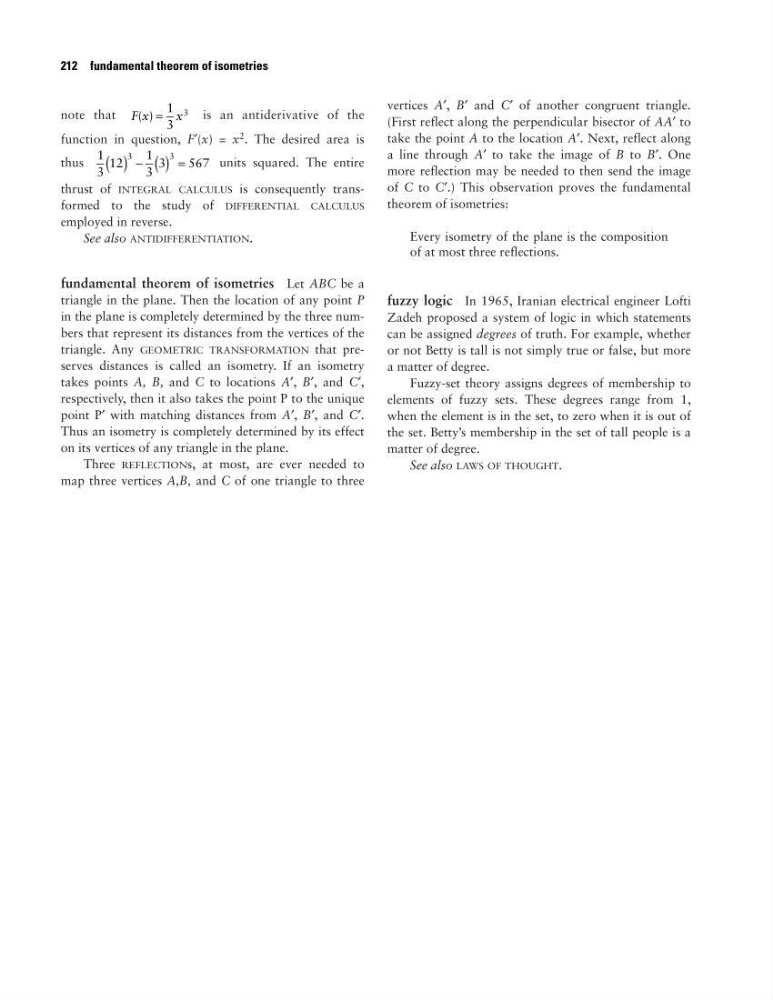
note that
is an antiderivative of the
function in question, F′(x) = x
2
. The desired area is
thus
units squared. The entire
thrust of INTEGRAL CALCULUS is consequently transformed to the study of DIFFERENTIAL CALCULUS
employed in reverse.
See also ANTIDIFFERENTIATION.
fundamental theorem of isometries Let ABC be a
triangle in the plane. Then the location of any point P
in the plane is completely determined by the three numbers that represent its distances from the vertices of the
triangle. Any GEOMETRIC TRANSFORMATION that preserves distances is called an isometry. If an isometry
takes points A, B, and C to locations A′, B′, and C′,
respectively, then it also takes the point P to the unique
point P′ with matching distances from A′, B′, and C′.
Thus an isometry is completely determined by its effect
on its vertices of any triangle in the plane.
Three REFLECTIONs, at most, are ever needed to
map three vertices A,B, and C of one triangle to three
vertices A′, B′ and C′ of another congruent triangle.
(First reflect along the perpendicular bisector of AA′ to
take the point A to the location A′. Next, reflect along
a line through A′ to take the image of B to B′. One
more reflection may be needed to then send the image
of C to C′.) This observation proves the fundamental
theorem of isometries:
Every isometry of the plane is the composition
of at most three reflections.
fuzzy logic In 1965, Iranian electrical engineer Lofti
Zadeh proposed a system of logic in which statements
can be assigned degrees of truth. For example, whether
or not Betty is tall is not simply true or false, but more
a matter of degree.
Fuzzy-set theory assigns degrees of membership to
elements of fuzzy sets. These degrees range from 1,
when the element is in the set, to zero when it is out of
the set. Betty’s membership in the set of tall people is a
matter of degree.
See also LAWS OF THOUGHT.
1
3
12
1
3
3
567
3
3
( ) − ( ) =
F x
x
( ) =
1
3
3
212 fundamental theorem of isometries
is an antiderivative of the
function in question, F′(x) = x
2
. The desired area is
thus
units squared. The entire
thrust of INTEGRAL CALCULUS is consequently transformed to the study of DIFFERENTIAL CALCULUS
employed in reverse.
See also ANTIDIFFERENTIATION.
fundamental theorem of isometries Let ABC be a
triangle in the plane. Then the location of any point P
in the plane is completely determined by the three numbers that represent its distances from the vertices of the
triangle. Any GEOMETRIC TRANSFORMATION that preserves distances is called an isometry. If an isometry
takes points A, B, and C to locations A′, B′, and C′,
respectively, then it also takes the point P to the unique
point P′ with matching distances from A′, B′, and C′.
Thus an isometry is completely determined by its effect
on its vertices of any triangle in the plane.
Three REFLECTIONs, at most, are ever needed to
map three vertices A,B, and C of one triangle to three
vertices A′, B′ and C′ of another congruent triangle.
(First reflect along the perpendicular bisector of AA′ to
take the point A to the location A′. Next, reflect along
a line through A′ to take the image of B to B′. One
more reflection may be needed to then send the image
of C to C′.) This observation proves the fundamental
theorem of isometries:
Every isometry of the plane is the composition
of at most three reflections.
fuzzy logic In 1965, Iranian electrical engineer Lofti
Zadeh proposed a system of logic in which statements
can be assigned degrees of truth. For example, whether
or not Betty is tall is not simply true or false, but more
a matter of degree.
Fuzzy-set theory assigns degrees of membership to
elements of fuzzy sets. These degrees range from 1,
when the element is in the set, to zero when it is out of
the set. Betty’s membership in the set of tall people is a
matter of degree.
See also LAWS OF THOUGHT.
1
3
12
1
3
3
567
3
3
( ) − ( ) =
F x
x
( ) =
1
3
3
212 fundamental theorem of isometries