

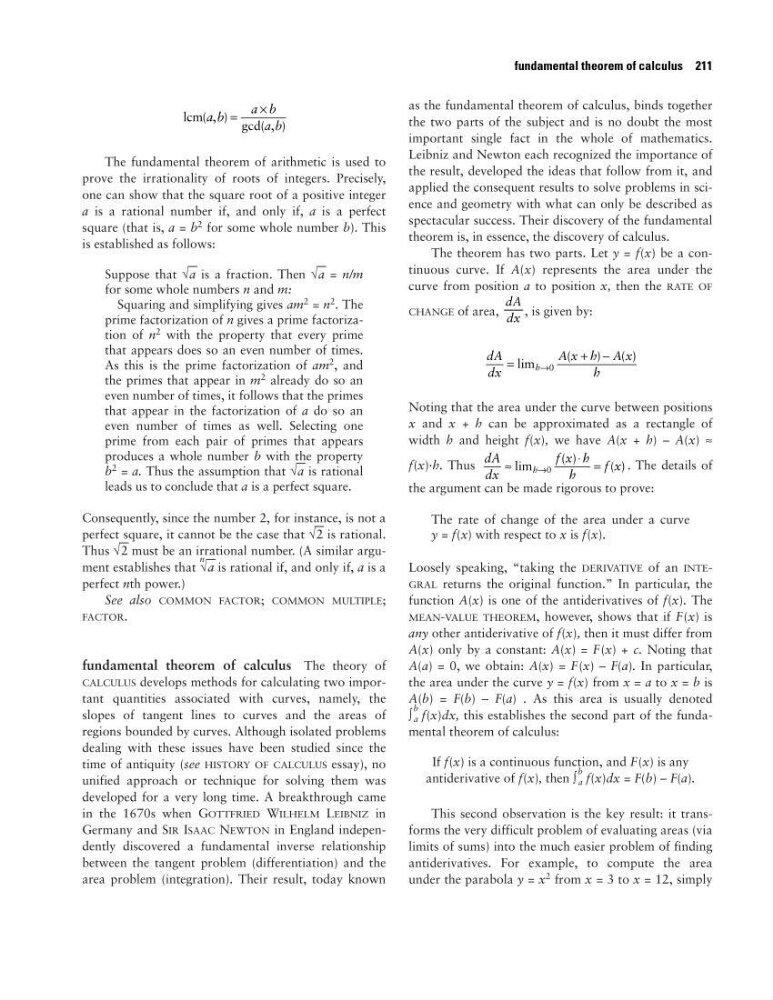
The fundamental theorem of arithmetic is used to
prove the irrationality of roots of integers. Precisely,
one can show that the square root of a positive integer
a is a rational number if, and only if, a is a perfect
square (that is, a = b
2 for some whole number b). This
is established as follows:
Suppose that √
–
a is a fraction. Then √
–
a = n/m
for some whole numbers n and m:
Squaring and simplifying gives am
2 = n
2 . The
prime factorization of n gives a prime factorization of n
2 with the property that every prime
that appears does so an even number of times.
As this is the prime factorization of am
2 , and
the primes that appear in m
2 already do so an
even number of times, it follows that the primes
that appear in the factorization of a do so an
even number of times as well. Selecting one
prime from each pair of primes that appears
produces a whole number b with the property
b
2 = a. Thus the assumption that √
–
a is rational
leads us to conclude that a is a perfect square.
Consequently, since the number 2, for instance, is not a
perfect square, it cannot be the case that √
–
2 is rational.
Thus √
–
2 must be an irrational number. (A similar argument establishes that
n
√
–
a is rational if, and only if, a is a
perfect nth power.)
See also COMMON FACTOR; COMMON MULTIPLE;
FACTOR.
fundamental theorem of calculus The theory of
CALCULUS develops methods for calculating two important quantities associated with curves, namely, the
slopes of tangent lines to curves and the areas of
regions bounded by curves. Although isolated problems
dealing with these issues have been studied since the
time of antiquity (see HISTORY OF CALCULUS essay), no
unified approach or technique for solving them was
developed for a very long time. A breakthrough came
in the 1670s when GOTTFRIED WILHELM LEIBNIZ in
Germany and SIR ISAAC NEWTON in England independently discovered a fundamental inverse relationship
between the tangent problem (differentiation) and the
area problem (integration). Their result, today known
as the fundamental theorem of calculus, binds together
the two parts of the subject and is no doubt the most
important single fact in the whole of mathematics.
Leibniz and Newton each recognized the importance of
the result, developed the ideas that follow from it, and
applied the consequent results to solve problems in science and geometry with what can only be described as
spectacular success. Their discovery of the fundamental
theorem is, in essence, the discovery of calculus.
The theorem has two parts. Let y = f(x) be a continuous curve. If A(x) represents the area under the
curve from position a to position x, then the RATE OF
CHANGE of area,
, is given by:
Noting that the area under the curve between positions
x and x + h can be approximated as a rectangle of
width h and height f(x), we have A(x + h) – A(x) ≈
f(x)·h. Thus
. The details of
the argument can be made rigorous to prove:
The rate of change of the area under a curve
y = f(x) with respect to x is f(x).
Loosely speaking, “taking the DERIVATIVE of an INTEGRAL returns the original function.” In particular, the
function A(x) is one of the antiderivatives of f(x). The
MEAN-VALUE THEOREM, however, shows that if F (x) is
any other antiderivative of f(x), then it must differ from
A(x) only by a constant: A(x) = F(x) + c. Noting that
A(a) = 0, we obtain: A(x) = F(x) – F(a). In particular,
the area under the curve y = f(x) from x = a to x = b is
A(b) = F(b) – F(a) . As this area is usually denoted
∫
b
a f(x)dx, this establishes the second part of the fundamental theorem of calculus:
If f(x) is a continuous function, and F(x) is any
antiderivative of f(x), then ∫
b
a f(x)dx = F(b) – F(a).
This second observation is the key result: it transforms the very difficult problem of evaluating areas (via
limits of sums) into the much easier problem of finding
antiderivatives. For example, to compute the area
under the parabola y = x
2 from x = 3 to x = 12, simply
dA
dx
f x h
h
f x
h
≈
⋅ =
→
lim
( )
( )
0
dA
dx
A x h A x
h
h
=
+ −
→
lim
(
)
( )
0
dA
––
dx
lcm( , ) gcd( , )
a b
a b
a b
=
×
fundamental theorem of calculus 211
prove the irrationality of roots of integers. Precisely,
one can show that the square root of a positive integer
a is a rational number if, and only if, a is a perfect
square (that is, a = b
2 for some whole number b). This
is established as follows:
Suppose that √
–
a is a fraction. Then √
–
a = n/m
for some whole numbers n and m:
Squaring and simplifying gives am
2 = n
2 . The
prime factorization of n gives a prime factorization of n
2 with the property that every prime
that appears does so an even number of times.
As this is the prime factorization of am
2 , and
the primes that appear in m
2 already do so an
even number of times, it follows that the primes
that appear in the factorization of a do so an
even number of times as well. Selecting one
prime from each pair of primes that appears
produces a whole number b with the property
b
2 = a. Thus the assumption that √
–
a is rational
leads us to conclude that a is a perfect square.
Consequently, since the number 2, for instance, is not a
perfect square, it cannot be the case that √
–
2 is rational.
Thus √
–
2 must be an irrational number. (A similar argument establishes that
n
√
–
a is rational if, and only if, a is a
perfect nth power.)
See also COMMON FACTOR; COMMON MULTIPLE;
FACTOR.
fundamental theorem of calculus The theory of
CALCULUS develops methods for calculating two important quantities associated with curves, namely, the
slopes of tangent lines to curves and the areas of
regions bounded by curves. Although isolated problems
dealing with these issues have been studied since the
time of antiquity (see HISTORY OF CALCULUS essay), no
unified approach or technique for solving them was
developed for a very long time. A breakthrough came
in the 1670s when GOTTFRIED WILHELM LEIBNIZ in
Germany and SIR ISAAC NEWTON in England independently discovered a fundamental inverse relationship
between the tangent problem (differentiation) and the
area problem (integration). Their result, today known
as the fundamental theorem of calculus, binds together
the two parts of the subject and is no doubt the most
important single fact in the whole of mathematics.
Leibniz and Newton each recognized the importance of
the result, developed the ideas that follow from it, and
applied the consequent results to solve problems in science and geometry with what can only be described as
spectacular success. Their discovery of the fundamental
theorem is, in essence, the discovery of calculus.
The theorem has two parts. Let y = f(x) be a continuous curve. If A(x) represents the area under the
curve from position a to position x, then the RATE OF
CHANGE of area,
, is given by:
Noting that the area under the curve between positions
x and x + h can be approximated as a rectangle of
width h and height f(x), we have A(x + h) – A(x) ≈
f(x)·h. Thus
. The details of
the argument can be made rigorous to prove:
The rate of change of the area under a curve
y = f(x) with respect to x is f(x).
Loosely speaking, “taking the DERIVATIVE of an INTEGRAL returns the original function.” In particular, the
function A(x) is one of the antiderivatives of f(x). The
MEAN-VALUE THEOREM, however, shows that if F (x) is
any other antiderivative of f(x), then it must differ from
A(x) only by a constant: A(x) = F(x) + c. Noting that
A(a) = 0, we obtain: A(x) = F(x) – F(a). In particular,
the area under the curve y = f(x) from x = a to x = b is
A(b) = F(b) – F(a) . As this area is usually denoted
∫
b
a f(x)dx, this establishes the second part of the fundamental theorem of calculus:
If f(x) is a continuous function, and F(x) is any
antiderivative of f(x), then ∫
b
a f(x)dx = F(b) – F(a).
This second observation is the key result: it transforms the very difficult problem of evaluating areas (via
limits of sums) into the much easier problem of finding
antiderivatives. For example, to compute the area
under the parabola y = x
2 from x = 3 to x = 12, simply
dA
dx
f x h
h
f x
h
≈
⋅ =
→
lim
( )
( )
0
dA
dx
A x h A x
h
h
=
+ −
→
lim
(
)
( )
0
dA
––
dx
lcm( , ) gcd( , )
a b
a b
a b
=
×
fundamental theorem of calculus 211