

For this reason, mathematicians say that there are only
seven possible frieze patterns.
A wallpaper pattern is the two-dimensional analogue of a frieze pattern. Mathematicians have proved
that there are exactly 17 different wallpaper patterns.
frustum If a geometric solid is cut by two parallel
planes, then the portion of the solid between the two
planes is called a frustum. A frustum is also produced
by cutting the solid by one plane parallel to the BASE of
the solid. For example, a conical frustum, is the shape
produced by slicing the top off a cone (with the cut
made parallel to the base). A pyramidal frustum is
made by slicing off the top of a pyramid, again with
the cut made parallel to the base.
The altitude h of a frustum is the distance between
the two parallel planes. The volume of a conical or
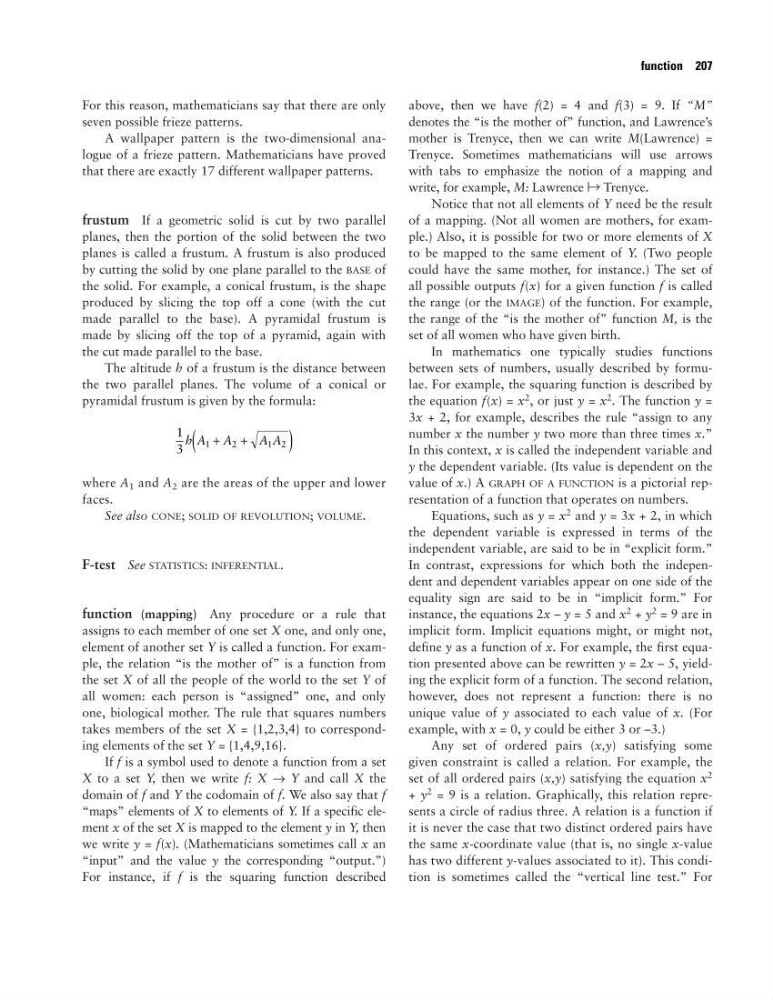
pyramidal frustum is given by the formula:
where A 1 and A 2 are the areas of the upper and lower
faces.
See also CONE; SOLID OF REVOLUTION; VOLUME.
F-test See STATISTICS: INFERENTIAL.
function (mapping) Any procedure or a rule that
assigns to each member of one set X one, and only one,
element of another set Y is called a function. For example, the relation “is the mother of” is a function from
the set X of all the people of the world to the set Y of
all women: each person is “assigned” one, and only
one, biological mother. The rule that squares numbers
takes members of the set X = {1,2,3,4} to corresponding elements of the set Y = {1,4,9,16}.
If f is a symbol used to denote a function from a set
X to a set Y, then we write f: X → Y and call X the
domain of f and Y the codomain of f. We also say that f
“maps” elements of X to elements of Y. If a specific element x of the set X is mapped to the element y in Y, then
we write y = f(x). (Mathematicians sometimes call x an
“input” and the value y the corresponding “output.”)
For instance, if f is the squaring function described
above, then we have f(2) = 4 and f(3) = 9. If “M”
denotes the “is the mother of” function, and Lawrence’s
mother is Trenyce, then we can write M(Lawrence) =
Trenyce. Sometimes mathematicians will use arrows
with tabs to emphasize the notion of a mapping and
write, for example, M: Lawrence | → Trenyce.
Notice that not all elements of Y need be the result
of a mapping. (Not all women are mothers, for example.) Also, it is possible for two or more elements of X
to be mapped to the same element of Y. (Two people
could have the same mother, for instance.) The set of
all possible outputs f(x) for a given function f is called
the range (or the IMAGE) of the function. For example,
the range of the “is the mother of” function M, is the
set of all women who have given birth.
In mathematics one typically studies functions
between sets of numbers, usually described by formulae. For example, the squaring function is described by
the equation f(x) = x
2
, or just y = x
2
. The function y =
3x + 2, for example, describes the rule “assign to any
number x the number y two more than three times x.”
In this context, x is called the independent variable and
y the dependent variable. (Its value is dependent on the
value of x.) A GRAPH OF A FUNCTION is a pictorial representation of a function that operates on numbers.
Equations, such as y = x
2 and y = 3x + 2, in which
the dependent variable is expressed in terms of the
independent variable, are said to be in “explicit form.”
In contrast, expressions for which both the independent and dependent variables appear on one side of the
equality sign are said to be in “implicit form.” For
instance, the equations 2x – y = 5 and x
2 + y
2 = 9 are in
implicit form. Implicit equations might, or might not,
define y as a function of x. For example, the first equation presented above can be rewritten y = 2x – 5, yielding the explicit form of a function. The second relation,
however, does not represent a function: there is no
unique value of y associated to each value of x. (For
example, with x = 0, y could be either 3 or –3.)
Any set of ordered pairs (x,y) satisfying some
given constraint is called a relation. For example, the
set of all ordered pairs (x,y) satisfying the equation x
2
+ y
2 = 9 is a relation. Graphically, this relation represents a circle of radius three. A relation is a function if
it is never the case that two distinct ordered pairs have
the same x-coordinate value (that is, no single x-value
has two different y-values associated to it). This condition is sometimes called the “vertical line test.” For
1
3
1
2
1 2
h A A
A A
+
+
(
)
function 207
seven possible frieze patterns.
A wallpaper pattern is the two-dimensional analogue of a frieze pattern. Mathematicians have proved
that there are exactly 17 different wallpaper patterns.
frustum If a geometric solid is cut by two parallel
planes, then the portion of the solid between the two
planes is called a frustum. A frustum is also produced
by cutting the solid by one plane parallel to the BASE of
the solid. For example, a conical frustum, is the shape
produced by slicing the top off a cone (with the cut
made parallel to the base). A pyramidal frustum is
made by slicing off the top of a pyramid, again with
the cut made parallel to the base.
The altitude h of a frustum is the distance between
the two parallel planes. The volume of a conical or
pyramidal frustum is given by the formula:
where A 1 and A 2 are the areas of the upper and lower
faces.
See also CONE; SOLID OF REVOLUTION; VOLUME.
F-test See STATISTICS: INFERENTIAL.
function (mapping) Any procedure or a rule that
assigns to each member of one set X one, and only one,
element of another set Y is called a function. For example, the relation “is the mother of” is a function from
the set X of all the people of the world to the set Y of
all women: each person is “assigned” one, and only
one, biological mother. The rule that squares numbers
takes members of the set X = {1,2,3,4} to corresponding elements of the set Y = {1,4,9,16}.
If f is a symbol used to denote a function from a set
X to a set Y, then we write f: X → Y and call X the
domain of f and Y the codomain of f. We also say that f
“maps” elements of X to elements of Y. If a specific element x of the set X is mapped to the element y in Y, then
we write y = f(x). (Mathematicians sometimes call x an
“input” and the value y the corresponding “output.”)
For instance, if f is the squaring function described
above, then we have f(2) = 4 and f(3) = 9. If “M”
denotes the “is the mother of” function, and Lawrence’s
mother is Trenyce, then we can write M(Lawrence) =
Trenyce. Sometimes mathematicians will use arrows
with tabs to emphasize the notion of a mapping and
write, for example, M: Lawrence | → Trenyce.
Notice that not all elements of Y need be the result
of a mapping. (Not all women are mothers, for example.) Also, it is possible for two or more elements of X
to be mapped to the same element of Y. (Two people
could have the same mother, for instance.) The set of
all possible outputs f(x) for a given function f is called
the range (or the IMAGE) of the function. For example,
the range of the “is the mother of” function M, is the
set of all women who have given birth.
In mathematics one typically studies functions
between sets of numbers, usually described by formulae. For example, the squaring function is described by
the equation f(x) = x
2
, or just y = x
2
. The function y =
3x + 2, for example, describes the rule “assign to any
number x the number y two more than three times x.”
In this context, x is called the independent variable and
y the dependent variable. (Its value is dependent on the
value of x.) A GRAPH OF A FUNCTION is a pictorial representation of a function that operates on numbers.
Equations, such as y = x
2 and y = 3x + 2, in which
the dependent variable is expressed in terms of the
independent variable, are said to be in “explicit form.”
In contrast, expressions for which both the independent and dependent variables appear on one side of the
equality sign are said to be in “implicit form.” For
instance, the equations 2x – y = 5 and x
2 + y
2 = 9 are in
implicit form. Implicit equations might, or might not,
define y as a function of x. For example, the first equation presented above can be rewritten y = 2x – 5, yielding the explicit form of a function. The second relation,
however, does not represent a function: there is no
unique value of y associated to each value of x. (For
example, with x = 0, y could be either 3 or –3.)
Any set of ordered pairs (x,y) satisfying some
given constraint is called a relation. For example, the
set of all ordered pairs (x,y) satisfying the equation x
2
+ y
2 = 9 is a relation. Graphically, this relation represents a circle of radius three. A relation is a function if
it is never the case that two distinct ordered pairs have
the same x-coordinate value (that is, no single x-value
has two different y-values associated to it). This condition is sometimes called the “vertical line test.” For
1
3
1
2
1 2
h A A
A A
+
+
(
)
function 207