

zero by zero could, allegedly, have any desired value.
For example, one could argue that 0/0 = 17 by noting
that 0 × 17 = 0 is a true statement. There is no single
appropriate value for this quantity.)
A “unit” fraction, also known as an EGYPTIAN
FRACTION, is a proper fraction with numerator equal to
one. A “complex” fraction is one in which the numerator or denominator, or both, is a fraction. For example,
is a complex fraction. The division-of-fractions
rule provides the means to simplify complex fractions.
See also CANCELLATION; CONTINUED FRACTION;
DECIMAL REPRESENTATION; PARTIAL FRACTIONS; PERCENTAGE; RATIO; RATIONALIZING THE DENOMINATOR;
REDUCED FORM.
fractional part function See FLOOR/CEILING/
FRACTIONAL PART FUNCTIONS.
frequency In STATISTICS, the absolute frequency of an
observed value is the number of times that value
appears in a data set. For example, in the sample 4, 6,
3, 4, 4, 1, 7, 3, 7, 9, 8, 4, 4, 5, 2, the absolute frequency of the observation 4 is five, and that of 8 is one.
The relative frequency of an observed value is the proportion of times it appears. This is computed by dividing the absolute frequency of the observation by the
total number of entries in the data set. For example,
the relative frequency of 4 in the above data set is
5/15 = 1/3, and that of 8 is 1/15.
One can compute the relative frequency of entries
in an infinite data set by making use of a LIMIT. For
example, mathematicians have proved that 5.8% of
the powers of two 1, 2, 4, 8, 16, 32, 64, 128,… begin
with a 7. (The first power to do so is 2
46 .) By this they
mean that if one were to examine the first N powers of
two, approximately 5.8 percent of them begin with a
7. This approximation is made more exact by taking
larger and larger values of N.
In physics the term frequency is defined as the
number of cycles that occur per unit time in a system
that oscillates (such as a pendulum, a wave, a vibrating
string, or an alternating current). The symbol used for
frequency is usually f, although the Greek letter ν is
often employed for the frequency of light or other electromagnetic radiation. A unit of frequency is called a
hertz (Hz).
frequency distribution See STATISTICS: DESCRIPTIVE.
frequency polygon See STATISTICS: DESCRIPTIVE.
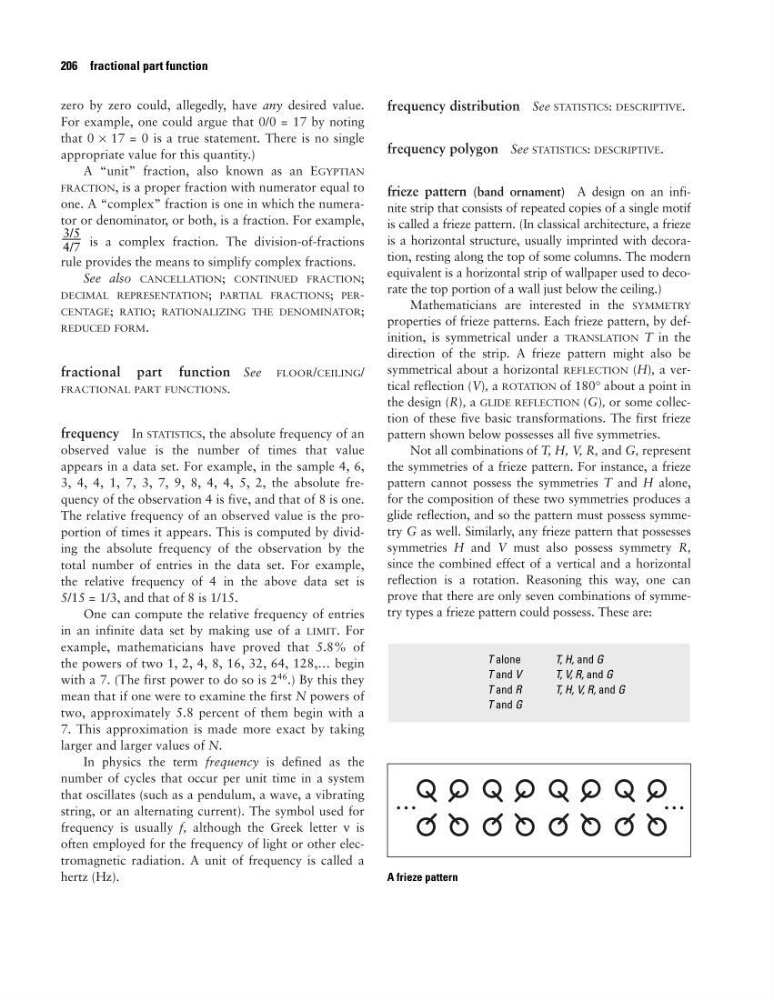
frieze pattern (band ornament) A design on an infinite strip that consists of repeated copies of a single motif
is called a frieze pattern. (In classical architecture, a frieze
is a horizontal structure, usually imprinted with decoration, resting along the top of some columns. The modern
equivalent is a horizontal strip of wallpaper used to decorate the top portion of a wall just below the ceiling.)
Mathematicians are interested in the SYMMETRY
properties of frieze patterns. Each frieze pattern, by definition, is symmetrical under a TRANSLATION T in the
direction of the strip. A frieze pattern might also be
symmetrical about a horizontal REFLECTION (H), a vertical reflection (V), a ROTATION of 180° about a point in
the design (R), a GLIDE REFLECTION (G), or some collection of these five basic transformations. The first frieze
pattern shown below possesses all five symmetries.
Not all combinations of T, H, V, R, and G, represent
the symmetries of a frieze pattern. For instance, a frieze
pattern cannot possess the symmetries T and H alone,
for the composition of these two symmetries produces a
glide reflection, and so the pattern must possess symmetry G as well. Similarly, any frieze pattern that possesses
symmetries H and V must also possess symmetry R,
since the combined effect of a vertical and a horizontal
reflection is a rotation. Reasoning this way, one can
prove that there are only seven combinations of symmetry types a frieze pattern could possess. These are:
T alone
T, H, and G
T and V
T, V, R, and G
T and R
T, H, V, R, and G
T and G
3/5
–
4/7
206 fractional part function
A frieze pattern
For example, one could argue that 0/0 = 17 by noting
that 0 × 17 = 0 is a true statement. There is no single
appropriate value for this quantity.)
A “unit” fraction, also known as an EGYPTIAN
FRACTION, is a proper fraction with numerator equal to
one. A “complex” fraction is one in which the numerator or denominator, or both, is a fraction. For example,
is a complex fraction. The division-of-fractions
rule provides the means to simplify complex fractions.
See also CANCELLATION; CONTINUED FRACTION;
DECIMAL REPRESENTATION; PARTIAL FRACTIONS; PERCENTAGE; RATIO; RATIONALIZING THE DENOMINATOR;
REDUCED FORM.
fractional part function See FLOOR/CEILING/
FRACTIONAL PART FUNCTIONS.
frequency In STATISTICS, the absolute frequency of an
observed value is the number of times that value
appears in a data set. For example, in the sample 4, 6,
3, 4, 4, 1, 7, 3, 7, 9, 8, 4, 4, 5, 2, the absolute frequency of the observation 4 is five, and that of 8 is one.
The relative frequency of an observed value is the proportion of times it appears. This is computed by dividing the absolute frequency of the observation by the
total number of entries in the data set. For example,
the relative frequency of 4 in the above data set is
5/15 = 1/3, and that of 8 is 1/15.
One can compute the relative frequency of entries
in an infinite data set by making use of a LIMIT. For
example, mathematicians have proved that 5.8% of
the powers of two 1, 2, 4, 8, 16, 32, 64, 128,… begin
with a 7. (The first power to do so is 2
46 .) By this they
mean that if one were to examine the first N powers of
two, approximately 5.8 percent of them begin with a
7. This approximation is made more exact by taking
larger and larger values of N.
In physics the term frequency is defined as the
number of cycles that occur per unit time in a system
that oscillates (such as a pendulum, a wave, a vibrating
string, or an alternating current). The symbol used for
frequency is usually f, although the Greek letter ν is
often employed for the frequency of light or other electromagnetic radiation. A unit of frequency is called a
hertz (Hz).
frequency distribution See STATISTICS: DESCRIPTIVE.
frequency polygon See STATISTICS: DESCRIPTIVE.
frieze pattern (band ornament) A design on an infinite strip that consists of repeated copies of a single motif
is called a frieze pattern. (In classical architecture, a frieze
is a horizontal structure, usually imprinted with decoration, resting along the top of some columns. The modern
equivalent is a horizontal strip of wallpaper used to decorate the top portion of a wall just below the ceiling.)
Mathematicians are interested in the SYMMETRY
properties of frieze patterns. Each frieze pattern, by definition, is symmetrical under a TRANSLATION T in the
direction of the strip. A frieze pattern might also be
symmetrical about a horizontal REFLECTION (H), a vertical reflection (V), a ROTATION of 180° about a point in
the design (R), a GLIDE REFLECTION (G), or some collection of these five basic transformations. The first frieze
pattern shown below possesses all five symmetries.
Not all combinations of T, H, V, R, and G, represent
the symmetries of a frieze pattern. For instance, a frieze
pattern cannot possess the symmetries T and H alone,
for the composition of these two symmetries produces a
glide reflection, and so the pattern must possess symmetry G as well. Similarly, any frieze pattern that possesses
symmetries H and V must also possess symmetry R,
since the combined effect of a vertical and a horizontal
reflection is a rotation. Reasoning this way, one can
prove that there are only seven combinations of symmetry types a frieze pattern could possess. These are:
T alone
T, H, and G
T and V
T, V, R, and G
T and R
T, H, V, R, and G
T and G
3/5
–
4/7
206 fractional part function
A frieze pattern