

f′ are not continuous for a finite number of locations in
the interval [–π,π]. This shows, for example, that functions that zig-zag like a sawtooth, or jump up and
down in value like a staircase, for example, can still be
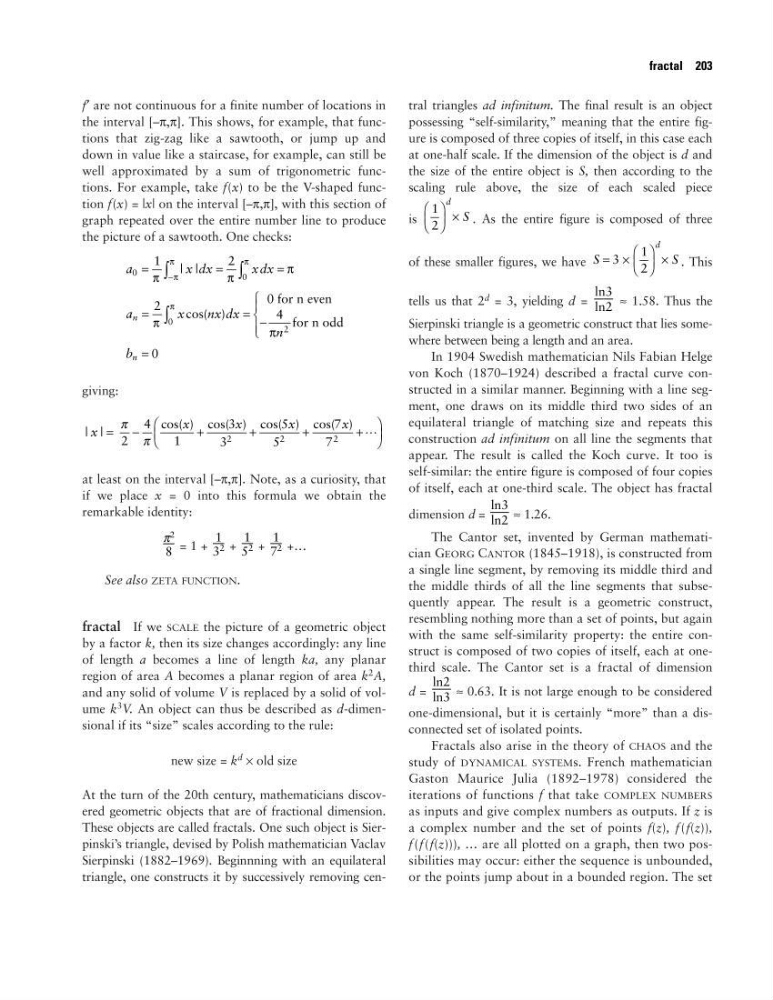
well approximated by a sum of trigonometric functions. For example, take f(x) to be the V-shaped function f(x) = |x| on the interval [–π,π], with this section of
graph repeated over the entire number line to produce
the picture of a sawtooth. One checks:
giving:
at least on the interval [–π,π]. Note, as a curiosity, that
if we place x = 0 into this formula we obtain the
remarkable identity:
= 1 +
+
+
+…
See also ZETA FUNCTION.
fractal If we SCALE the picture of a geometric object
by a factor k, then its size changes accordingly: any line
of length a becomes a line of length ka, any planar
region of area A becomes a planar region of area k
2
A,
and any solid of volume V is replaced by a solid of volume k
3
V. An object can thus be described as d-dimensional if its “size” scales according to the rule:
new size = k
d
× old size
At the turn of the 20th century, mathematicians discovered geometric objects that are of fractional dimension.
These objects are called fractals. One such object is Sierpinski’s triangle, devised by Polish mathematician Vaclav
Sierpinski (1882–1969). Beginnning with an equilateral
triangle, one constructs it by successively removing central triangles ad infinitum. The final result is an object
possessing “self-similarity,” meaning that the entire figure is composed of three copies of itself, in this case each
at one-half scale. If the dimension of the object is d and
the size of the entire object is S, then according to the
scaling rule above, the size of each scaled piece
is
. As the entire figure is composed of three
of these smaller figures, we have
. This
tells us that 2
d = 3, yielding d =
≈ 1.58. Thus the
Sierpinski triangle is a geometric construct that lies somewhere between being a length and an area.
In 1904 Swedish mathematician Nils Fabian Helge
von Koch (1870–1924) described a fractal curve constructed in a similar manner. Beginning with a line segment, one draws on its middle third two sides of an
equilateral triangle of matching size and repeats this
construction ad infinitum on all line the segments that
appear. The result is called the Koch curve. It too is
self-similar: the entire figure is composed of four copies
of itself, each at one-third scale. The object has fractal
dimension d =
≈ 1.26.
The Cantor set, invented by German mathematician GEORG CANTOR (1845–1918), is constructed from
a single line segment, by removing its middle third and
the middle thirds of all the line segments that subsequently appear. The result is a geometric construct,
resembling nothing more than a set of points, but again
with the same self-similarity property: the entire construct is composed of two copies of itself, each at onethird scale. The Cantor set is a fractal of dimension
d =
≈ 0.63. It is not large enough to be considered
one-dimensional, but it is certainly “more” than a disconnected set of isolated points.
Fractals also arise in the theory of CHAOS and the
study of DYNAMICAL SYSTEMs. French mathematician
Gaston Maurice Julia (1892–1978) considered the
iterations of functions f that take COMPLEX NUMBERS
as inputs and give complex numbers as outputs. If z is
a complex number and the set of points f(z), f (f(z)),
f (f (f(z))), … are all plotted on a graph, then two possibilities may occur: either the sequence is unbounded,
or the points jump about in a bounded region. The set
ln2
––
ln3
ln3
––
ln2
ln3
––
ln2
S
S
d
= ×
×
3
1
2
1
2
×
d
S
1
–
7
2
1
–
5
2
1
–
3
2
π
2
–
8
| |
cos( ) cos( ) cos( ) cos( )
x
x
x
x
x
=
−
+
+
+
+
π
π
2
4
1
3
3
5
5
7
7
2
2
2
L
a
x dx
xdx
a
x
nx dx
n
b
n
n
0
0
2
0
1
2
2
0
4
0
=
=
=
=
= −
=
∫
∫
∫
−
π
π
π
π
π
π
π
π
π
| |
cos( )
for n even
for n odd
fractal 203
the interval [–π,π]. This shows, for example, that functions that zig-zag like a sawtooth, or jump up and
down in value like a staircase, for example, can still be
well approximated by a sum of trigonometric functions. For example, take f(x) to be the V-shaped function f(x) = |x| on the interval [–π,π], with this section of
graph repeated over the entire number line to produce
the picture of a sawtooth. One checks:
giving:
at least on the interval [–π,π]. Note, as a curiosity, that
if we place x = 0 into this formula we obtain the
remarkable identity:
= 1 +
+
+
+…
See also ZETA FUNCTION.
fractal If we SCALE the picture of a geometric object
by a factor k, then its size changes accordingly: any line
of length a becomes a line of length ka, any planar
region of area A becomes a planar region of area k
2
A,
and any solid of volume V is replaced by a solid of volume k
3
V. An object can thus be described as d-dimensional if its “size” scales according to the rule:
new size = k
d
× old size
At the turn of the 20th century, mathematicians discovered geometric objects that are of fractional dimension.
These objects are called fractals. One such object is Sierpinski’s triangle, devised by Polish mathematician Vaclav
Sierpinski (1882–1969). Beginnning with an equilateral
triangle, one constructs it by successively removing central triangles ad infinitum. The final result is an object
possessing “self-similarity,” meaning that the entire figure is composed of three copies of itself, in this case each
at one-half scale. If the dimension of the object is d and
the size of the entire object is S, then according to the
scaling rule above, the size of each scaled piece
is
. As the entire figure is composed of three
of these smaller figures, we have
. This
tells us that 2
d = 3, yielding d =
≈ 1.58. Thus the
Sierpinski triangle is a geometric construct that lies somewhere between being a length and an area.
In 1904 Swedish mathematician Nils Fabian Helge
von Koch (1870–1924) described a fractal curve constructed in a similar manner. Beginning with a line segment, one draws on its middle third two sides of an
equilateral triangle of matching size and repeats this
construction ad infinitum on all line the segments that
appear. The result is called the Koch curve. It too is
self-similar: the entire figure is composed of four copies
of itself, each at one-third scale. The object has fractal
dimension d =
≈ 1.26.
The Cantor set, invented by German mathematician GEORG CANTOR (1845–1918), is constructed from
a single line segment, by removing its middle third and
the middle thirds of all the line segments that subsequently appear. The result is a geometric construct,
resembling nothing more than a set of points, but again
with the same self-similarity property: the entire construct is composed of two copies of itself, each at onethird scale. The Cantor set is a fractal of dimension
d =
≈ 0.63. It is not large enough to be considered
one-dimensional, but it is certainly “more” than a disconnected set of isolated points.
Fractals also arise in the theory of CHAOS and the
study of DYNAMICAL SYSTEMs. French mathematician
Gaston Maurice Julia (1892–1978) considered the
iterations of functions f that take COMPLEX NUMBERS
as inputs and give complex numbers as outputs. If z is
a complex number and the set of points f(z), f (f(z)),
f (f (f(z))), … are all plotted on a graph, then two possibilities may occur: either the sequence is unbounded,
or the points jump about in a bounded region. The set
ln2
––
ln3
ln3
––
ln2
ln3
––
ln2
S
S
d
= ×
×
3
1
2
1
2
×
d
S
1
–
7
2
1
–
5
2
1
–
3
2
π
2
–
8
| |
cos( ) cos( ) cos( ) cos( )
x
x
x
x
x
=
−
+
+
+
+
π
π
2
4
1
3
3
5
5
7
7
2
2
2
L
a
x dx
xdx
a
x
nx dx
n
b
n
n
0
0
2
0
1
2
2
0
4
0
=
=
=
=
= −
=
∫
∫
∫
−
π
π
π
π
π
π
π
π
π
| |
cos( )
for n even
for n odd
fractal 203