

In the 18th century, French mathematician and
physicist JEAN LE ROND D’ALEMBERT (1717–83), and
the Swiss mathematician LEONHARD EULER (1707–83)
worked to describe complicated vibrations of strings
as sums of simpler functions. The Swiss mathematician Daniel Bernoulli (1700–82) of the famous
BERNOULLI FAMILY introduced the use of trigonometric functions in this study, an approach that was later
fully developed by French mathematician and physicist JEAN BAPTISTE JOSEPH FOURIER (1768–1830),
although his work was motivated by the study of heat
conduction. Fourier showed that many functions
could be represented as infinite sums of sine and
cosine functions.
The result of writing a function as a sum of
trigonometric functions is today called a Fourier series.
As the trigonometric functions cycle in value every 2π
in RADIAN MEASURE, it is assumed in these studies that
the functions under consideration are themselves periodic with period 2π.
Assume f(x) is such a function. Then a Fourier
series for f is an expression of the form:
One finds the values of the constants a 0 ,a 1 ,a 2 ,…b 1 ,b 2 ,…
by integrating. For example, since ∫
π
–π cos(kx) dx = 0 =
∫
π
–π sin(kx) dx, we have:
yielding: a 0 =
∫
π
–π f(x)dx. Multiplying through by
sin(x) and integrating gives:
showing that b 1 = ∫
π
–π f(x)sin(x)dx.
One can show that the functions {1,cos(x),cos(2x),
…,sin(x),sin(2x),…} are ORTHOGONAL in the sense that
the integral of the product of any two different functions from this set is zero. This observation allows us
to compute all the values a 0 ,a 1 ,a 2 ,…,b 1 ,b 2 ,… by this
method of multiplying through by a trigonometric
function and integrating. We have, in general:
Mathematicians have shown that if f(x) and its
DERIVATIVE f′(x) are both CONTINUOUS FUNCTIONs,
then the expansion
is valid. They have also shown that, if interpreted
appropriately, the expansion remains valid even if f or
f x
a
a
x a
x
b
x b
x
( )
cos( )
cos( )
sin( )
sin( )
=
+
+
+
+
+
+
0
1
2
1
2
2
2
2
L
L
a
fxd x
a
fx
n xd x
b
fx
n xd x
n
n
0
1
1
1
=
=
=
−
−
−
∫
∫
∫
π
π
π
π
π
π
π
π
π
( )
( )cos( )
( )sin( )
1
– π
f x
x dx
a
x dx
a
x
x dx
a
x
xdx
b
x
x dx
b
x
xdx
b
b
( )sin( )
sin( )
cos( )sin( )
cos( )sin( )
sin( )sin( )
sin( )sin( )
−
−
−
−
−
−
∫
∫
∫
∫
∫
∫
=
+
+
+
+ +
+
+
= + + + +
+ +
π
π
π
π
π
π
π
π
π
π
π
π
π
0
1
2
1
2
1
1
2
2
2
0 0 0
0
L
L
L
L
L
1
– π
f x dx
a dx
( ) =
+ + + + + +
−
−
∫
∫
0
2
0 0
0 0
π
π
π
π
L
L
f x
a
a
x a
x
b
x b
x
( )
cos( )
cos( )
sin( )
sin( )
=
+
+
+
+
+
+
0
1
2
1
2
2
2
2
L
L
202 Fourier series
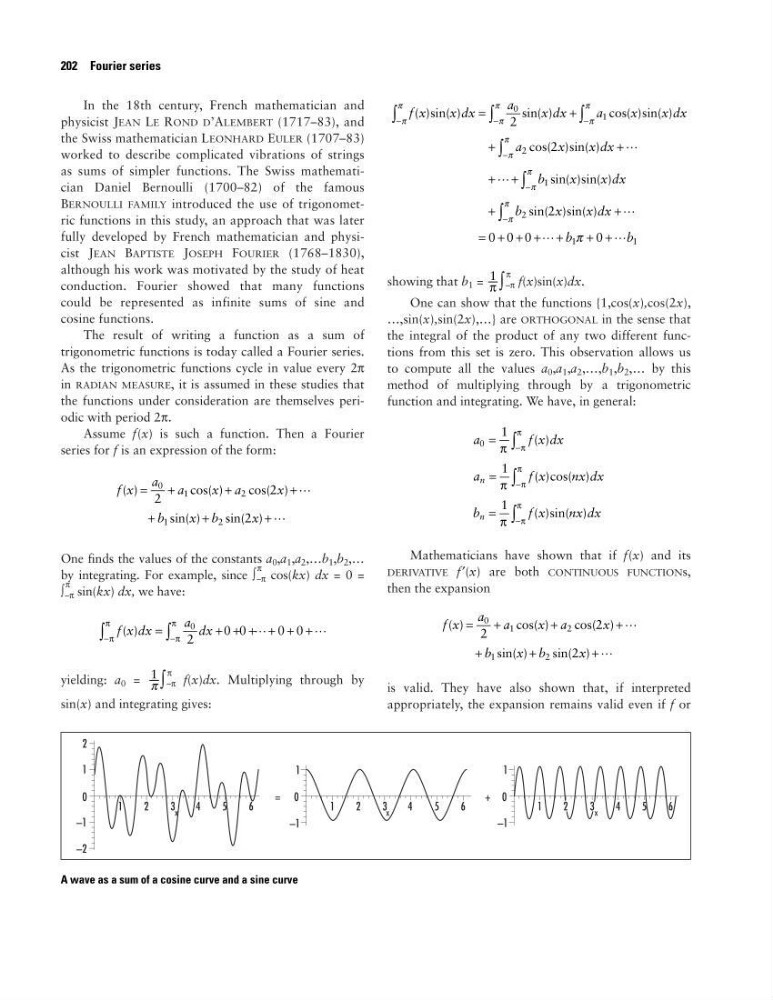
A wave as a sum of a cosine curve and a sine curve
physicist JEAN LE ROND D’ALEMBERT (1717–83), and
the Swiss mathematician LEONHARD EULER (1707–83)
worked to describe complicated vibrations of strings
as sums of simpler functions. The Swiss mathematician Daniel Bernoulli (1700–82) of the famous
BERNOULLI FAMILY introduced the use of trigonometric functions in this study, an approach that was later
fully developed by French mathematician and physicist JEAN BAPTISTE JOSEPH FOURIER (1768–1830),
although his work was motivated by the study of heat
conduction. Fourier showed that many functions
could be represented as infinite sums of sine and
cosine functions.
The result of writing a function as a sum of
trigonometric functions is today called a Fourier series.
As the trigonometric functions cycle in value every 2π
in RADIAN MEASURE, it is assumed in these studies that
the functions under consideration are themselves periodic with period 2π.
Assume f(x) is such a function. Then a Fourier
series for f is an expression of the form:
One finds the values of the constants a 0 ,a 1 ,a 2 ,…b 1 ,b 2 ,…
by integrating. For example, since ∫
π
–π cos(kx) dx = 0 =
∫
π
–π sin(kx) dx, we have:
yielding: a 0 =
∫
π
–π f(x)dx. Multiplying through by
sin(x) and integrating gives:
showing that b 1 = ∫
π
–π f(x)sin(x)dx.
One can show that the functions {1,cos(x),cos(2x),
…,sin(x),sin(2x),…} are ORTHOGONAL in the sense that
the integral of the product of any two different functions from this set is zero. This observation allows us
to compute all the values a 0 ,a 1 ,a 2 ,…,b 1 ,b 2 ,… by this
method of multiplying through by a trigonometric
function and integrating. We have, in general:
Mathematicians have shown that if f(x) and its
DERIVATIVE f′(x) are both CONTINUOUS FUNCTIONs,
then the expansion
is valid. They have also shown that, if interpreted
appropriately, the expansion remains valid even if f or
f x
a
a
x a
x
b
x b
x
( )
cos( )
cos( )
sin( )
sin( )
=
+
+
+
+
+
+
0
1
2
1
2
2
2
2
L
L
a
fxd x
a
fx
n xd x
b
fx
n xd x
n
n
0
1
1
1
=
=
=
−
−
−
∫
∫
∫
π
π
π
π
π
π
π
π
π
( )
( )cos( )
( )sin( )
1
– π
f x
x dx
a
x dx
a
x
x dx
a
x
xdx
b
x
x dx
b
x
xdx
b
b
( )sin( )
sin( )
cos( )sin( )
cos( )sin( )
sin( )sin( )
sin( )sin( )
−
−
−
−
−
−
∫
∫
∫
∫
∫
∫
=
+
+
+
+ +
+
+
= + + + +
+ +
π
π
π
π
π
π
π
π
π
π
π
π
π
0
1
2
1
2
1
1
2
2
2
0 0 0
0
L
L
L
L
L
1
– π
f x dx
a dx
( ) =
+ + + + + +
−
−
∫
∫
0
2
0 0
0 0
π
π
π
π
L
L
f x
a
a
x a
x
b
x b
x
( )
cos( )
cos( )
sin( )
sin( )
=
+
+
+
+
+
+
0
1
2
1
2
2
2
2
L
L
202 Fourier series
A wave as a sum of a cosine curve and a sine curve