

The multiplication rule also allows us to make sense of
fractional exponents. Consider the quantity 2 . It must
be the case that 2 × 2 = 2
1 = 2. Thus 2 is a value
that, when multiplied by itself, equals 2. Consequently
2 = √
–
2. Similarly, 2 is a value that, when multiplied
by itself three times, equals 2, and so 2 =
3
√
—
2, the cube
root of 2. In general, 2 equals the nth root of 2. This
works for any nonzero base.
A fractional exponent indicates that a root is
to be taken: b =
n
√
—
b.
We use the power rule to make sense of other types of
fractional exponents. For example, the quantity 27
can be computed as
. In general, we have:
Finally, to compute a quantity raised to an irrational
power, one approximates the exponent by a fraction,
computes the corresponding exponential expression,
and takes the LIMIT as one uses better and better
approximations. For example, writing √
–
2 = 1.414…,
we see that any of the fractions 1, ,
,
,… can
be used to approximate √
–
2 with better and better degrees
of accuracy. We define 2
√
–
2 to be the limit of the values:
2
1 = 2,
,
,
, ….
The multiplication and power rules are valid even
for irrational exponents. For example, we have:
The Greek mathematician ARCHIMEDES OF SYRACUSE (287–212 B.C.E.) was one of the first scholars to
use a special word for the power of a number. He
called the quantity 10,000, 10
4
, a myriad, and he used
the phrase “myriad of myriads” for 10,000 squared,
10
4
× 10
4 = 10
8
. The ancient Greeks, for whom mathematics was synonymous with geometry, called the
square of an unspecified quantity a tetragon number,
meaning a “four-corner number.” DIOPHANTUS OF
ALEXANDRIA (ca. 200–284 C.E.) used the Greek word
dynamis, meaning “power,” for the square of an
unknown, and called a third power a “cube,” a fourth
power a “power-power,” and fifth and sixth powers
“power-cube” and “cube-cube,” respectively.
It took many centuries for scholars to begin using
symbols to denote unknown quantities. German
mathematician Michael Stifel (ca. 1487–1567) was
the first to develop a notational system for powers of
an unspecified quantity x. He denoted the fourth
power of x simply as xxxx. Other scholars developed
alternative notational systems. Scholars eventually
settled on the notational system French mathematician and philosopher RENÉ DESCARTES (1596–1650)
introduced in 1637, the one we use today. Although
Descartes considered only positive integral exponents, later that century the English mathematician
SIR ISAAC NEWTON (1642–1727), inspired by the
work of JOHN WALLIS (1616–1703), showed that the
same notational system can be extended to include
negative, fractional, and irrational exponents. LEONHARD EULER (1707–83) later allowed for the possibility of complex exponents.
See also COMPLEX NUMBERS; EXPONENTIAL FUNCTION; LOGARITHM.
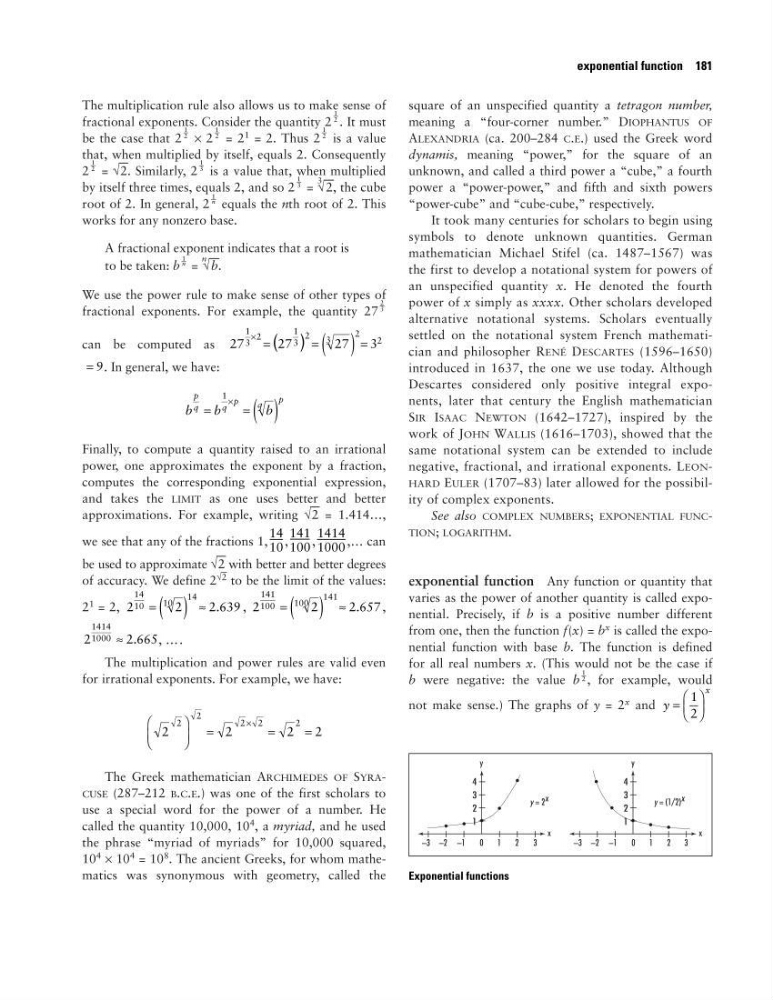
exponential function Any function or quantity that
varies as the power of another quantity is called exponential. Precisely, if b is a positive number different
from one, then the function f(x) = b
x is called the exponential function with base b. The function is defined
for all real numbers x. (This would not be the case if
b were negative: the value b , for example, would
not make sense.) The graphs of y = 2
x and y
x
=
1
2
1
–
2
2
2
2
2
2
2
2 2
2
=
=
=
×
2
2 665
1414
1000 ≈ .
2
2
2 657
141
100
100
141
= ( ) ≈ .
2
2
2 639
14
10
10
14
= ( ) ≈ .
1414
––––
1000
141 –
100
14 –
10
b
b
b
p
q
q
p
q
p
=
= ( )
×
1
9
=
27
27
27
3
1
3
2
1
3
2
3
2
2
=
= ( ) =
×
( )
2
–
3
1
– n
1
– n
1
–
3
1
–
3
1
–
2
1
–
2
1
–
2
1
–
2
1
–
2
exponential function 181
Exponential functions
fractional exponents. Consider the quantity 2 . It must
be the case that 2 × 2 = 2
1 = 2. Thus 2 is a value
that, when multiplied by itself, equals 2. Consequently
2 = √
–
2. Similarly, 2 is a value that, when multiplied
by itself three times, equals 2, and so 2 =
3
√
—
2, the cube
root of 2. In general, 2 equals the nth root of 2. This
works for any nonzero base.
A fractional exponent indicates that a root is
to be taken: b =
n
√
—
b.
We use the power rule to make sense of other types of
fractional exponents. For example, the quantity 27
can be computed as
. In general, we have:
Finally, to compute a quantity raised to an irrational
power, one approximates the exponent by a fraction,
computes the corresponding exponential expression,
and takes the LIMIT as one uses better and better
approximations. For example, writing √
–
2 = 1.414…,
we see that any of the fractions 1, ,
,
,… can
be used to approximate √
–
2 with better and better degrees
of accuracy. We define 2
√
–
2 to be the limit of the values:
2
1 = 2,
,
,
, ….
The multiplication and power rules are valid even
for irrational exponents. For example, we have:
The Greek mathematician ARCHIMEDES OF SYRACUSE (287–212 B.C.E.) was one of the first scholars to
use a special word for the power of a number. He
called the quantity 10,000, 10
4
, a myriad, and he used
the phrase “myriad of myriads” for 10,000 squared,
10
4
× 10
4 = 10
8
. The ancient Greeks, for whom mathematics was synonymous with geometry, called the
square of an unspecified quantity a tetragon number,
meaning a “four-corner number.” DIOPHANTUS OF
ALEXANDRIA (ca. 200–284 C.E.) used the Greek word
dynamis, meaning “power,” for the square of an
unknown, and called a third power a “cube,” a fourth
power a “power-power,” and fifth and sixth powers
“power-cube” and “cube-cube,” respectively.
It took many centuries for scholars to begin using
symbols to denote unknown quantities. German
mathematician Michael Stifel (ca. 1487–1567) was
the first to develop a notational system for powers of
an unspecified quantity x. He denoted the fourth
power of x simply as xxxx. Other scholars developed
alternative notational systems. Scholars eventually
settled on the notational system French mathematician and philosopher RENÉ DESCARTES (1596–1650)
introduced in 1637, the one we use today. Although
Descartes considered only positive integral exponents, later that century the English mathematician
SIR ISAAC NEWTON (1642–1727), inspired by the
work of JOHN WALLIS (1616–1703), showed that the
same notational system can be extended to include
negative, fractional, and irrational exponents. LEONHARD EULER (1707–83) later allowed for the possibility of complex exponents.
See also COMPLEX NUMBERS; EXPONENTIAL FUNCTION; LOGARITHM.
exponential function Any function or quantity that
varies as the power of another quantity is called exponential. Precisely, if b is a positive number different
from one, then the function f(x) = b
x is called the exponential function with base b. The function is defined
for all real numbers x. (This would not be the case if
b were negative: the value b , for example, would
not make sense.) The graphs of y = 2
x and y
x
=
1
2
1
–
2
2
2
2
2
2
2
2 2
2
=
=
=
×
2
2 665
1414
1000 ≈ .
2
2
2 657
141
100
100
141
= ( ) ≈ .
2
2
2 639
14
10
10
14
= ( ) ≈ .
1414
––––
1000
141 –
100
14 –
10
b
b
b
p
q
q
p
q
p
=
= ( )
×
1
9
=
27
27
27
3
1
3
2
1
3
2
3
2
2
=
= ( ) =
×
( )
2
–
3
1
– n
1
– n
1
–
3
1
–
3
1
–
2
1
–
2
1
–
2
1
–
2
1
–
2
exponential function 181
Exponential functions