

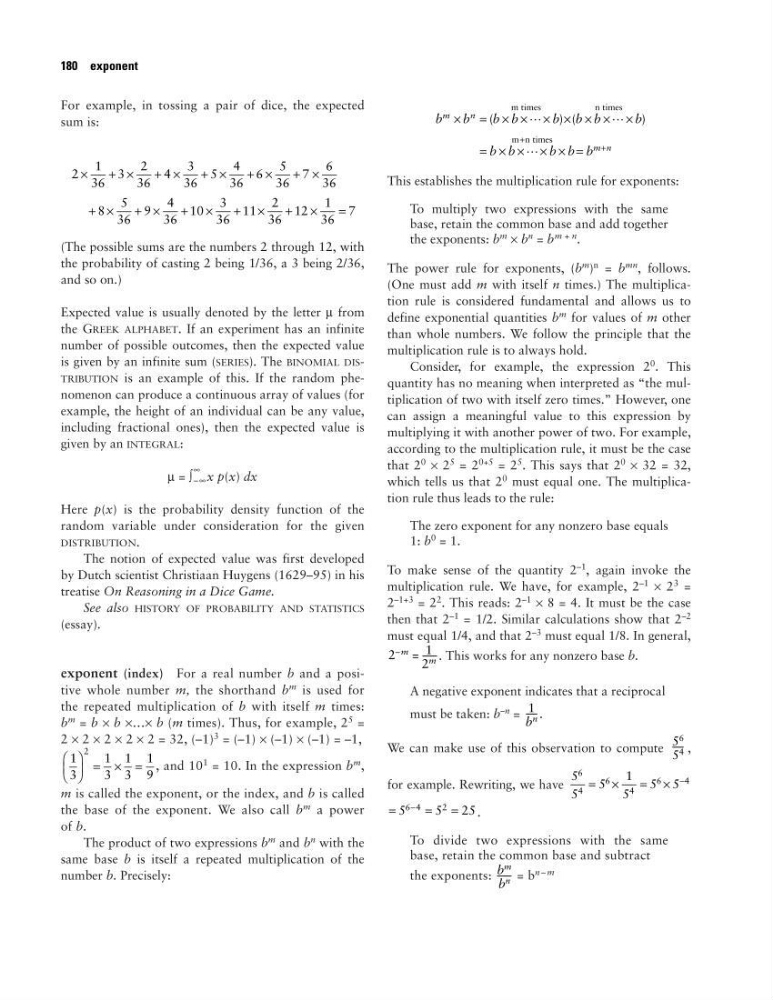
For example, in tossing a pair of dice, the expected
sum is:
(The possible sums are the numbers 2 through 12, with
the probability of casting 2 being 1/36, a 3 being 2/36,
and so on.)
Expected value is usually denoted by the letter μ from
the GREEK ALPHABET. If an experiment has an infinite
number of possible outcomes, then the expected value
is given by an infinite sum (SERIES). The BINOMIAL DISTRIBUTION is an example of this. If the random phenomenon can produce a continuous array of values (for
example, the height of an individual can be any value,
including fractional ones), then the expected value is
given by an INTEGRAL:
μ = ∫
∞
– ∞ x p(x) dx
Here p(x) is the probability density function of the
random variable under consideration for the given
DISTRIBUTION.
The notion of expected value was first developed
by Dutch scientist Christiaan Huygens (1629–95) in his
treatise On Reasoning in a Dice Game.
See also HISTORY OF PROBABILITY AND STATISTICS
(essay).
exponent (index) For a real number b and a positive whole number m, the shorthand b
m is used for
the repeated multiplication of b with itself m times:
b
m = b × b ×…× b (m times). Thus, for example, 2
5 =
2 × 2 × 2 × 2 × 2 = 32, (–1)
3 = (–1) × (–1) × (–1) = –1,
, and 10
1 = 10. In the expression b
m ,
m is called the exponent, or the index, and b is called
the base of the exponent. We also call b
m a power
of b.
The product of two expressions b
m and b
n with the
same base b is itself a repeated multiplication of the
number b. Precisely:
This establishes the multiplication rule for exponents:
To multiply two expressions with the same
base, retain the common base and add together
the exponents: b m × b
n = b
m + n
.
The power rule for exponents, (b
m
)
n = b
mn
, follows.
(One must add m with itself n times.) The multiplication rule is considered fundamental and allows us to
define exponential quantities b
m for values of m other
than whole numbers. We follow the principle that the
multiplication rule is to always hold.
Consider, for example, the expression 2
0
. This
quantity has no meaning when interpreted as “the multiplication of two with itself zero times.” However, one
can assign a meaningful value to this expression by
multiplying it with another power of two. For example,
according to the multiplication rule, it must be the case
that 2
0
× 2
5 = 2
0+5 = 2
5
. This says that 2
0
× 32 = 32,
which tells us that 2
0 must equal one. The multiplication rule thus leads to the rule:
The zero exponent for any nonzero base equals
1: b
0 = 1.
To make sense of the quantity 2
–1 , again invoke the
multiplication rule. We have, for example, 2
–1
× 2
3 =
2
–1+3 = 2
2
. This reads: 2
–1
× 8 = 4. It must be the case
then that 2
–1 = 1/2. Similar calculations show that 2
–2
must equal 1/4, and that 2
–3 must equal 1/8. In general,
. This works for any nonzero base b.
A negative exponent indicates that a reciprocal
must be taken: b
–n =
.
We can make use of this observation to compute
,
for example. Rewriting, we have
.
To divide two expressions with the same
base, retain the common base and subtract
the exponents:
= b
n – m
b
m
–
b
n
5
5
25
6 4
2
=
=
=
−
5
5
5
1
5
5 5
6
4
6
4
6
4
= ×
= ×
−
5
6
–
5
4
1
–
b
n
1
2
– m = ––
2
m
b
b
b b
b b b
b
b b
b b b
m
n
m n
× = × × × × × × ×
= × × × × =
+
+
(
) (
)
L
L
L
m times
n times
m n times
1
3
1
3
1
3
1
9
2
⎛
⎝
⎜
⎞
⎠
⎟ = × =
2
1
36
3
2
36
4
3
36
5
4
36
6
5
36
7
6
36
8
5
36
9
4
36
10
3
36
11
2
36
12
1
36
7
×
+ ×
+ ×
+ ×
+ ×
+ ×
+ ×
+ ×
+ ×
+ ×
+ ×
=
180 exponent
sum is:
(The possible sums are the numbers 2 through 12, with
the probability of casting 2 being 1/36, a 3 being 2/36,
and so on.)
Expected value is usually denoted by the letter μ from
the GREEK ALPHABET. If an experiment has an infinite
number of possible outcomes, then the expected value
is given by an infinite sum (SERIES). The BINOMIAL DISTRIBUTION is an example of this. If the random phenomenon can produce a continuous array of values (for
example, the height of an individual can be any value,
including fractional ones), then the expected value is
given by an INTEGRAL:
μ = ∫
∞
– ∞ x p(x) dx
Here p(x) is the probability density function of the
random variable under consideration for the given
DISTRIBUTION.
The notion of expected value was first developed
by Dutch scientist Christiaan Huygens (1629–95) in his
treatise On Reasoning in a Dice Game.
See also HISTORY OF PROBABILITY AND STATISTICS
(essay).
exponent (index) For a real number b and a positive whole number m, the shorthand b
m is used for
the repeated multiplication of b with itself m times:
b
m = b × b ×…× b (m times). Thus, for example, 2
5 =
2 × 2 × 2 × 2 × 2 = 32, (–1)
3 = (–1) × (–1) × (–1) = –1,
, and 10
1 = 10. In the expression b
m ,
m is called the exponent, or the index, and b is called
the base of the exponent. We also call b
m a power
of b.
The product of two expressions b
m and b
n with the
same base b is itself a repeated multiplication of the
number b. Precisely:
This establishes the multiplication rule for exponents:
To multiply two expressions with the same
base, retain the common base and add together
the exponents: b m × b
n = b
m + n
.
The power rule for exponents, (b
m
)
n = b
mn
, follows.
(One must add m with itself n times.) The multiplication rule is considered fundamental and allows us to
define exponential quantities b
m for values of m other
than whole numbers. We follow the principle that the
multiplication rule is to always hold.
Consider, for example, the expression 2
0
. This
quantity has no meaning when interpreted as “the multiplication of two with itself zero times.” However, one
can assign a meaningful value to this expression by
multiplying it with another power of two. For example,
according to the multiplication rule, it must be the case
that 2
0
× 2
5 = 2
0+5 = 2
5
. This says that 2
0
× 32 = 32,
which tells us that 2
0 must equal one. The multiplication rule thus leads to the rule:
The zero exponent for any nonzero base equals
1: b
0 = 1.
To make sense of the quantity 2
–1 , again invoke the
multiplication rule. We have, for example, 2
–1
× 2
3 =
2
–1+3 = 2
2
. This reads: 2
–1
× 8 = 4. It must be the case
then that 2
–1 = 1/2. Similar calculations show that 2
–2
must equal 1/4, and that 2
–3 must equal 1/8. In general,
. This works for any nonzero base b.
A negative exponent indicates that a reciprocal
must be taken: b
–n =
.
We can make use of this observation to compute
,
for example. Rewriting, we have
.
To divide two expressions with the same
base, retain the common base and subtract
the exponents:
= b
n – m
b
m
–
b
n
5
5
25
6 4
2
=
=
=
−
5
5
5
1
5
5 5
6
4
6
4
6
4
= ×
= ×
−
5
6
–
5
4
1
–
b
n
1
2
– m = ––
2
m
b
b
b b
b b b
b
b b
b b b
m
n
m n
× = × × × × × × ×
= × × × × =
+
+
(
) (
)
L
L
L
m times
n times
m n times
1
3
1
3
1
3
1
9
2
⎛
⎝
⎜
⎞
⎠
⎟ = × =
2
1
36
3
2
36
4
3
36
5
4
36
6
5
36
7
6
36
8
5
36
9
4
36
10
3
36
11
2
36
12
1
36
7
×
+ ×
+ ×
+ ×
+ ×
+ ×
+ ×
+ ×
+ ×
+ ×
+ ×
=
180 exponent