

and set B to be the matrix whose columns are the corresponding eigenvectors of A. Then it is possible to
show that:
A = BDB
–1
This observation allows one to compute high powers of
A with very little work. For instance, the quantity A
100
,
for instance, is just a product of three matrices:
A
100 = (BDB
–1 )
100
= BD
100
B
–1
noting that D
100 is simply:
This work also allows mathematicians to define the
square root of a matrix:
(provided the square roots of the eigenvalues are
defined), or to define new quantities, such as the logarithm of a matrix:
Such actions have proved useful in the study of theoretical physics and engineering.
The prefix eigen is German for “characteristic” or
“own.” The eigenvalues and eigenvectors of a matrix
completely characterize the matrix.
See also CAYLEY-HAMILTON THEOREM; INVERSE
MATRIX; LINEARLY DEPENDENT AND INDEPENDENT.
Einstein, Albert (1879–1955) German Relativity,
Quantum mechanics Born on March 14, 1879, in
Ulm, Germany, Albert Einstein is recognized as an
outstanding mathematical physicist whose work on
the special and general theories of relativity completely revolutionized how scientists think about
space, matter, and time. Although he regarded himself
as a physicist, Einstein’s work inspired many significant developments in modern mathematics, including
the development of TENSOR analysis as the appropriate means to describe the curvature of space.
The classical school environment did not suit Einstein well. In 1895 he failed the entrance exam for a
Swiss technical school, where he hoped to study electrical engineering. After attending a second school at
Aarau, he did eventually manage to enter the Zurich
ln( )
ln( )
ln( )
ln( )
A B
B
=
−
λ
λ
λ
1
2
3
1
0
0
0
0
0
0
A B
B
=
−
λ
λ
λ
1
2
3
1
0
0
0
0
0
0
D
100
1
100
2
100
3
100
0
0
0
0
0
0
=
λ
λ
λ
D =
λ
λ
λ
1
2
3
0
0
0
0
0 0
Einstein, Albert 157
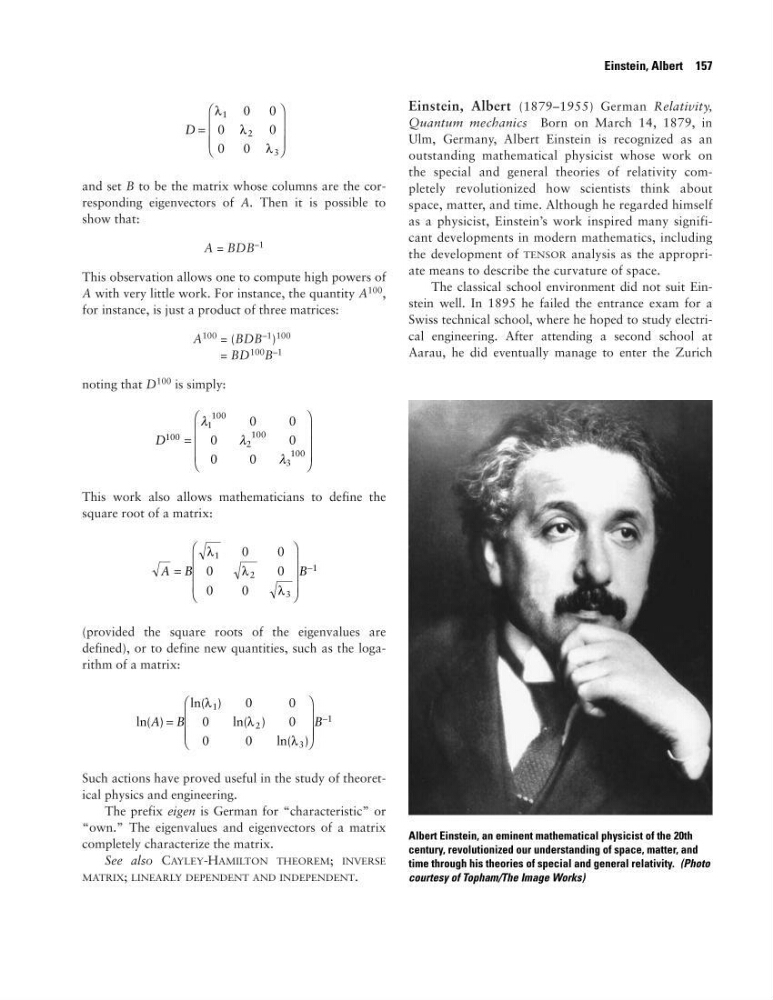
Albert Einstein, an eminent mathematical physicist of the 20th
century, revolutionized our understanding of space, matter, and
time through his theories of special and general relativity. (Photo
courtesy of Topham/The Image Works)
show that:
A = BDB
–1
This observation allows one to compute high powers of
A with very little work. For instance, the quantity A
100
,
for instance, is just a product of three matrices:
A
100 = (BDB
–1 )
100
= BD
100
B
–1
noting that D
100 is simply:
This work also allows mathematicians to define the
square root of a matrix:
(provided the square roots of the eigenvalues are
defined), or to define new quantities, such as the logarithm of a matrix:
Such actions have proved useful in the study of theoretical physics and engineering.
The prefix eigen is German for “characteristic” or
“own.” The eigenvalues and eigenvectors of a matrix
completely characterize the matrix.
See also CAYLEY-HAMILTON THEOREM; INVERSE
MATRIX; LINEARLY DEPENDENT AND INDEPENDENT.
Einstein, Albert (1879–1955) German Relativity,
Quantum mechanics Born on March 14, 1879, in
Ulm, Germany, Albert Einstein is recognized as an
outstanding mathematical physicist whose work on
the special and general theories of relativity completely revolutionized how scientists think about
space, matter, and time. Although he regarded himself
as a physicist, Einstein’s work inspired many significant developments in modern mathematics, including
the development of TENSOR analysis as the appropriate means to describe the curvature of space.
The classical school environment did not suit Einstein well. In 1895 he failed the entrance exam for a
Swiss technical school, where he hoped to study electrical engineering. After attending a second school at
Aarau, he did eventually manage to enter the Zurich
ln( )
ln( )
ln( )
ln( )
A B
B
=
−
λ
λ
λ
1
2
3
1
0
0
0
0
0
0
A B
B
=
−
λ
λ
λ
1
2
3
1
0
0
0
0
0
0
D
100
1
100
2
100
3
100
0
0
0
0
0
0
=
λ
λ
λ
D =
λ
λ
λ
1
2
3
0
0
0
0
0 0
Einstein, Albert 157
Albert Einstein, an eminent mathematical physicist of the 20th
century, revolutionized our understanding of space, matter, and
time through his theories of special and general relativity. (Photo
courtesy of Topham/The Image Works)