

own symbol. Thus the Egyptians only dealt with fractions of the form
(with the exception of two-thirds).
Fractions with unit numerators are known today as
EGYPTIAN FRACTIONS. All other fractional quantities
were expressed as sums of distinct Egyptian fractions.
For example, , which equals
+
, was written
, and
as
.
The Egyptian’s ability to compute such expressions
is impressive. The Rhind papyrus provides reference
lists of such expressions, and the first 23 problems in
the document are exercises in working with such fractional representations.
The ancient Egyptians were adept at solving LINEAR EQUATIONs. They used a method called false position to attain solutions. This involves guessing an
answer, observing the outcome from the guess, and
adjusting the guess accordingly. As an example, problem 24 of the Rhind papyrus asks:
Find the quantity so that when 1/7 of itself is
added to it, the total is 19.
To demonstrate the solution, the author suggests a
guess of 7. That plus its one-seventh is 8, by far too
small, but multiplying the outcome by 19/8 produces
the answer of 19 that we need. Thus 7 × (19/8) must be
the quantity we desire.
The majority of problems in the Rhind papyrus are
practical in nature, dealing with issues of area (of rectangles, trapezoids, triangles, circles), volume (of cylinders, for example), slopes and altitudes of pyramids
(which were built 1,000 years before the text was written), and number theoretic problems about sharing
goods under certain constraints. Some problems, however, indicate a delight in mathematical thinking for its
own sake. For example, problem 79 asks:
If there are seven houses, each house with
seven cats, seven mice for each cat, seven ears
of grain for each mouse, and each ear of grain
would produce seven measures of grain if
planted, how many items are there altogether?
This problem appears in FIBONACCI’s Liber abaci, written 600 years before the Rhind papyrus was discovered.
A version of this problem also appears as a familiar
nursery-rhyme and riddle, “As I Was Going to St. Ives.”
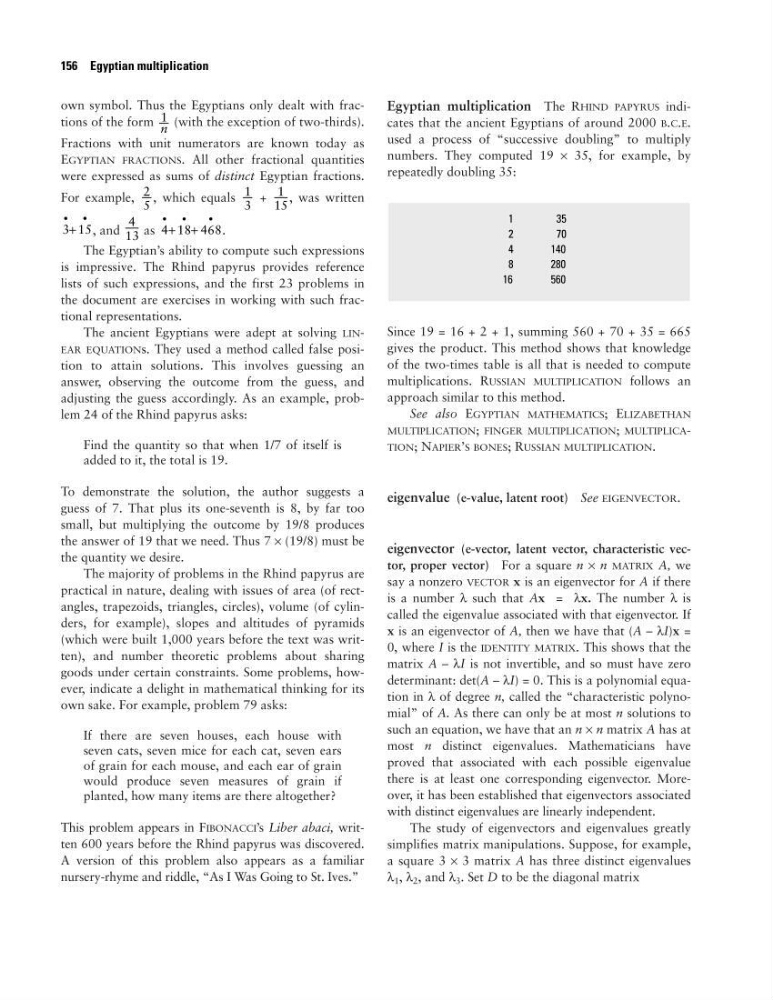
Egyptian multiplication The RHIND PAPYRUS indicates that the ancient Egyptians of around 2000 B.C.E.
used a process of “successive doubling” to multiply
numbers. They computed 19 × 35, for example, by
repeatedly doubling 35:
Since 19 = 16 + 2 + 1, summing 560 + 70 + 35 = 665
gives the product. This method shows that knowledge
of the two-times table is all that is needed to compute
multiplications. RUSSIAN MULTIPLICATION follows an
approach similar to this method.
See also EGYPTIAN MATHEMATICS; ELIZABETHAN
MULTIPLICATION; FINGER MULTIPLICATION; MULTIPLICATION; NAPIER’S BONES; RUSSIAN MULTIPLICATION.
eigenvalue (e-value, latent root) See EIGENVECTOR.
eigenvector (e-vector, latent vector, characteristic vector, proper vector) For a square n × n MATRIX A, we
say a nonzero VECTOR x is an eigenvector for A if there
is a number λ such that Ax = λx. The number λ is
called the eigenvalue associated with that eigenvector. If
x is an eigenvector of A, then we have that (A – λI)x =
0, where I is the IDENTITY MATRIX. This shows that the
matrix A – λI is not invertible, and so must have zero
determinant: det(A – λI) = 0. This is a polynomial equation in λ of degree n, called the “characteristic polynomial” of A. As there can only be at most n solutions to
such an equation, we have that an n × n matrix A has at
most n distinct eigenvalues. Mathematicians have
proved that associated with each possible eigenvalue
there is at least one corresponding eigenvector. Moreover, it has been established that eigenvectors associated
with distinct eigenvalues are linearly independent.
The study of eigenvectors and eigenvalues greatly
simplifies matrix manipulations. Suppose, for example,
a square 3 × 3 matrix A has three distinct eigenvalues
λ 1 , λ 2 , and λ 3 . Set D to be the diagonal matrix
1
3 5
2
7 0
4
140
8
280
16
560
4 18 468
•
•
•
+ +
4
–
13
3 15
•
•
+
1
–
15
1
–
3
2
–
5
1
– n
156 Egyptian multiplication
(with the exception of two-thirds).
Fractions with unit numerators are known today as
EGYPTIAN FRACTIONS. All other fractional quantities
were expressed as sums of distinct Egyptian fractions.
For example, , which equals
+
, was written
, and
as
.
The Egyptian’s ability to compute such expressions
is impressive. The Rhind papyrus provides reference
lists of such expressions, and the first 23 problems in
the document are exercises in working with such fractional representations.
The ancient Egyptians were adept at solving LINEAR EQUATIONs. They used a method called false position to attain solutions. This involves guessing an
answer, observing the outcome from the guess, and
adjusting the guess accordingly. As an example, problem 24 of the Rhind papyrus asks:
Find the quantity so that when 1/7 of itself is
added to it, the total is 19.
To demonstrate the solution, the author suggests a
guess of 7. That plus its one-seventh is 8, by far too
small, but multiplying the outcome by 19/8 produces
the answer of 19 that we need. Thus 7 × (19/8) must be
the quantity we desire.
The majority of problems in the Rhind papyrus are
practical in nature, dealing with issues of area (of rectangles, trapezoids, triangles, circles), volume (of cylinders, for example), slopes and altitudes of pyramids
(which were built 1,000 years before the text was written), and number theoretic problems about sharing
goods under certain constraints. Some problems, however, indicate a delight in mathematical thinking for its
own sake. For example, problem 79 asks:
If there are seven houses, each house with
seven cats, seven mice for each cat, seven ears
of grain for each mouse, and each ear of grain
would produce seven measures of grain if
planted, how many items are there altogether?
This problem appears in FIBONACCI’s Liber abaci, written 600 years before the Rhind papyrus was discovered.
A version of this problem also appears as a familiar
nursery-rhyme and riddle, “As I Was Going to St. Ives.”
Egyptian multiplication The RHIND PAPYRUS indicates that the ancient Egyptians of around 2000 B.C.E.
used a process of “successive doubling” to multiply
numbers. They computed 19 × 35, for example, by
repeatedly doubling 35:
Since 19 = 16 + 2 + 1, summing 560 + 70 + 35 = 665
gives the product. This method shows that knowledge
of the two-times table is all that is needed to compute
multiplications. RUSSIAN MULTIPLICATION follows an
approach similar to this method.
See also EGYPTIAN MATHEMATICS; ELIZABETHAN
MULTIPLICATION; FINGER MULTIPLICATION; MULTIPLICATION; NAPIER’S BONES; RUSSIAN MULTIPLICATION.
eigenvalue (e-value, latent root) See EIGENVECTOR.
eigenvector (e-vector, latent vector, characteristic vector, proper vector) For a square n × n MATRIX A, we
say a nonzero VECTOR x is an eigenvector for A if there
is a number λ such that Ax = λx. The number λ is
called the eigenvalue associated with that eigenvector. If
x is an eigenvector of A, then we have that (A – λI)x =
0, where I is the IDENTITY MATRIX. This shows that the
matrix A – λI is not invertible, and so must have zero
determinant: det(A – λI) = 0. This is a polynomial equation in λ of degree n, called the “characteristic polynomial” of A. As there can only be at most n solutions to
such an equation, we have that an n × n matrix A has at
most n distinct eigenvalues. Mathematicians have
proved that associated with each possible eigenvalue
there is at least one corresponding eigenvector. Moreover, it has been established that eigenvectors associated
with distinct eigenvalues are linearly independent.
The study of eigenvectors and eigenvalues greatly
simplifies matrix manipulations. Suppose, for example,
a square 3 × 3 matrix A has three distinct eigenvalues
λ 1 , λ 2 , and λ 3 . Set D to be the diagonal matrix
1
3 5
2
7 0
4
140
8
280
16
560
4 18 468
•
•
•
+ +
4
–
13
3 15
•
•
+
1
–
15
1
–
3
2
–
5
1
– n
156 Egyptian multiplication