

between these two vectors is 90°, their dot product i · j
will be zero (i · j = 1.0 + 0.1 + 0.0 = 0). In general:
Two vectors a and b are at right angles if,
and only if, their dot product a · b is zero.
The dot product has the following commutative and
distributive properties:
a · b = b · a
a · (b + c) = a · b + a · c
See also CROSS PRODUCT; NORMAL TO A PLANE;
ORTHOGONAL; TRIPLE VECTOR PRODUCT; VECTOR
EQUATION OF A PLANE.
double integral The volume under a graph z = f(x,y)
of two variables (which is drawn as a surface sitting in
three-dimensional space) above a region R in the xyplane is computed via a double integral, denoted:
One approximates this volume by subdividing the
region R into small rectangular pieces, drawing a rectangular cuboid above each rectangle with height reaching the surface, and summing the volumes of each of
these cuboids. As one takes finer and finer approximations, this process produces better and better approximations to the true volume under the graph. The limit
of this process is the double integral:
where dA k denotes the area of the kth rectangular
region used to approximate R.
GOTTFRIED WILHELM LEIBNIZ (1646–1716) showed
that if the region R is itself a rectangle, say, given by
a ≤ x ≤ b and c ≤ y ≤ d, then the double integral can be
computed as either of the two iterated integrals:
(In an iterated integral, one integrates one variable at a
time, regarding the second variable as a constant.) This
result holds true for other shaped regions R as well, as
long as they are not too complicated.
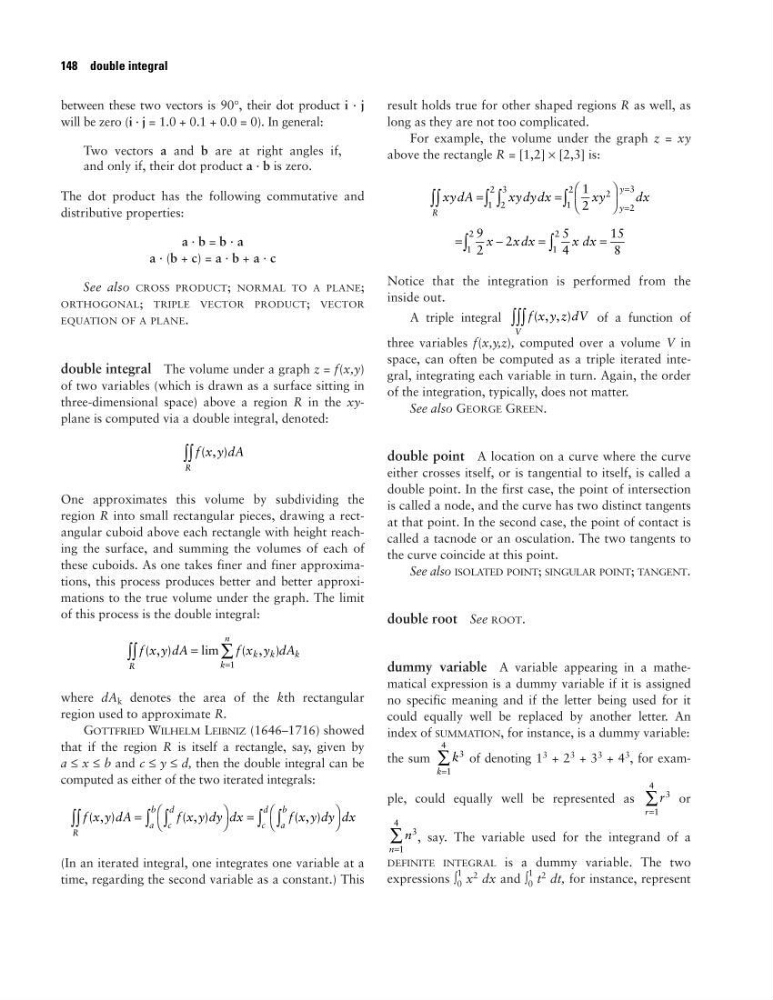
For example, the volume under the graph z = xy
above the rectangle R = [1,2] × [2,3] is:
Notice that the integration is performed from the
inside out.
A triple integral
of a function of
three variables f(x,y,z), computed over a volume V in
space, can often be computed as a triple iterated integral, integrating each variable in turn. Again, the order
of the integration, typically, does not matter.
See also GEORGE GREEN.
double point A location on a curve where the curve
either crosses itself, or is tangential to itself, is called a
double point. In the first case, the point of intersection
is called a node, and the curve has two distinct tangents
at that point. In the second case, the point of contact is
called a tacnode or an osculation. The two tangents to
the curve coincide at this point.
See also ISOLATED POINT; SINGULAR POINT; TANGENT.
double root See ROOT.
dummy variable A variable appearing in a mathematical expression is a dummy variable if it is assigned
no specific meaning and if the letter being used for it
could equally well be replaced by another letter. An
index of SUMMATION, for instance, is a dummy variable:
the sum
of denoting 1
3 + 2
3 + 3
3 + 4
3
, for example, could equally well be represented as
or
, say. The variable used for the integrand of a
DEFINITE INTEGRAL is a dummy variable. The two
expressions ∫
1
0 x
2 dx and ∫
1
0 t
2 dt, for instance, represent
n
n
3
1
4
=
∑
r
r
3
1
4
=
∑
k
k
3
1
4
=
∑
f x y z dV
V
( , , )
∫∫∫
xydA
xydydx
xy
dx
x
xdx
x dx
R
y
y
=
=
=
−
=
=
∫∫
∫
∫
∫
∫
∫
=
=
1
2
9
2
2
5
4
15
8
2
3
2
1
2
2
3
1
2
1
2
1
2
f x y dA
f x y dy dx
f x y dy dx
R
c
d
a
b
a
b
c
d
( , )
( , )
( , )
∫∫
∫
∫
∫
∫
=
=
f x y dA
f x y dA
R
k k
k
k
n
( , )
lim
( , )
∫∫
∑
=
=1
f x y dA
R
( , )
∫∫
148 double integral
will be zero (i · j = 1.0 + 0.1 + 0.0 = 0). In general:
Two vectors a and b are at right angles if,
and only if, their dot product a · b is zero.
The dot product has the following commutative and
distributive properties:
a · b = b · a
a · (b + c) = a · b + a · c
See also CROSS PRODUCT; NORMAL TO A PLANE;
ORTHOGONAL; TRIPLE VECTOR PRODUCT; VECTOR
EQUATION OF A PLANE.
double integral The volume under a graph z = f(x,y)
of two variables (which is drawn as a surface sitting in
three-dimensional space) above a region R in the xyplane is computed via a double integral, denoted:
One approximates this volume by subdividing the
region R into small rectangular pieces, drawing a rectangular cuboid above each rectangle with height reaching the surface, and summing the volumes of each of
these cuboids. As one takes finer and finer approximations, this process produces better and better approximations to the true volume under the graph. The limit
of this process is the double integral:
where dA k denotes the area of the kth rectangular
region used to approximate R.
GOTTFRIED WILHELM LEIBNIZ (1646–1716) showed
that if the region R is itself a rectangle, say, given by
a ≤ x ≤ b and c ≤ y ≤ d, then the double integral can be
computed as either of the two iterated integrals:
(In an iterated integral, one integrates one variable at a
time, regarding the second variable as a constant.) This
result holds true for other shaped regions R as well, as
long as they are not too complicated.
For example, the volume under the graph z = xy
above the rectangle R = [1,2] × [2,3] is:
Notice that the integration is performed from the
inside out.
A triple integral
of a function of
three variables f(x,y,z), computed over a volume V in
space, can often be computed as a triple iterated integral, integrating each variable in turn. Again, the order
of the integration, typically, does not matter.
See also GEORGE GREEN.
double point A location on a curve where the curve
either crosses itself, or is tangential to itself, is called a
double point. In the first case, the point of intersection
is called a node, and the curve has two distinct tangents
at that point. In the second case, the point of contact is
called a tacnode or an osculation. The two tangents to
the curve coincide at this point.
See also ISOLATED POINT; SINGULAR POINT; TANGENT.
double root See ROOT.
dummy variable A variable appearing in a mathematical expression is a dummy variable if it is assigned
no specific meaning and if the letter being used for it
could equally well be replaced by another letter. An
index of SUMMATION, for instance, is a dummy variable:
the sum
of denoting 1
3 + 2
3 + 3
3 + 4
3
, for example, could equally well be represented as
or
, say. The variable used for the integrand of a
DEFINITE INTEGRAL is a dummy variable. The two
expressions ∫
1
0 x
2 dx and ∫
1
0 t
2 dt, for instance, represent
n
n
3
1
4
=
∑
r
r
3
1
4
=
∑
k
k
3
1
4
=
∑
f x y z dV
V
( , , )
∫∫∫
xydA
xydydx
xy
dx
x
xdx
x dx
R
y
y
=
=
=
−
=
=
∫∫
∫
∫
∫
∫
∫
=
=
1
2
9
2
2
5
4
15
8
2
3
2
1
2
2
3
1
2
1
2
1
2
f x y dA
f x y dy dx
f x y dy dx
R
c
d
a
b
a
b
c
d
( , )
( , )
( , )
∫∫
∫
∫
∫
∫
=
=
f x y dA
f x y dA
R
k k
k
k
n
( , )
lim
( , )
∫∫
∑
=
=1
f x y dA
R
( , )
∫∫
148 double integral