

divisor of zero Two quantities, neither of which are
zero, yet multiply together to give zero as their product
are called divisors of zero. In ordinary arithmetic, divisors of zero never arise: if a × b = 0, then at least one of
a or b must be zero. In MODULAR ARITHMETIC, however,
divisors of zero can exist. For example, 3 × 2 equals zero
in arithmetic modulo 6. Two nonzero matrices may multiply to give the zero MATRIX, and the product of two
nonzero functions could be the zero function.
The presence of zero divisors in a mathematical
system often complicates the arithmetic one can perform within that system. For example, for arithmetic
modulo 10, 2 × 4 equals 2 × 9, but dividing by 2, a
divisor of zero in this system, leads to the erroneous
conclusion that 4 and 9 are equal in this system. In
general, one can never perform division when a divisor
of zero is involved.
dot product (inner product, scalar product) Denoted
a · b, the dot product of two VECTORs a and b is the sum
of the products of respective components of the vectors.
Precisely, if a = and b = ,
then a · b is the number:
a · b = a 1 b 1 + a 2 b 2 +…+ a n b n
The result of the dot product operation is always a real
number (scalar). For example, the dot product of the
two vectors a = < 1,4> and b = < 2,3> is a · b = 1 · 2 +
4 · 3 = 14.
The dot product arises in many situations. For
example, a local delicatessen receives the following
lunch order form:
One could interpret the order as a five-dimensional vector <2,0,1,3,0> to be matched with a five-dimensional
“cost vector” <2.80,3.15,1.95,2.50,3.60>. The total
cost of the order is then the dot product of these two
vectors:
2 × 2.80 + 0 × 3.15 + 1 × 1.95 + 3 × 2.50 + 0 × 3.60 =
$15.05
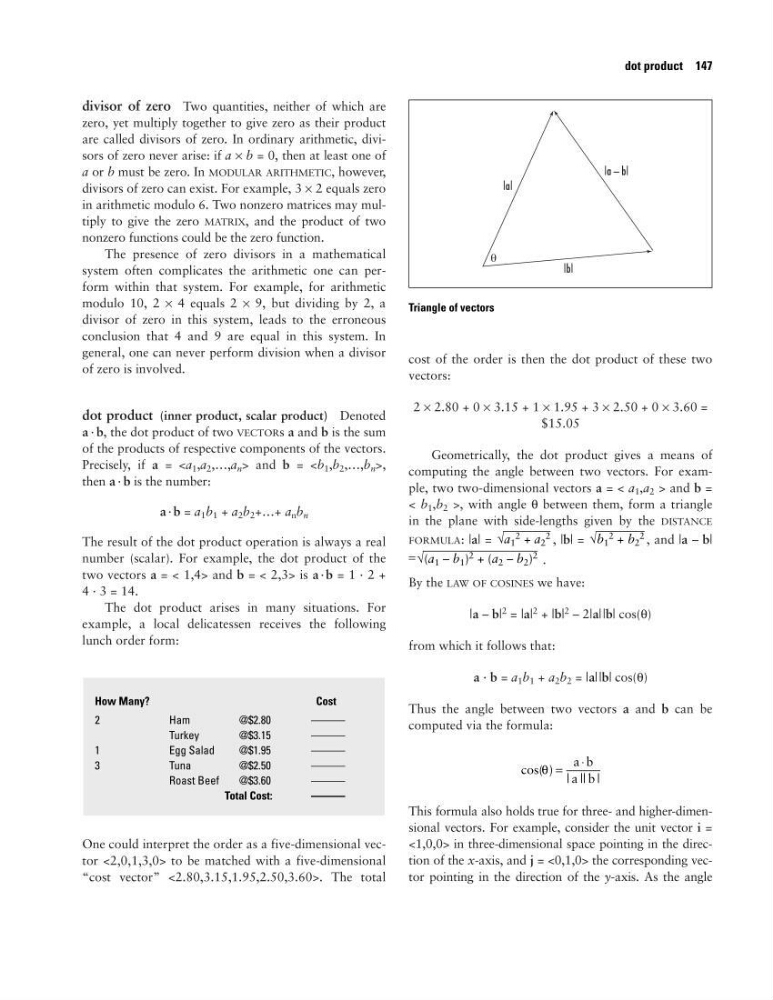
Geometrically, the dot product gives a means of
computing the angle between two vectors. For example, two two-dimensional vectors a = < a 1 ,a 2 > and b =
< b 1 ,b 2 >, with angle θ between them, form a triangle
in the plane with side-lengths given by the DISTANCE
FORMULA: |a| =
, |b| =
, and |a – b|
=
.
By the LAW OF COSINES we have:
|a – b|
2 = |a|
2 + |b|
2 – 2|a||b| cos(θ)
from which it follows that:
a · b = a 1 b 1 + a 2 b 2 = |a||b| cos(θ)
Thus the angle between two vectors a and b can be
computed via the formula:
This formula also holds true for three- and higher-dimensional vectors. For example, consider the unit vector i =
<1,0,0> in three-dimensional space pointing in the direction of the x-axis, and j = <0,1,0> the corresponding vector pointing in the direction of the y-axis. As the angle
cos( ) | || |
θ =
⋅
a b
a b
√(a 1 – b 1 )
2 + (a 2 – b 2 )
2
√b 1
2 + b 2
2
√a 1
2 + a 2
2
How Many?
Cost
2
Ham
@$2.80
———
Turkey
@$3.15
———
1
Egg Salad
@$1.95
———
3
Tuna
@$2.50
———
Roast Beef
@$3.60
———
Total Cost:
———
dot product 147
Triangle of vectors
zero, yet multiply together to give zero as their product
are called divisors of zero. In ordinary arithmetic, divisors of zero never arise: if a × b = 0, then at least one of
a or b must be zero. In MODULAR ARITHMETIC, however,
divisors of zero can exist. For example, 3 × 2 equals zero
in arithmetic modulo 6. Two nonzero matrices may multiply to give the zero MATRIX, and the product of two
nonzero functions could be the zero function.
The presence of zero divisors in a mathematical
system often complicates the arithmetic one can perform within that system. For example, for arithmetic
modulo 10, 2 × 4 equals 2 × 9, but dividing by 2, a
divisor of zero in this system, leads to the erroneous
conclusion that 4 and 9 are equal in this system. In
general, one can never perform division when a divisor
of zero is involved.
dot product (inner product, scalar product) Denoted
a · b, the dot product of two VECTORs a and b is the sum
of the products of respective components of the vectors.
Precisely, if a = and b = ,
then a · b is the number:
a · b = a 1 b 1 + a 2 b 2 +…+ a n b n
The result of the dot product operation is always a real
number (scalar). For example, the dot product of the
two vectors a = < 1,4> and b = < 2,3> is a · b = 1 · 2 +
4 · 3 = 14.
The dot product arises in many situations. For
example, a local delicatessen receives the following
lunch order form:
One could interpret the order as a five-dimensional vector <2,0,1,3,0> to be matched with a five-dimensional
“cost vector” <2.80,3.15,1.95,2.50,3.60>. The total
cost of the order is then the dot product of these two
vectors:
2 × 2.80 + 0 × 3.15 + 1 × 1.95 + 3 × 2.50 + 0 × 3.60 =
$15.05
Geometrically, the dot product gives a means of
computing the angle between two vectors. For example, two two-dimensional vectors a = < a 1 ,a 2 > and b =
< b 1 ,b 2 >, with angle θ between them, form a triangle
in the plane with side-lengths given by the DISTANCE
FORMULA: |a| =
, |b| =
, and |a – b|
=
.
By the LAW OF COSINES we have:
|a – b|
2 = |a|
2 + |b|
2 – 2|a||b| cos(θ)
from which it follows that:
a · b = a 1 b 1 + a 2 b 2 = |a||b| cos(θ)
Thus the angle between two vectors a and b can be
computed via the formula:
This formula also holds true for three- and higher-dimensional vectors. For example, consider the unit vector i =
<1,0,0> in three-dimensional space pointing in the direction of the x-axis, and j = <0,1,0> the corresponding vector pointing in the direction of the y-axis. As the angle
cos( ) | || |
θ =
⋅
a b
a b
√(a 1 – b 1 )
2 + (a 2 – b 2 )
2
√b 1
2 + b 2
2
√a 1
2 + a 2
2
How Many?
Cost
2
Ham
@$2.80
———
Turkey
@$3.15
———
1
Egg Salad
@$1.95
———
3
Tuna
@$2.50
———
Roast Beef
@$3.60
———
Total Cost:
———
dot product 147
Triangle of vectors