

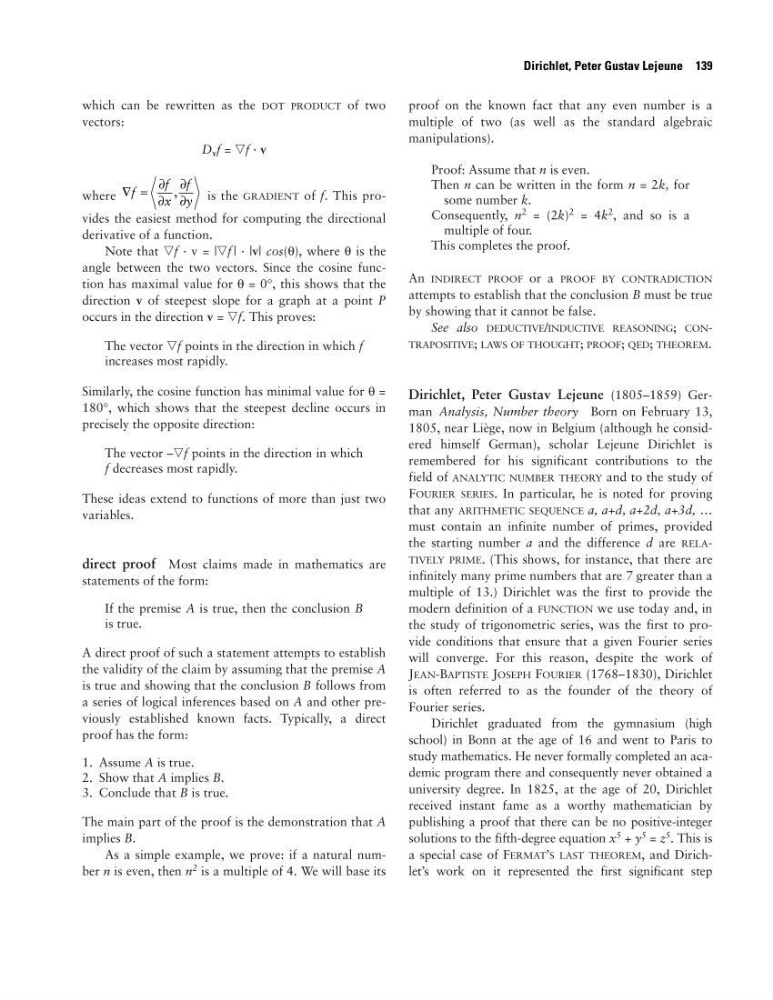
which can be rewritten as the DOT PRODUCT of two
vectors:
D v f = ᭞f · v
where
is the GRADIENT of f. This provides the easiest method for computing the directional
derivative of a function.
Note that ᭞f · v = |᭞f | · |v| cos(θ), where θ is the
angle between the two vectors. Since the cosine function has maximal value for θ = 0°, this shows that the
direction v of steepest slope for a graph at a point P
occurs in the direction v = ᭞f. This proves:
The vector ᭞f points in the direction in which f
increases most rapidly.
Similarly, the cosine function has minimal value for θ =
180°, which shows that the steepest decline occurs in
precisely the opposite direction:
The vector –᭞f points in the direction in which
f decreases most rapidly.
These ideas extend to functions of more than just two
variables.
direct proof Most claims made in mathematics are
statements of the form:
If the premise A is true, then the conclusion B
is true.
A direct proof of such a statement attempts to establish
the validity of the claim by assuming that the premise A
is true and showing that the conclusion B follows from
a series of logical inferences based on A and other previously established known facts. Typically, a direct
proof has the form:
1. Assume A is true.
2. Show that A implies B.
3. Conclude that B is true.
The main part of the proof is the demonstration that A
implies B.
As a simple example, we prove: if a natural number n is even, then n
2 is a multiple of 4. We will base its
proof on the known fact that any even number is a
multiple of two (as well as the standard algebraic
manipulations).
Proof: Assume that n is even.
Then n can be written in the form n = 2k, for
some number k.
Consequently, n
2 = (2k)
2 = 4k
2
, and so is a
multiple of four.
This completes the proof.
An INDIRECT PROOF or a PROOF BY CONTRADICTION
attempts to establish that the conclusion B must be true
by showing that it cannot be false.
See also DEDUCTIVE/INDUCTIVE REASONING; CONTRAPOSITIVE; LAWS OF THOUGHT; PROOF; QED; THEOREM.
Dirichlet, Peter Gustav Lejeune (1805–1859) German Analysis, Number theory Born on February 13,
1805, near Liège, now in Belgium (although he considered himself German), scholar Lejeune Dirichlet is
remembered for his significant contributions to the
field of ANALYTIC NUMBER THEORY and to the study of
FOURIER SERIES. In particular, he is noted for proving
that any ARITHMETIC SEQUENCE a, a+d, a+2d, a+3d, …
must contain an infinite number of primes, provided
the starting number a and the difference d are RELATIVELY PRIME. (This shows, for instance, that there are
infinitely many prime numbers that are 7 greater than a
multiple of 13.) Dirichlet was the first to provide the
modern definition of a FUNCTION we use today and, in
the study of trigonometric series, was the first to provide conditions that ensure that a given Fourier series
will converge. For this reason, despite the work of
JEAN-BAPTISTE JOSEPH FOURIER (1768–1830), Dirichlet
is often referred to as the founder of the theory of
Fourier series.
Dirichlet graduated from the gymnasium (high
school) in Bonn at the age of 16 and went to Paris to
study mathematics. He never formally completed an academic program there and consequently never obtained a
university degree. In 1825, at the age of 20, Dirichlet
received instant fame as a worthy mathematician by
publishing a proof that there can be no positive-integer
solutions to the fifth-degree equation x
5 + y
5 = z
5
. This is
a special case of FERMAT’S LAST THEOREM, and Dirichlet’s work on it represented the first significant step
∇ =
∂
∂
∂
∂
f
f
x
f
y
,
Dirichlet, Peter Gustav Lejeune 139
vectors:
D v f = ᭞f · v
where
is the GRADIENT of f. This provides the easiest method for computing the directional
derivative of a function.
Note that ᭞f · v = |᭞f | · |v| cos(θ), where θ is the
angle between the two vectors. Since the cosine function has maximal value for θ = 0°, this shows that the
direction v of steepest slope for a graph at a point P
occurs in the direction v = ᭞f. This proves:
The vector ᭞f points in the direction in which f
increases most rapidly.
Similarly, the cosine function has minimal value for θ =
180°, which shows that the steepest decline occurs in
precisely the opposite direction:
The vector –᭞f points in the direction in which
f decreases most rapidly.
These ideas extend to functions of more than just two
variables.
direct proof Most claims made in mathematics are
statements of the form:
If the premise A is true, then the conclusion B
is true.
A direct proof of such a statement attempts to establish
the validity of the claim by assuming that the premise A
is true and showing that the conclusion B follows from
a series of logical inferences based on A and other previously established known facts. Typically, a direct
proof has the form:
1. Assume A is true.
2. Show that A implies B.
3. Conclude that B is true.
The main part of the proof is the demonstration that A
implies B.
As a simple example, we prove: if a natural number n is even, then n
2 is a multiple of 4. We will base its
proof on the known fact that any even number is a
multiple of two (as well as the standard algebraic
manipulations).
Proof: Assume that n is even.
Then n can be written in the form n = 2k, for
some number k.
Consequently, n
2 = (2k)
2 = 4k
2
, and so is a
multiple of four.
This completes the proof.
An INDIRECT PROOF or a PROOF BY CONTRADICTION
attempts to establish that the conclusion B must be true
by showing that it cannot be false.
See also DEDUCTIVE/INDUCTIVE REASONING; CONTRAPOSITIVE; LAWS OF THOUGHT; PROOF; QED; THEOREM.
Dirichlet, Peter Gustav Lejeune (1805–1859) German Analysis, Number theory Born on February 13,
1805, near Liège, now in Belgium (although he considered himself German), scholar Lejeune Dirichlet is
remembered for his significant contributions to the
field of ANALYTIC NUMBER THEORY and to the study of
FOURIER SERIES. In particular, he is noted for proving
that any ARITHMETIC SEQUENCE a, a+d, a+2d, a+3d, …
must contain an infinite number of primes, provided
the starting number a and the difference d are RELATIVELY PRIME. (This shows, for instance, that there are
infinitely many prime numbers that are 7 greater than a
multiple of 13.) Dirichlet was the first to provide the
modern definition of a FUNCTION we use today and, in
the study of trigonometric series, was the first to provide conditions that ensure that a given Fourier series
will converge. For this reason, despite the work of
JEAN-BAPTISTE JOSEPH FOURIER (1768–1830), Dirichlet
is often referred to as the founder of the theory of
Fourier series.
Dirichlet graduated from the gymnasium (high
school) in Bonn at the age of 16 and went to Paris to
study mathematics. He never formally completed an academic program there and consequently never obtained a
university degree. In 1825, at the age of 20, Dirichlet
received instant fame as a worthy mathematician by
publishing a proof that there can be no positive-integer
solutions to the fifth-degree equation x
5 + y
5 = z
5
. This is
a special case of FERMAT’S LAST THEOREM, and Dirichlet’s work on it represented the first significant step
∇ =
∂
∂
∂
∂
f
f
x
f
y
,
Dirichlet, Peter Gustav Lejeune 139