

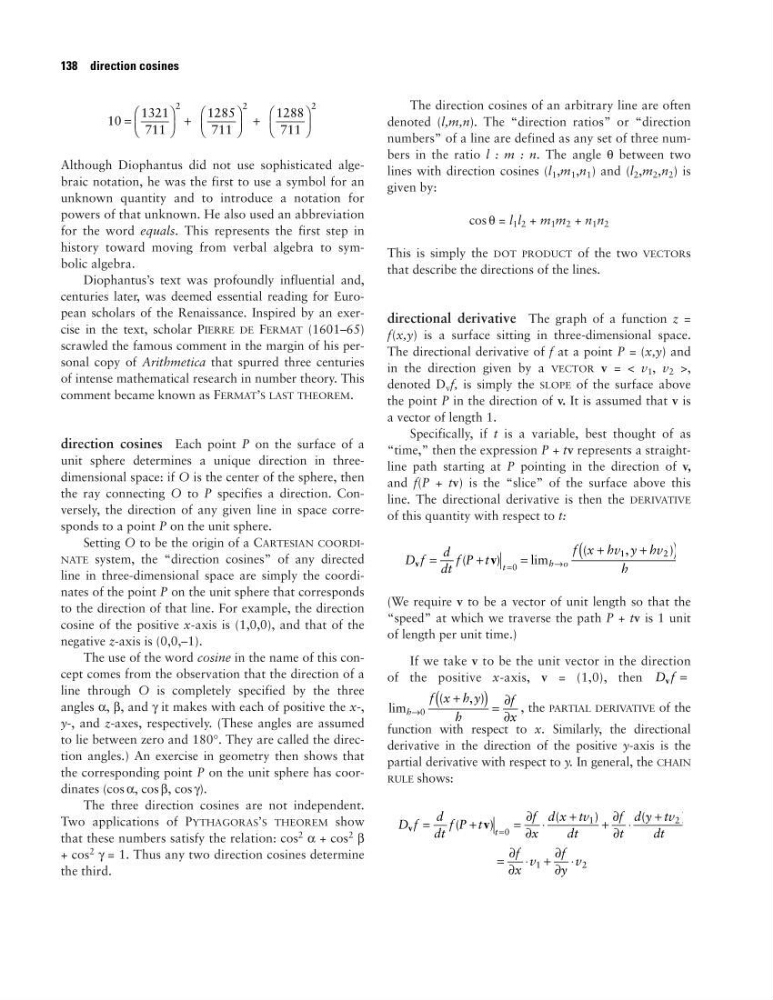
Although Diophantus did not use sophisticated algebraic notation, he was the first to use a symbol for an
unknown quantity and to introduce a notation for
powers of that unknown. He also used an abbreviation
for the word equals. This represents the first step in
history toward moving from verbal algebra to symbolic algebra.
Diophantus’s text was profoundly influential and,
centuries later, was deemed essential reading for European scholars of the Renaissance. Inspired by an exercise in the text, scholar PIERRE DE FERMAT (1601–65)
scrawled the famous comment in the margin of his personal copy of Arithmetica that spurred three centuries
of intense mathematical research in number theory. This
comment became known as FERMAT’S LAST THEOREM.
direction cosines Each point P on the surface of a
unit sphere determines a unique direction in threedimensional space: if O is the center of the sphere, then
the ray connecting O to P specifies a direction. Conversely, the direction of any given line in space corresponds to a point P on the unit sphere.
Setting O to be the origin of a CARTESIAN COORDINATE system, the “direction cosines” of any directed
line in three-dimensional space are simply the coordinates of the point P on the unit sphere that corresponds
to the direction of that line. For example, the direction
cosine of the positive x-axis is (1,0,0), and that of the
negative z-axis is (0,0,–1).
The use of the word cosine in the name of this concept comes from the observation that the direction of a
line through O is completely specified by the three
angles α, β, and γ it makes with each of positive the x-,
y-, and z-axes, respectively. (These angles are assumed
to lie between zero and 180°. They are called the direction angles.) An exercise in geometry then shows that
the corresponding point P on the unit sphere has coordinates (cos α, cos β, cos γ).
The three direction cosines are not independent.
Two applications of PYTHAGORAS’S THEOREM show
that these numbers satisfy the relation: cos
2
α + cos
2
β
+ cos
2
γ = 1. Thus any two direction cosines determine
the third.
The direction cosines of an arbitrary line are often
denoted (l,m,n). The “direction ratios” or “direction
numbers” of a line are defined as any set of three numbers in the ratio l : m : n. The angle θ between two
lines with direction cosines (l 1 ,m 1 ,n 1 ) and (l 2 ,m 2 ,n 2 ) is
given by:
cos θ = l 1 l 2 + m 1 m 2 + n 1 n 2
This is simply the DOT PRODUCT of the two VECTORs
that describe the directions of the lines.
directional derivative The graph of a function z =
f(x,y) is a surface sitting in three-dimensional space.
The directional derivative of f at a point P = (x,y) and
in the direction given by a VECTOR v = < v 1 , v 2 >,
denoted D v f, is simply the SLOPE of the surface above
the point P in the direction of v. It is assumed that v is
a vector of length 1.
Specifically, if t is a variable, best thought of as
“time,” then the expression P + tv represents a straightline path starting at P pointing in the direction of v,
and f(P + tv) is the “slice” of the surface above this
line. The directional derivative is then the DERIVATIVE
of this quantity with respect to t:
(We require v to be a vector of unit length so that the
“speed” at which we traverse the path P + tv is 1 unit
of length per unit time.)
If we take v to be the unit vector in the direction
of the positive x-axis, v = (1,0), then
, the PARTIAL DERIVATIVE of the
function with respect to x. Similarly, the directional
derivative in the direction of the positive y-axis is the
partial derivative with respect to y. In general, the CHAIN
RULE shows:
D f
d
dt
f P t
f
x
d x tv
dt
f
t
d y tv
dt
f
x
v
f
y
v
t
v
v
=
+
=
∂
∂
⋅
+
+
∂
∂
⋅
+
=
∂
∂
⋅ +
∂
∂
⋅
=
(
)
(
)
(
)
0
1
2
1
2
f x h y
h
f
x
h
+
(
) =
∂
∂
→
lim
(
, )
0
D f
v =
D f
d
dt
f P t
f x hv y hv
h
t
h o
v
v
=
+
=
+
+
(
)
=
→
(
)
lim
(
,
)
0
1
2
10
1321
711
1285
711
1288
711
2
2
2
=
+
+
138 direction cosines
unknown quantity and to introduce a notation for
powers of that unknown. He also used an abbreviation
for the word equals. This represents the first step in
history toward moving from verbal algebra to symbolic algebra.
Diophantus’s text was profoundly influential and,
centuries later, was deemed essential reading for European scholars of the Renaissance. Inspired by an exercise in the text, scholar PIERRE DE FERMAT (1601–65)
scrawled the famous comment in the margin of his personal copy of Arithmetica that spurred three centuries
of intense mathematical research in number theory. This
comment became known as FERMAT’S LAST THEOREM.
direction cosines Each point P on the surface of a
unit sphere determines a unique direction in threedimensional space: if O is the center of the sphere, then
the ray connecting O to P specifies a direction. Conversely, the direction of any given line in space corresponds to a point P on the unit sphere.
Setting O to be the origin of a CARTESIAN COORDINATE system, the “direction cosines” of any directed
line in three-dimensional space are simply the coordinates of the point P on the unit sphere that corresponds
to the direction of that line. For example, the direction
cosine of the positive x-axis is (1,0,0), and that of the
negative z-axis is (0,0,–1).
The use of the word cosine in the name of this concept comes from the observation that the direction of a
line through O is completely specified by the three
angles α, β, and γ it makes with each of positive the x-,
y-, and z-axes, respectively. (These angles are assumed
to lie between zero and 180°. They are called the direction angles.) An exercise in geometry then shows that
the corresponding point P on the unit sphere has coordinates (cos α, cos β, cos γ).
The three direction cosines are not independent.
Two applications of PYTHAGORAS’S THEOREM show
that these numbers satisfy the relation: cos
2
α + cos
2
β
+ cos
2
γ = 1. Thus any two direction cosines determine
the third.
The direction cosines of an arbitrary line are often
denoted (l,m,n). The “direction ratios” or “direction
numbers” of a line are defined as any set of three numbers in the ratio l : m : n. The angle θ between two
lines with direction cosines (l 1 ,m 1 ,n 1 ) and (l 2 ,m 2 ,n 2 ) is
given by:
cos θ = l 1 l 2 + m 1 m 2 + n 1 n 2
This is simply the DOT PRODUCT of the two VECTORs
that describe the directions of the lines.
directional derivative The graph of a function z =
f(x,y) is a surface sitting in three-dimensional space.
The directional derivative of f at a point P = (x,y) and
in the direction given by a VECTOR v = < v 1 , v 2 >,
denoted D v f, is simply the SLOPE of the surface above
the point P in the direction of v. It is assumed that v is
a vector of length 1.
Specifically, if t is a variable, best thought of as
“time,” then the expression P + tv represents a straightline path starting at P pointing in the direction of v,
and f(P + tv) is the “slice” of the surface above this
line. The directional derivative is then the DERIVATIVE
of this quantity with respect to t:
(We require v to be a vector of unit length so that the
“speed” at which we traverse the path P + tv is 1 unit
of length per unit time.)
If we take v to be the unit vector in the direction
of the positive x-axis, v = (1,0), then
, the PARTIAL DERIVATIVE of the
function with respect to x. Similarly, the directional
derivative in the direction of the positive y-axis is the
partial derivative with respect to y. In general, the CHAIN
RULE shows:
D f
d
dt
f P t
f
x
d x tv
dt
f
t
d y tv
dt
f
x
v
f
y
v
t
v
v
=
+
=
∂
∂
⋅
+
+
∂
∂
⋅
+
=
∂
∂
⋅ +
∂
∂
⋅
=
(
)
(
)
(
)
0
1
2
1
2
f x h y
h
f
x
h
+
(
) =
∂
∂
→
lim
(
, )
0
D f
v =
D f
d
dt
f P t
f x hv y hv
h
t
h o
v
v
=
+
=
+
+
(
)
=
→
(
)
lim
(
,
)
0
1
2
10
1321
711
1285
711
1288
711
2
2
2
=
+
+
138 direction cosines