

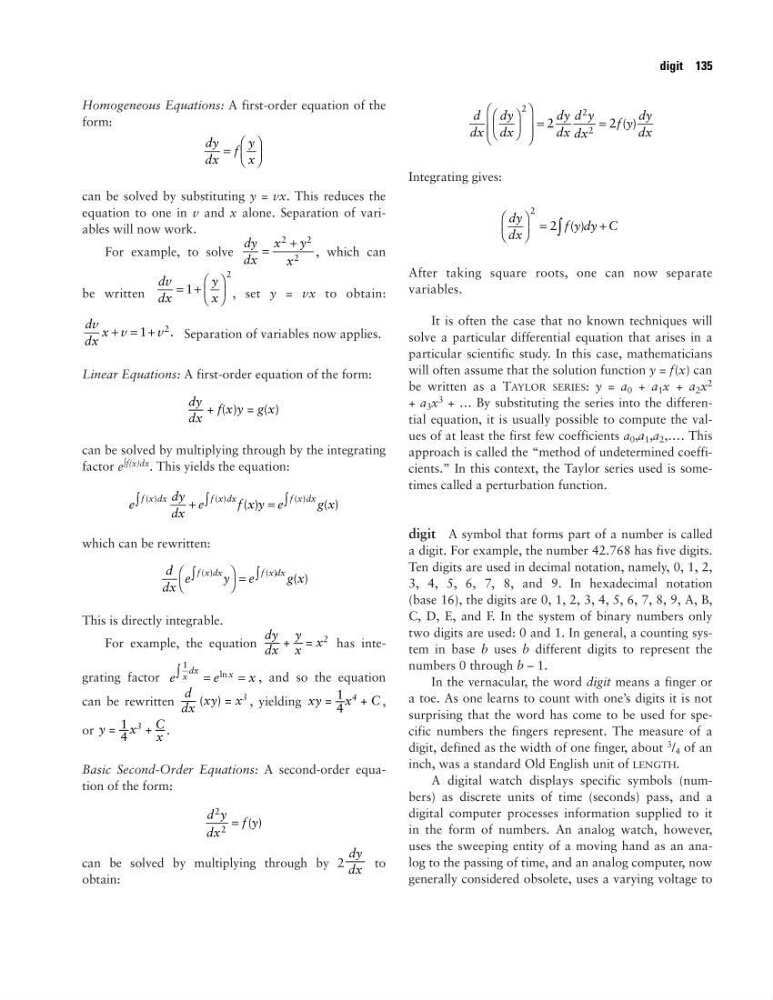
Homogeneous Equations: A first-order equation of the
form:
can be solved by substituting y = vx. This reduces the
equation to one in v and x alone. Separation of variables will now work.
For example, to solve
, which can
be written
, set y = vx to obtain:
Separation of variables now applies.
Linear Equations: A first-order equation of the form:
can be solved by multiplying through by the integrating
factor e
∫f(x)dx
. This yields the equation:
which can be rewritten:
This is directly integrable.
For example, the equation
has integrating factor
, and so the equation
can be rewritten
, yielding
,
or
.
Basic Second-Order Equations: A second-order equation of the form:
can be solved by multiplying through by 2
to
obtain:
Integrating gives:
After taking square roots, one can now separate
variables.
It is often the case that no known techniques will
solve a particular differential equation that arises in a
particular scientific study. In this case, mathematicians
will often assume that the solution function y = f(x) can
be written as a TAYLOR SERIES: y = a 0 + a 1 x + a 2 x
2
+ a 3 x
3 + … By substituting the series into the differential equation, it is usually possible to compute the values of at least the first few coefficients a 0 ,a 1 ,a 2 ,…. This
approach is called the “method of undetermined coefficients.” In this context, the Taylor series used is sometimes called a perturbation function.
digit A symbol that forms part of a number is called
a digit. For example, the number 42.768 has five digits.
Ten digits are used in decimal notation, namely, 0, 1, 2,
3, 4, 5, 6, 7, 8, and 9. In hexadecimal notation
(base 16), the digits are 0, 1, 2, 3, 4, 5, 6, 7, 8, 9, A, B,
C, D, E, and F. In the system of binary numbers only
two digits are used: 0 and 1. In general, a counting system in base b uses b different digits to represent the
numbers 0 through b – 1.
In the vernacular, the word digit means a finger or
a toe. As one learns to count with one’s digits it is not
surprising that the word has come to be used for specific numbers the fingers represent. The measure of a
digit, defined as the width of one finger, about
3
/ 4 of an
inch, was a standard Old English unit of LENGTH.
A digital watch displays specific symbols (numbers) as discrete units of time (seconds) pass, and a
digital computer processes information supplied to it
in the form of numbers. An analog watch, however,
uses the sweeping entity of a moving hand as an analog to the passing of time, and an analog computer, now
generally considered obsolete, uses a varying voltage to
dy
dx
f y dy C
=
+
∫
2
2 ( )
d
dx
dy
dx
dy
dx
d y
dx
f y
dy
dx
=
=
2
2
2
2
2()
dy
––
dx
d y
dx
f y
2
2
= ( )
1
C
y = –x
3 + –
4
x
1
xy = –x
4 + C
4
d
–– (xy) = x
3
dx
e
e
x
x
dx
x
1
∫
=
=
ln
dy y
–– + – = x
2
dx x
d
dx
e
y
e
gx
f x dx
f x dx
( )
( )
( )
∫
∫
=
e
dy
dx
e
f xy e
gx
f x dx
f x dx
f x dx
( )
( )
( )
( )
( )
∫
∫
∫
+
=
dy
–– + f(x)y = g(x)
dx
dv
dx
x v
v
+ = +
1 2 .
dv
dx
y
x
= +
1
2
dy
dx
x y
x
=
+
2
2
2
dy
dx
f
y
x
=
digit 135
form:
can be solved by substituting y = vx. This reduces the
equation to one in v and x alone. Separation of variables will now work.
For example, to solve
, which can
be written
, set y = vx to obtain:
Separation of variables now applies.
Linear Equations: A first-order equation of the form:
can be solved by multiplying through by the integrating
factor e
∫f(x)dx
. This yields the equation:
which can be rewritten:
This is directly integrable.
For example, the equation
has integrating factor
, and so the equation
can be rewritten
, yielding
,
or
.
Basic Second-Order Equations: A second-order equation of the form:
can be solved by multiplying through by 2
to
obtain:
Integrating gives:
After taking square roots, one can now separate
variables.
It is often the case that no known techniques will
solve a particular differential equation that arises in a
particular scientific study. In this case, mathematicians
will often assume that the solution function y = f(x) can
be written as a TAYLOR SERIES: y = a 0 + a 1 x + a 2 x
2
+ a 3 x
3 + … By substituting the series into the differential equation, it is usually possible to compute the values of at least the first few coefficients a 0 ,a 1 ,a 2 ,…. This
approach is called the “method of undetermined coefficients.” In this context, the Taylor series used is sometimes called a perturbation function.
digit A symbol that forms part of a number is called
a digit. For example, the number 42.768 has five digits.
Ten digits are used in decimal notation, namely, 0, 1, 2,
3, 4, 5, 6, 7, 8, and 9. In hexadecimal notation
(base 16), the digits are 0, 1, 2, 3, 4, 5, 6, 7, 8, 9, A, B,
C, D, E, and F. In the system of binary numbers only
two digits are used: 0 and 1. In general, a counting system in base b uses b different digits to represent the
numbers 0 through b – 1.
In the vernacular, the word digit means a finger or
a toe. As one learns to count with one’s digits it is not
surprising that the word has come to be used for specific numbers the fingers represent. The measure of a
digit, defined as the width of one finger, about
3
/ 4 of an
inch, was a standard Old English unit of LENGTH.
A digital watch displays specific symbols (numbers) as discrete units of time (seconds) pass, and a
digital computer processes information supplied to it
in the form of numbers. An analog watch, however,
uses the sweeping entity of a moving hand as an analog to the passing of time, and an analog computer, now
generally considered obsolete, uses a varying voltage to
dy
dx
f y dy C
=
+
∫
2
2 ( )
d
dx
dy
dx
dy
dx
d y
dx
f y
dy
dx
=
=
2
2
2
2
2()
dy
––
dx
d y
dx
f y
2
2
= ( )
1
C
y = –x
3 + –
4
x
1
xy = –x
4 + C
4
d
–– (xy) = x
3
dx
e
e
x
x
dx
x
1
∫
=
=
ln
dy y
–– + – = x
2
dx x
d
dx
e
y
e
gx
f x dx
f x dx
( )
( )
( )
∫
∫
=
e
dy
dx
e
f xy e
gx
f x dx
f x dx
f x dx
( )
( )
( )
( )
( )
∫
∫
∫
+
=
dy
–– + f(x)y = g(x)
dx
dv
dx
x v
v
+ = +
1 2 .
dv
dx
y
x
= +
1
2
dy
dx
x y
x
=
+
2
2
2
dy
dx
f
y
x
=
digit 135