

and the definition of a REAL NUMBER was subject to
much debate.
In 1872 JULIUS DEDEKIND had the very simple and
elegant idea to simply define the irrationals to be the
gaps in the rational number line. He noted that each
“gap,” like the square root of 2 for example, divides the
line of rationals into two pieces—a left piece and a right
piece. One can focus one’s attention on just the left
piece (for those points that are not in it constitute the
right piece) and this left piece L satisfies the following
three properties:
1. It is not empty, nor is it the whole set of points.
2. If a is a number in L, and b
3. If a is a number in L, it is possible to find another
number c also in L but slightly larger than a.
Dedekind simply defined a real number to be any subset
L of the rational numbers satisfying these three properties. Such a set is today known as a Dedekind cut.
Every rational number r defines a cut. One can
check that the set r* = {a ∈ Q : a < r} satisfies the three
properties. Thus the set of Dedekind cuts “contains”
all the rational numbers as sets of this type. It also contains other types of numbers. For example, the square
root of 2 is given by the set:
L = {a ∈ Q : a is negative, or a is positive and a
2
<2}
One can check that any union of cuts, in the context
of SET THEORY, is again a cut. With this surprisingly
simple definition of a real number, Dedekind was
able to prove all the properties of the real-number
system required for establishing the soundness of calculus. In particular, he was able to show that any collection of real numbers with an upper BOUND
necessarily possesses a least upper bound. (This least
upper bound is the union of all the cuts listed in the
collection.)
deductive/inductive reasoning In the scientific method, there are two general processes for establishing
results. The first, called inductive reasoning, arrives at
general conclusions by observing specific examples,
identifying trends, and generalizing. “The sun has
always risen in the past, therefore it will rise tomorrow,” for example, illustrates this mode of reasoning.
The inductive process relies on discerning patterns
but does not attempt to prove that the patterns
observed apply to all cases. (Maybe the sun will not
rise tomorrow.) For this reason, a conclusion drawn by
the inductive process is called a conjecture or an educated guess. If there is just one case for which the conclusion does not hold, then the conjecture is false. Such
a case is called a COUNTEREXAMPLE.
To illustrate, in the mid-1700s LEONHARD EULER
observed that the product of two consecutive integers
plus 41 seems always to yield a PRIME number. For example, 2 × 3 + 41 = 47 is prime, as is 23 × 24 + 41 = 593
and 37 × 38 + 41 = 1447. By inductive reasoning, we
would conclude that n × (n + 1) + 41 is always prime.
However, this is a false conclusion. The case n=40 provides a counterexample: 40 × 41 + 41 = 41 × 41 = 1681
is not prime. (Curiously n × (n + 1) + 41 is prime for all
values n between –40 and 39.)
Many intelligence tests ask participants to identify
“the next number in the sequence.” These questions
rely on inductive reasoning, but are not mathematically
sound. For example, given the challenge:
What number comes next in the sequence:
2 4 6?
any answer is actually acceptable (although the test
designers clearly expect the answer “8”). One can
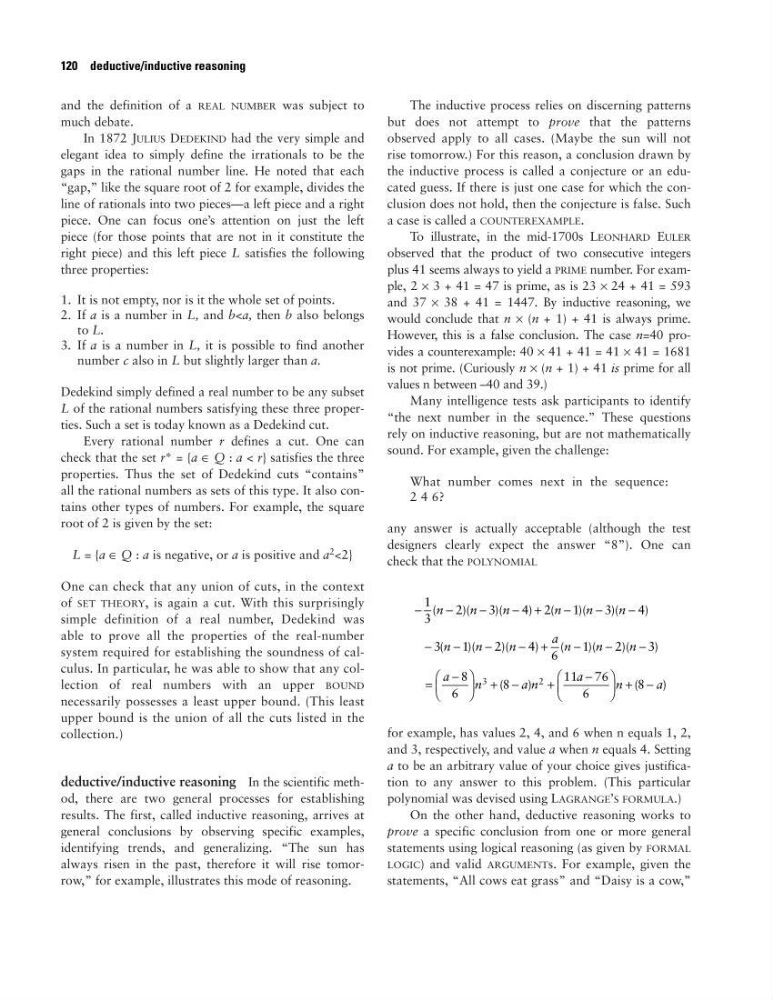
check that the POLYNOMIAL
for example, has values 2, 4, and 6 when n equals 1, 2,
and 3, respectively, and value a when n equals 4. Setting
a to be an arbitrary value of your choice gives justification to any answer to this problem. (This particular
polynomial was devised using LAGRANGE’S FORMULA.)
On the other hand, deductive reasoning works to
prove a specific conclusion from one or more general
statements using logical reasoning (as given by FORMAL
LOGIC) and valid ARGUMENTs. For example, given the
statements, “All cows eat grass” and “Daisy is a cow,”
−
−
−
− +
−
−
−
−
−
−
− +
−
−
−
=
−
+ −
+
−
+ −
1
3
2
3
4 2
1
3
4
3
1
2
4 6
1
2
3
8
6
8
11 76
6
8
3
2
(
)(
)(
) (
)(
)(
)
(
)(
)(
)
(
)(
)(
)
(
)
(
)
n
n
n
n
n
n
n
n
n
a n
n
n
a
n
an
a
n
a
120 deductive/inductive reasoning
much debate.
In 1872 JULIUS DEDEKIND had the very simple and
elegant idea to simply define the irrationals to be the
gaps in the rational number line. He noted that each
“gap,” like the square root of 2 for example, divides the
line of rationals into two pieces—a left piece and a right
piece. One can focus one’s attention on just the left
piece (for those points that are not in it constitute the
right piece) and this left piece L satisfies the following
three properties:
1. It is not empty, nor is it the whole set of points.
2. If a is a number in L, and b
3. If a is a number in L, it is possible to find another
number c also in L but slightly larger than a.
Dedekind simply defined a real number to be any subset
L of the rational numbers satisfying these three properties. Such a set is today known as a Dedekind cut.
Every rational number r defines a cut. One can
check that the set r* = {a ∈ Q : a < r} satisfies the three
properties. Thus the set of Dedekind cuts “contains”
all the rational numbers as sets of this type. It also contains other types of numbers. For example, the square
root of 2 is given by the set:
L = {a ∈ Q : a is negative, or a is positive and a
2
<2}
One can check that any union of cuts, in the context
of SET THEORY, is again a cut. With this surprisingly
simple definition of a real number, Dedekind was
able to prove all the properties of the real-number
system required for establishing the soundness of calculus. In particular, he was able to show that any collection of real numbers with an upper BOUND
necessarily possesses a least upper bound. (This least
upper bound is the union of all the cuts listed in the
collection.)
deductive/inductive reasoning In the scientific method, there are two general processes for establishing
results. The first, called inductive reasoning, arrives at
general conclusions by observing specific examples,
identifying trends, and generalizing. “The sun has
always risen in the past, therefore it will rise tomorrow,” for example, illustrates this mode of reasoning.
The inductive process relies on discerning patterns
but does not attempt to prove that the patterns
observed apply to all cases. (Maybe the sun will not
rise tomorrow.) For this reason, a conclusion drawn by
the inductive process is called a conjecture or an educated guess. If there is just one case for which the conclusion does not hold, then the conjecture is false. Such
a case is called a COUNTEREXAMPLE.
To illustrate, in the mid-1700s LEONHARD EULER
observed that the product of two consecutive integers
plus 41 seems always to yield a PRIME number. For example, 2 × 3 + 41 = 47 is prime, as is 23 × 24 + 41 = 593
and 37 × 38 + 41 = 1447. By inductive reasoning, we
would conclude that n × (n + 1) + 41 is always prime.
However, this is a false conclusion. The case n=40 provides a counterexample: 40 × 41 + 41 = 41 × 41 = 1681
is not prime. (Curiously n × (n + 1) + 41 is prime for all
values n between –40 and 39.)
Many intelligence tests ask participants to identify
“the next number in the sequence.” These questions
rely on inductive reasoning, but are not mathematically
sound. For example, given the challenge:
What number comes next in the sequence:
2 4 6?
any answer is actually acceptable (although the test
designers clearly expect the answer “8”). One can
check that the POLYNOMIAL
for example, has values 2, 4, and 6 when n equals 1, 2,
and 3, respectively, and value a when n equals 4. Setting
a to be an arbitrary value of your choice gives justification to any answer to this problem. (This particular
polynomial was devised using LAGRANGE’S FORMULA.)
On the other hand, deductive reasoning works to
prove a specific conclusion from one or more general
statements using logical reasoning (as given by FORMAL
LOGIC) and valid ARGUMENTs. For example, given the
statements, “All cows eat grass” and “Daisy is a cow,”
−
−
−
− +
−
−
−
−
−
−
− +
−
−
−
=
−
+ −
+
−
+ −
1
3
2
3
4 2
1
3
4
3
1
2
4 6
1
2
3
8
6
8
11 76
6
8
3
2
(
)(
)(
) (
)(
)(
)
(
)(
)(
)
(
)(
)(
)
(
)
(
)
n
n
n
n
n
n
n
n
n
a n
n
n
a
n
an
a
n
a
120 deductive/inductive reasoning