

numbers. Also, any rational function decomposes into
a sum of PARTIAL FRACTIONS. The process of GAUSSIAN
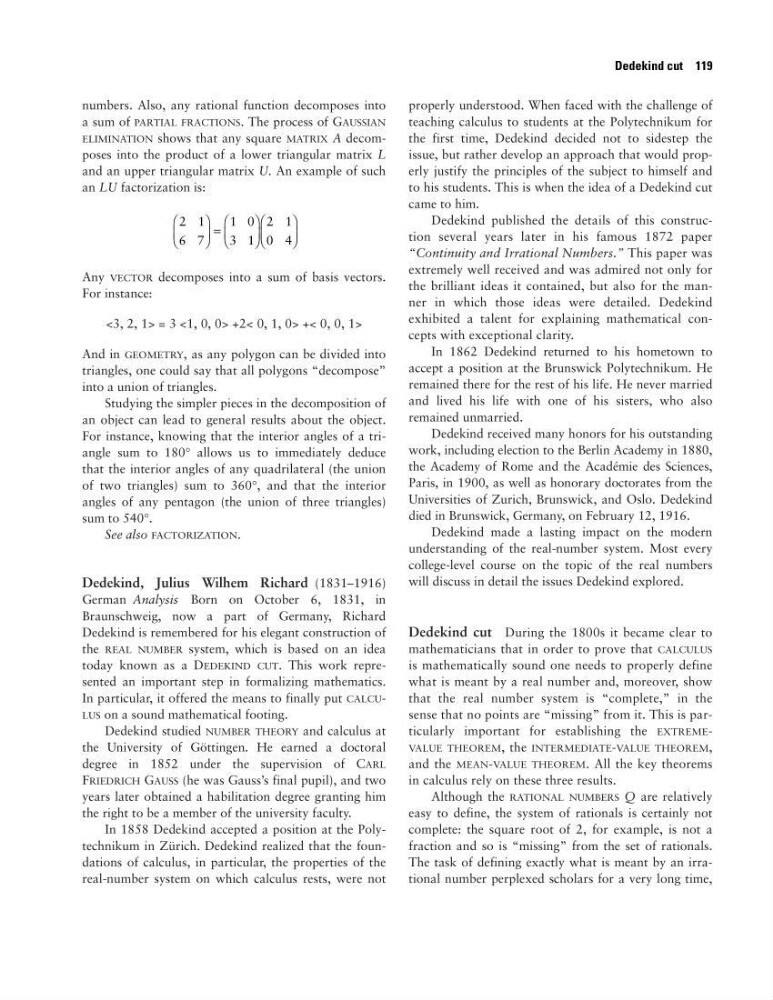
ELIMINATION shows that any square MATRIX A decomposes into the product of a lower triangular matrix L
and an upper triangular matrix U. An example of such
an LU factorization is:
Any VECTOR decomposes into a sum of basis vectors.
For instance:
<3, 2, 1> = 3 <1, 0, 0> +2< 0, 1, 0> +< 0, 0, 1>
And in GEOMETRY, as any polygon can be divided into
triangles, one could say that all polygons “decompose”
into a union of triangles.
Studying the simpler pieces in the decomposition of
an object can lead to general results about the object.
For instance, knowing that the interior angles of a triangle sum to 180° allows us to immediately deduce
that the interior angles of any quadrilateral (the union
of two triangles) sum to 360°, and that the interior
angles of any pentagon (the union of three triangles)
sum to 540°.
See also FACTORIZATION.
Dedekind, Julius Wilhem Richard (1831–1916)
German Analysis Born on October 6, 1831, in
Braunschweig, now a part of Germany, Richard
Dedekind is remembered for his elegant construction of
the REAL NUMBER system, which is based on an idea
today known as a DEDEKIND CUT. This work represented an important step in formalizing mathematics.
In particular, it offered the means to finally put CALCULUS on a sound mathematical footing.
Dedekind studied NUMBER THEORY and calculus at
the University of Göttingen. He earned a doctoral
degree in 1852 under the supervision of CARL
FRIEDRICH GAUSS (he was Gauss’s final pupil), and two
years later obtained a habilitation degree granting him
the right to be a member of the university faculty.
In 1858 Dedekind accepted a position at the Polytechnikum in Zürich. Dedekind realized that the foundations of calculus, in particular, the properties of the
real-number system on which calculus rests, were not
properly understood. When faced with the challenge of
teaching calculus to students at the Polytechnikum for
the first time, Dedekind decided not to sidestep the
issue, but rather develop an approach that would properly justify the principles of the subject to himself and
to his students. This is when the idea of a Dedekind cut
came to him.
Dedekind published the details of this construction several years later in his famous 1872 paper
“Continuity and Irrational Numbers.” This paper was
extremely well received and was admired not only for
the brilliant ideas it contained, but also for the manner in which those ideas were detailed. Dedekind
exhibited a talent for explaining mathematical concepts with exceptional clarity.
In 1862 Dedekind returned to his hometown to
accept a position at the Brunswick Polytechnikum. He
remained there for the rest of his life. He never married
and lived his life with one of his sisters, who also
remained unmarried.
Dedekind received many honors for his outstanding
work, including election to the Berlin Academy in 1880,
the Academy of Rome and the Académie des Sciences,
Paris, in 1900, as well as honorary doctorates from the
Universities of Zurich, Brunswick, and Oslo. Dedekind
died in Brunswick, Germany, on February 12, 1916.
Dedekind made a lasting impact on the modern
understanding of the real-number system. Most every
college-level course on the topic of the real numbers
will discuss in detail the issues Dedekind explored.
Dedekind cut During the 1800s it became clear to
mathematicians that in order to prove that CALCULUS
is mathematically sound one needs to properly define
what is meant by a real number and, moreover, show
that the real number system is “complete,” in the
sense that no points are “missing” from it. This is particularly important for establishing the EXTREMEVALUE THEOREM, the INTERMEDIATE-VALUE THEOREM,
and the MEAN-VALUE THEOREM. All the key theorems
in calculus rely on these three results.
Although the RATIONAL NUMBERS Q are relatively
easy to define, the system of rationals is certainly not
complete: the square root of 2, for example, is not a
fraction and so is “missing” from the set of rationals.
The task of defining exactly what is meant by an irrational number perplexed scholars for a very long time,
2 1
6 7
1 0
3 1
2 1
0 4
=
Dedekind cut 119
a sum of PARTIAL FRACTIONS. The process of GAUSSIAN
ELIMINATION shows that any square MATRIX A decomposes into the product of a lower triangular matrix L
and an upper triangular matrix U. An example of such
an LU factorization is:
Any VECTOR decomposes into a sum of basis vectors.
For instance:
<3, 2, 1> = 3 <1, 0, 0> +2< 0, 1, 0> +< 0, 0, 1>
And in GEOMETRY, as any polygon can be divided into
triangles, one could say that all polygons “decompose”
into a union of triangles.
Studying the simpler pieces in the decomposition of
an object can lead to general results about the object.
For instance, knowing that the interior angles of a triangle sum to 180° allows us to immediately deduce
that the interior angles of any quadrilateral (the union
of two triangles) sum to 360°, and that the interior
angles of any pentagon (the union of three triangles)
sum to 540°.
See also FACTORIZATION.
Dedekind, Julius Wilhem Richard (1831–1916)
German Analysis Born on October 6, 1831, in
Braunschweig, now a part of Germany, Richard
Dedekind is remembered for his elegant construction of
the REAL NUMBER system, which is based on an idea
today known as a DEDEKIND CUT. This work represented an important step in formalizing mathematics.
In particular, it offered the means to finally put CALCULUS on a sound mathematical footing.
Dedekind studied NUMBER THEORY and calculus at
the University of Göttingen. He earned a doctoral
degree in 1852 under the supervision of CARL
FRIEDRICH GAUSS (he was Gauss’s final pupil), and two
years later obtained a habilitation degree granting him
the right to be a member of the university faculty.
In 1858 Dedekind accepted a position at the Polytechnikum in Zürich. Dedekind realized that the foundations of calculus, in particular, the properties of the
real-number system on which calculus rests, were not
properly understood. When faced with the challenge of
teaching calculus to students at the Polytechnikum for
the first time, Dedekind decided not to sidestep the
issue, but rather develop an approach that would properly justify the principles of the subject to himself and
to his students. This is when the idea of a Dedekind cut
came to him.
Dedekind published the details of this construction several years later in his famous 1872 paper
“Continuity and Irrational Numbers.” This paper was
extremely well received and was admired not only for
the brilliant ideas it contained, but also for the manner in which those ideas were detailed. Dedekind
exhibited a talent for explaining mathematical concepts with exceptional clarity.
In 1862 Dedekind returned to his hometown to
accept a position at the Brunswick Polytechnikum. He
remained there for the rest of his life. He never married
and lived his life with one of his sisters, who also
remained unmarried.
Dedekind received many honors for his outstanding
work, including election to the Berlin Academy in 1880,
the Academy of Rome and the Académie des Sciences,
Paris, in 1900, as well as honorary doctorates from the
Universities of Zurich, Brunswick, and Oslo. Dedekind
died in Brunswick, Germany, on February 12, 1916.
Dedekind made a lasting impact on the modern
understanding of the real-number system. Most every
college-level course on the topic of the real numbers
will discuss in detail the issues Dedekind explored.
Dedekind cut During the 1800s it became clear to
mathematicians that in order to prove that CALCULUS
is mathematically sound one needs to properly define
what is meant by a real number and, moreover, show
that the real number system is “complete,” in the
sense that no points are “missing” from it. This is particularly important for establishing the EXTREMEVALUE THEOREM, the INTERMEDIATE-VALUE THEOREM,
and the MEAN-VALUE THEOREM. All the key theorems
in calculus rely on these three results.
Although the RATIONAL NUMBERS Q are relatively
easy to define, the system of rationals is certainly not
complete: the square root of 2, for example, is not a
fraction and so is “missing” from the set of rationals.
The task of defining exactly what is meant by an irrational number perplexed scholars for a very long time,
2 1
6 7
1 0
3 1
2 1
0 4
=
Dedekind cut 119