

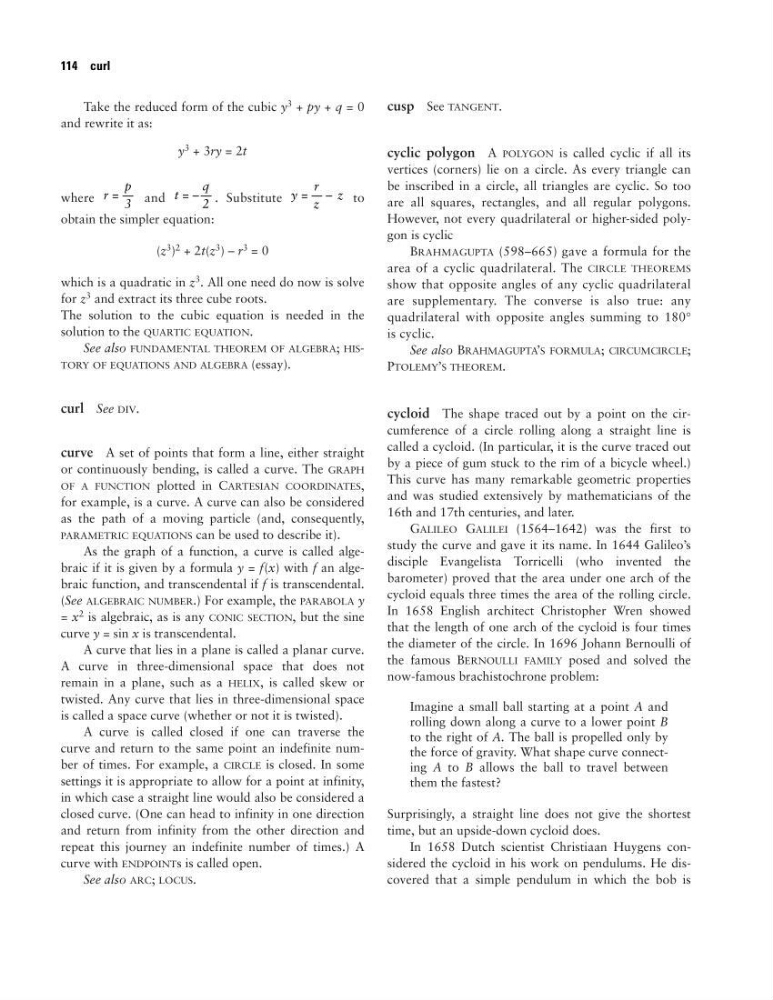
Take the reduced form of the cubic y
3 + py + q = 0
and rewrite it as:
y
3 + 3ry = 2t
where
and
. Substitute
to
obtain the simpler equation:
(z
3 )
2 + 2t(z
3 ) – r
3 = 0
which is a quadratic in z
3 . All one need do now is solve
for z
3 and extract its three cube roots.
The solution to the cubic equation is needed in the
solution to the QUARTIC EQUATION.
See also FUNDAMENTAL THEOREM OF ALGEBRA; HISTORY OF EQUATIONS AND ALGEBRA (essay).
curl See DIV.
curve A set of points that form a line, either straight
or continuously bending, is called a curve. The GRAPH
OF A FUNCTION plotted in CARTESIAN COORDINATES,
for example, is a curve. A curve can also be considered
as the path of a moving particle (and, consequently,
PARAMETRIC EQUATIONS can be used to describe it).
As the graph of a function, a curve is called algebraic if it is given by a formula y = f(x) with f an algebraic function, and transcendental if f is transcendental.
(See ALGEBRAIC NUMBER.) For example, the PARABOLA y
= x
2 is algebraic, as is any CONIC SECTION, but the sine
curve y = sin x is transcendental.
A curve that lies in a plane is called a planar curve.
A curve in three-dimensional space that does not
remain in a plane, such as a HELIX, is called skew or
twisted. Any curve that lies in three-dimensional space
is called a space curve (whether or not it is twisted).
A curve is called closed if one can traverse the
curve and return to the same point an indefinite number of times. For example, a CIRCLE is closed. In some
settings it is appropriate to allow for a point at infinity,
in which case a straight line would also be considered a
closed curve. (One can head to infinity in one direction
and return from infinity from the other direction and
repeat this journey an indefinite number of times.) A
curve with ENDPOINTs is called open.
See also ARC; LOCUS.
cusp See TANGENT.
cyclic polygon A POLYGON is called cyclic if all its
vertices (corners) lie on a circle. As every triangle can
be inscribed in a circle, all triangles are cyclic. So too
are all squares, rectangles, and all regular polygons.
However, not every quadrilateral or higher-sided polygon is cyclic
BRAHMAGUPTA (598–665) gave a formula for the
area of a cyclic quadrilateral. The CIRCLE THEOREMS
show that opposite angles of any cyclic quadrilateral
are supplementary. The converse is also true: any
quadrilateral with opposite angles summing to 180°
is cyclic.
See also BRAHMAGUPTA’S FORMULA; CIRCUMCIRCLE;
PTOLEMY’S THEOREM.
cycloid The shape traced out by a point on the circumference of a circle rolling along a straight line is
called a cycloid. (In particular, it is the curve traced out
by a piece of gum stuck to the rim of a bicycle wheel.)
This curve has many remarkable geometric properties
and was studied extensively by mathematicians of the
16th and 17th centuries, and later.
GALILEO GALILEI (1564–1642) was the first to
study the curve and gave it its name. In 1644 Galileo’s
disciple Evangelista Torricelli (who invented the
barometer) proved that the area under one arch of the
cycloid equals three times the area of the rolling circle.
In 1658 English architect Christopher Wren showed
that the length of one arch of the cycloid is four times
the diameter of the circle. In 1696 Johann Bernoulli of
the famous BERNOULLI FAMILY posed and solved the
now-famous brachistochrone problem:
Imagine a small ball starting at a point A and
rolling down along a curve to a lower point B
to the right of A. The ball is propelled only by
the force of gravity. What shape curve connecting A to B allows the ball to travel between
them the fastest?
Surprisingly, a straight line does not give the shortest
time, but an upside-down cycloid does.
In 1658 Dutch scientist Christiaan Huygens considered the cycloid in his work on pendulums. He discovered that a simple pendulum in which the bob is
r
y = — – z
z
q
t = – —
2
p
r = —
3
114 curl
3 + py + q = 0
and rewrite it as:
y
3 + 3ry = 2t
where
and
. Substitute
to
obtain the simpler equation:
(z
3 )
2 + 2t(z
3 ) – r
3 = 0
which is a quadratic in z
3 . All one need do now is solve
for z
3 and extract its three cube roots.
The solution to the cubic equation is needed in the
solution to the QUARTIC EQUATION.
See also FUNDAMENTAL THEOREM OF ALGEBRA; HISTORY OF EQUATIONS AND ALGEBRA (essay).
curl See DIV.
curve A set of points that form a line, either straight
or continuously bending, is called a curve. The GRAPH
OF A FUNCTION plotted in CARTESIAN COORDINATES,
for example, is a curve. A curve can also be considered
as the path of a moving particle (and, consequently,
PARAMETRIC EQUATIONS can be used to describe it).
As the graph of a function, a curve is called algebraic if it is given by a formula y = f(x) with f an algebraic function, and transcendental if f is transcendental.
(See ALGEBRAIC NUMBER.) For example, the PARABOLA y
= x
2 is algebraic, as is any CONIC SECTION, but the sine
curve y = sin x is transcendental.
A curve that lies in a plane is called a planar curve.
A curve in three-dimensional space that does not
remain in a plane, such as a HELIX, is called skew or
twisted. Any curve that lies in three-dimensional space
is called a space curve (whether or not it is twisted).
A curve is called closed if one can traverse the
curve and return to the same point an indefinite number of times. For example, a CIRCLE is closed. In some
settings it is appropriate to allow for a point at infinity,
in which case a straight line would also be considered a
closed curve. (One can head to infinity in one direction
and return from infinity from the other direction and
repeat this journey an indefinite number of times.) A
curve with ENDPOINTs is called open.
See also ARC; LOCUS.
cusp See TANGENT.
cyclic polygon A POLYGON is called cyclic if all its
vertices (corners) lie on a circle. As every triangle can
be inscribed in a circle, all triangles are cyclic. So too
are all squares, rectangles, and all regular polygons.
However, not every quadrilateral or higher-sided polygon is cyclic
BRAHMAGUPTA (598–665) gave a formula for the
area of a cyclic quadrilateral. The CIRCLE THEOREMS
show that opposite angles of any cyclic quadrilateral
are supplementary. The converse is also true: any
quadrilateral with opposite angles summing to 180°
is cyclic.
See also BRAHMAGUPTA’S FORMULA; CIRCUMCIRCLE;
PTOLEMY’S THEOREM.
cycloid The shape traced out by a point on the circumference of a circle rolling along a straight line is
called a cycloid. (In particular, it is the curve traced out
by a piece of gum stuck to the rim of a bicycle wheel.)
This curve has many remarkable geometric properties
and was studied extensively by mathematicians of the
16th and 17th centuries, and later.
GALILEO GALILEI (1564–1642) was the first to
study the curve and gave it its name. In 1644 Galileo’s
disciple Evangelista Torricelli (who invented the
barometer) proved that the area under one arch of the
cycloid equals three times the area of the rolling circle.
In 1658 English architect Christopher Wren showed
that the length of one arch of the cycloid is four times
the diameter of the circle. In 1696 Johann Bernoulli of
the famous BERNOULLI FAMILY posed and solved the
now-famous brachistochrone problem:
Imagine a small ball starting at a point A and
rolling down along a curve to a lower point B
to the right of A. The ball is propelled only by
the force of gravity. What shape curve connecting A to B allows the ball to travel between
them the fastest?
Surprisingly, a straight line does not give the shortest
time, but an upside-down cycloid does.
In 1658 Dutch scientist Christiaan Huygens considered the cycloid in his work on pendulums. He discovered that a simple pendulum in which the bob is
r
y = — – z
z
q
t = – —
2
p
r = —
3
114 curl