

(u
3 + v
3 ) + (3uv + p)(u + v) + q = 0
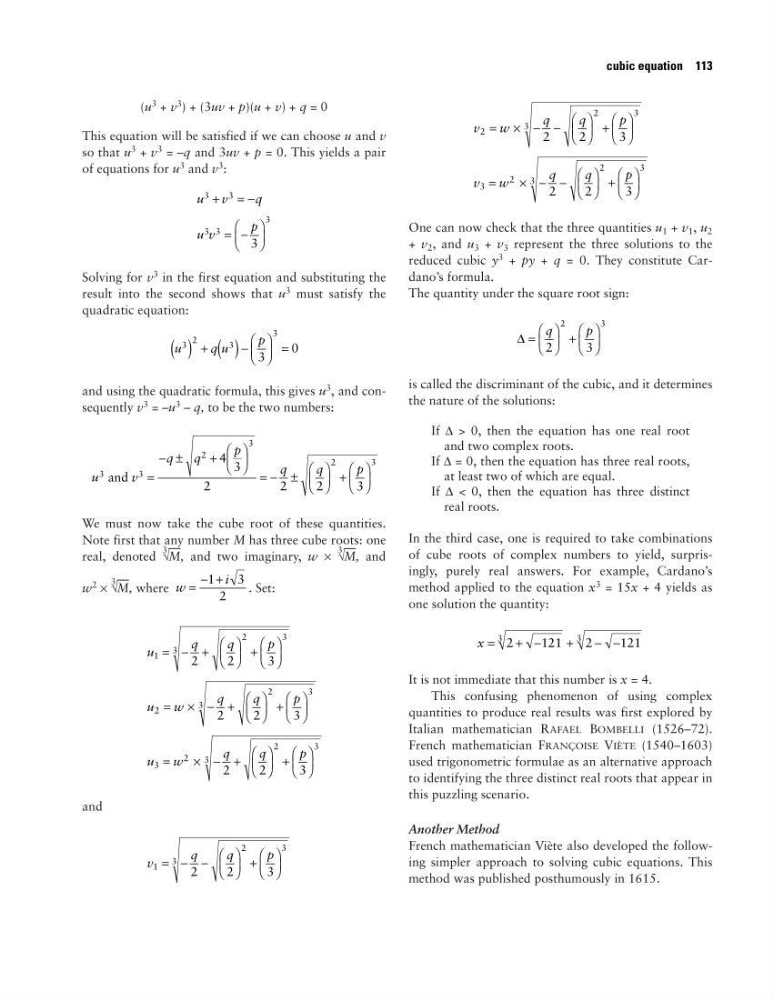
This equation will be satisfied if we can choose u and v
so that u
3 + v
3 = –q and 3uv + p = 0. This yields a pair
of equations for u
3 and v
3 :
Solving for v
3 in the first equation and substituting the
result into the second shows that u
3 must satisfy the
quadratic equation:
and using the quadratic formula, this gives u
3 , and consequently v
3 = –u
3 – q, to be the two numbers:
We must now take the cube root of these quantities.
Note first that any number M has three cube roots: one
real, denoted
3
√
–
M, and two imaginary, w ×
3
√
–
M, and
w
2
×
3
√
–
M, where
. Set:
and
One can now check that the three quantities u 1 + v 1 , u 2
+ v 2 , and u 3 + v 3 represent the three solutions to the
reduced cubic y
3 + py + q = 0. They constitute Cardano’s formula.
The quantity under the square root sign:
is called the discriminant of the cubic, and it determines
the nature of the solutions:
If ∆ > 0, then the equation has one real root
and two complex roots.
If ∆ = 0, then the equation has three real roots,
at least two of which are equal.
If ∆ < 0, then the equation has three distinct
real roots.
In the third case, one is required to take combinations
of cube roots of complex numbers to yield, surprisingly, purely real answers. For example, Cardano’s
method applied to the equation x 3 = 15x + 4 yields as
one solution the quantity:
It is not immediate that this number is x = 4.
This confusing phenomenon of using complex
quantities to produce real results was first explored by
Italian mathematician RAFAEL BOMBELLI (1526–72).
French mathematician FRANÇOISE VIÈTE (1540–1603)
used trigonometric formulae as an alternative approach
to identifying the three distinct real roots that appear in
this puzzling scenario.
Another Method
French mathematician Viète also developed the following simpler approach to solving cubic equations. This
method was published posthumously in 1615.
x =
+ −
+
− −
2
121
2
121
3
3
∆ =
+
q
p
2
3
2
3
v
w
q
q
p
v
w
q
q
p
2
2
3
3
3
2
2
3
3
2
2
3
2
2
3
= × − −
+
=
× − −
+
v
q
q
p
1
2
3
3
2
2
3
= − −
+
u
q
q
p
u
w
q
q
p
u
w
q
q
p
1
2
3
3
2
2
3
3
3
2
2
3
3
2
2
3
2
2
3
2
2
3
= − +
+
= × − +
+
=
× − +
+
w
i
=
− +
1
3
2
u
v
q
q
p
q
q
p
3
3
2
3
2
3
4 3
2
2
2
3
and
=
− ±
+
= − ±
+
u
qu
p
3
2
3
3
3
0
( ) + ( ) −
=
u v
q
u v
p
3
3
3 3
3
3
+ = −
= −
cubic equation 113
3 + v
3 ) + (3uv + p)(u + v) + q = 0
This equation will be satisfied if we can choose u and v
so that u
3 + v
3 = –q and 3uv + p = 0. This yields a pair
of equations for u
3 and v
3 :
Solving for v
3 in the first equation and substituting the
result into the second shows that u
3 must satisfy the
quadratic equation:
and using the quadratic formula, this gives u
3 , and consequently v
3 = –u
3 – q, to be the two numbers:
We must now take the cube root of these quantities.
Note first that any number M has three cube roots: one
real, denoted
3
√
–
M, and two imaginary, w ×
3
√
–
M, and
w
2
×
3
√
–
M, where
. Set:
and
One can now check that the three quantities u 1 + v 1 , u 2
+ v 2 , and u 3 + v 3 represent the three solutions to the
reduced cubic y
3 + py + q = 0. They constitute Cardano’s formula.
The quantity under the square root sign:
is called the discriminant of the cubic, and it determines
the nature of the solutions:
If ∆ > 0, then the equation has one real root
and two complex roots.
If ∆ = 0, then the equation has three real roots,
at least two of which are equal.
If ∆ < 0, then the equation has three distinct
real roots.
In the third case, one is required to take combinations
of cube roots of complex numbers to yield, surprisingly, purely real answers. For example, Cardano’s
method applied to the equation x 3 = 15x + 4 yields as
one solution the quantity:
It is not immediate that this number is x = 4.
This confusing phenomenon of using complex
quantities to produce real results was first explored by
Italian mathematician RAFAEL BOMBELLI (1526–72).
French mathematician FRANÇOISE VIÈTE (1540–1603)
used trigonometric formulae as an alternative approach
to identifying the three distinct real roots that appear in
this puzzling scenario.
Another Method
French mathematician Viète also developed the following simpler approach to solving cubic equations. This
method was published posthumously in 1615.
x =
+ −
+
− −
2
121
2
121
3
3
∆ =
+
q
p
2
3
2
3
v
w
q
q
p
v
w
q
q
p
2
2
3
3
3
2
2
3
3
2
2
3
2
2
3
= × − −
+
=
× − −
+
v
q
q
p
1
2
3
3
2
2
3
= − −
+
u
q
q
p
u
w
q
q
p
u
w
q
q
p
1
2
3
3
2
2
3
3
3
2
2
3
3
2
2
3
2
2
3
2
2
3
= − +
+
= × − +
+
=
× − +
+
w
i
=
− +
1
3
2
u
v
q
q
p
q
q
p
3
3
2
3
2
3
4 3
2
2
2
3
and
=
− ±
+
= − ±
+
u
qu
p
3
2
3
3
3
0
( ) + ( ) −
=
u v
q
u v
p
3
3
3 3
3
3
+ = −
= −
cubic equation 113