

i
i
“MPSI-fin” — 2013/7/22 — 9:45 — page 657 — #665
i
i
i
i
i
i
Exercices Corrigés
CORRIGÉS
pH
E /V
0
7,0
14,0
0,2
0,4
0,6
0,8
-0,2
-0,4
-0,6
-0,8
-1,0
1,0
1,2
1,4
S
S 2HS -
H 2 S
HSO 4
-
SO 4
2IO 3
-
I 3
-
I -
6. 1ère étape : le diiode en présence d’ions iodure est transformé en complexe I –
3 :
I 2 + I
−
=
I
−
3 .
En milieu basique, l’ion I –
3 se dismute en ions iodure et en ions iodate IO –
3 :
3 I
−
3
+ 6 HO
−
=
8 I
−
+ IO
−
3
+ 3 H 2 O.
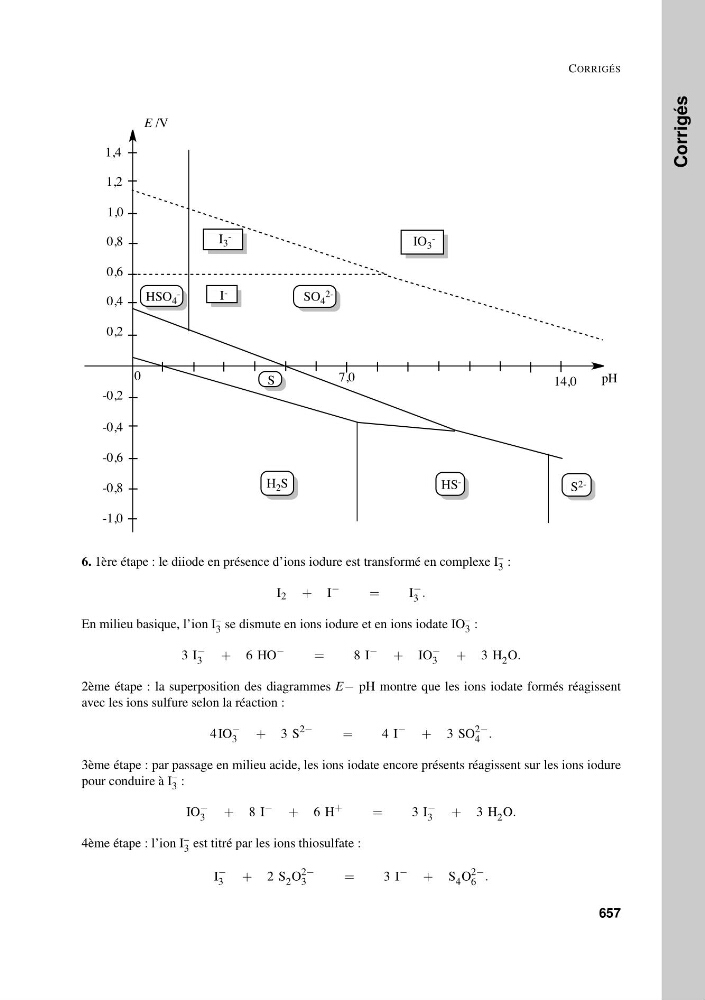
2ème étape : la superposition des diagrammes E− pH montre que les ions iodate formés réagissent
avec les ions sulfure selon la réaction :
4 IO
−
3
+ 3 S
2−
=
4 I
−
+ 3 SO
2−
4 .
3ème étape : par passage en milieu acide, les ions iodate encore présents réagissent sur les ions iodure
pour conduire à I –
3 :
IO
−
3
+ 8 I
−
+ 6 H
+
=
3 I
−
3
+ 3 H 2 O.
4ème étape : l’ion I –
3 est titré par les ions thiosulfate :
I
−
3
+ 2 S 2 O
2−
3
=
3 I
−
+ S 4 O
2−
6 .
657
i
“MPSI-fin” — 2013/7/22 — 9:45 — page 657 — #665
i
i
i
i
i
i
Exercices Corrigés
CORRIGÉS
pH
E /V
0
7,0
14,0
0,2
0,4
0,6
0,8
-0,2
-0,4
-0,6
-0,8
-1,0
1,0
1,2
1,4
S
S 2HS -
H 2 S
HSO 4
-
SO 4
2IO 3
-
I 3
-
I -
6. 1ère étape : le diiode en présence d’ions iodure est transformé en complexe I –
3 :
I 2 + I
−
=
I
−
3 .
En milieu basique, l’ion I –
3 se dismute en ions iodure et en ions iodate IO –
3 :
3 I
−
3
+ 6 HO
−
=
8 I
−
+ IO
−
3
+ 3 H 2 O.
2ème étape : la superposition des diagrammes E− pH montre que les ions iodate formés réagissent
avec les ions sulfure selon la réaction :
4 IO
−
3
+ 3 S
2−
=
4 I
−
+ 3 SO
2−
4 .
3ème étape : par passage en milieu acide, les ions iodate encore présents réagissent sur les ions iodure
pour conduire à I –
3 :
IO
−
3
+ 8 I
−
+ 6 H
+
=
3 I
−
3
+ 3 H 2 O.
4ème étape : l’ion I –
3 est titré par les ions thiosulfate :
I
−
3
+ 2 S 2 O
2−
3
=
3 I
−
+ S 4 O
2−
6 .
657