

5G Mobile Networks: Requirements, Enabling Technologies, and Research Activities 47
Although network slicing has been widely recognized as the key characteristic of
5G by many network operators and vendors, it has not yet been standardized, thus there
are variants of defining what slicing is. According to ITU‐T in [30], slicing is the basic
concept of the Network Softwarization. It allows logically isolated network partitions
(LINP), with a slice being considered as a unit of programmable resources such as
network, computation and storage. As NGMN defined in its white paper [2], a network
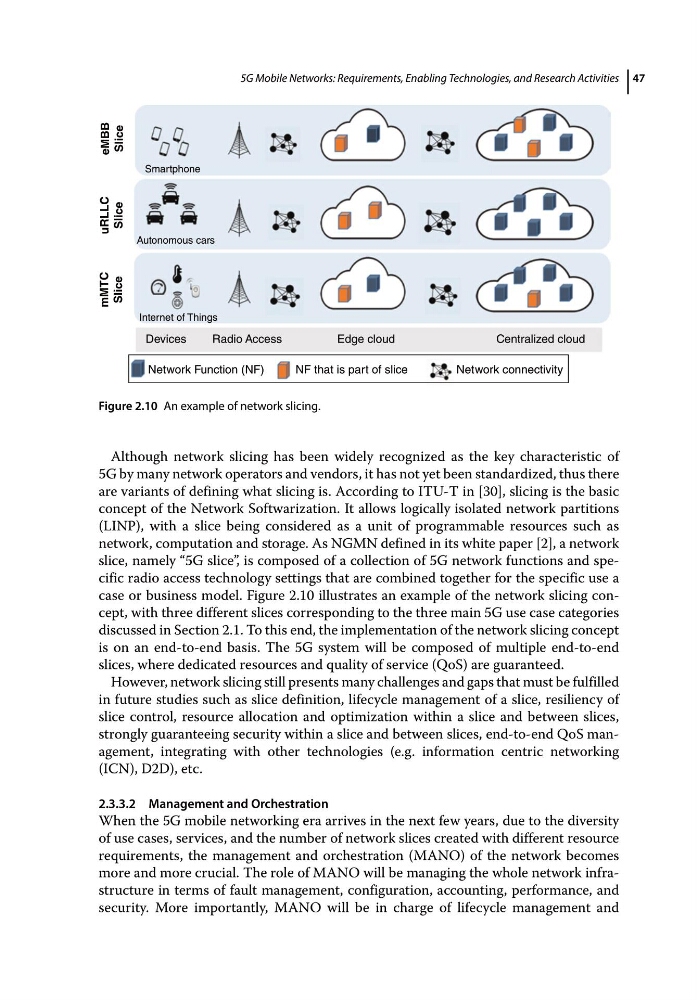
slice, namely “5G slice”, is composed of a collection of 5G network functions and specific radio access technology settings that are combined together for the specific use a
case or business model. Figure 2.10 illustrates an example of the network slicing concept, with three different slices corresponding to the three main 5G use case categories
discussed in Section 2.1. To this end, the implementation of the network slicing concept
is on an end‐to‐end basis. The 5G system will be composed of multiple end‐to‐end
slices, where dedicated resources and quality of service (QoS) are guaranteed.
However, network slicing still presents many challenges and gaps that must be fulfilled
in future studies such as slice definition, lifecycle management of a slice, resiliency of
slice control, resource allocation and optimization within a slice and between slices,
strongly guaranteeing security within a slice and between slices, end‐to‐end QoS management, integrating with other technologies (e.g. information centric networking
(ICN), D2D), etc.
2.3.3.2 Management and Orchestration
When the 5G mobile networking era arrives in the next few years, due to the diversity
of use cases, services, and the number of network slices created with different resource
requirements, the management and orchestration (MANO) of the network becomes
more and more crucial. The role of MANO will be managing the whole network infrastructure in terms of fault management, configuration, accounting, performance, and
security. More importantly, MANO will be in charge of lifecycle management and
Smartphone
Autonomous cars
Internet of Things
Network Function (NF)
NF that is part of slice
Network connectivity
Devices
Radio Access
Edge cloud
Centralized cloud
eMBB
Slice
uRLLC
Slice
mMTC
Slice
Figure 2.10 An example of network slicing.
Although network slicing has been widely recognized as the key characteristic of
5G by many network operators and vendors, it has not yet been standardized, thus there
are variants of defining what slicing is. According to ITU‐T in [30], slicing is the basic
concept of the Network Softwarization. It allows logically isolated network partitions
(LINP), with a slice being considered as a unit of programmable resources such as
network, computation and storage. As NGMN defined in its white paper [2], a network
slice, namely “5G slice”, is composed of a collection of 5G network functions and specific radio access technology settings that are combined together for the specific use a
case or business model. Figure 2.10 illustrates an example of the network slicing concept, with three different slices corresponding to the three main 5G use case categories
discussed in Section 2.1. To this end, the implementation of the network slicing concept
is on an end‐to‐end basis. The 5G system will be composed of multiple end‐to‐end
slices, where dedicated resources and quality of service (QoS) are guaranteed.
However, network slicing still presents many challenges and gaps that must be fulfilled
in future studies such as slice definition, lifecycle management of a slice, resiliency of
slice control, resource allocation and optimization within a slice and between slices,
strongly guaranteeing security within a slice and between slices, end‐to‐end QoS management, integrating with other technologies (e.g. information centric networking
(ICN), D2D), etc.
2.3.3.2 Management and Orchestration
When the 5G mobile networking era arrives in the next few years, due to the diversity
of use cases, services, and the number of network slices created with different resource
requirements, the management and orchestration (MANO) of the network becomes
more and more crucial. The role of MANO will be managing the whole network infrastructure in terms of fault management, configuration, accounting, performance, and
security. More importantly, MANO will be in charge of lifecycle management and
Smartphone
Autonomous cars
Internet of Things
Network Function (NF)
NF that is part of slice
Network connectivity
Devices
Radio Access
Edge cloud
Centralized cloud
eMBB
Slice
uRLLC
Slice
mMTC
Slice
Figure 2.10 An example of network slicing.