

Nguyen, Brunstrom, Grinnemo, and Taheri
40
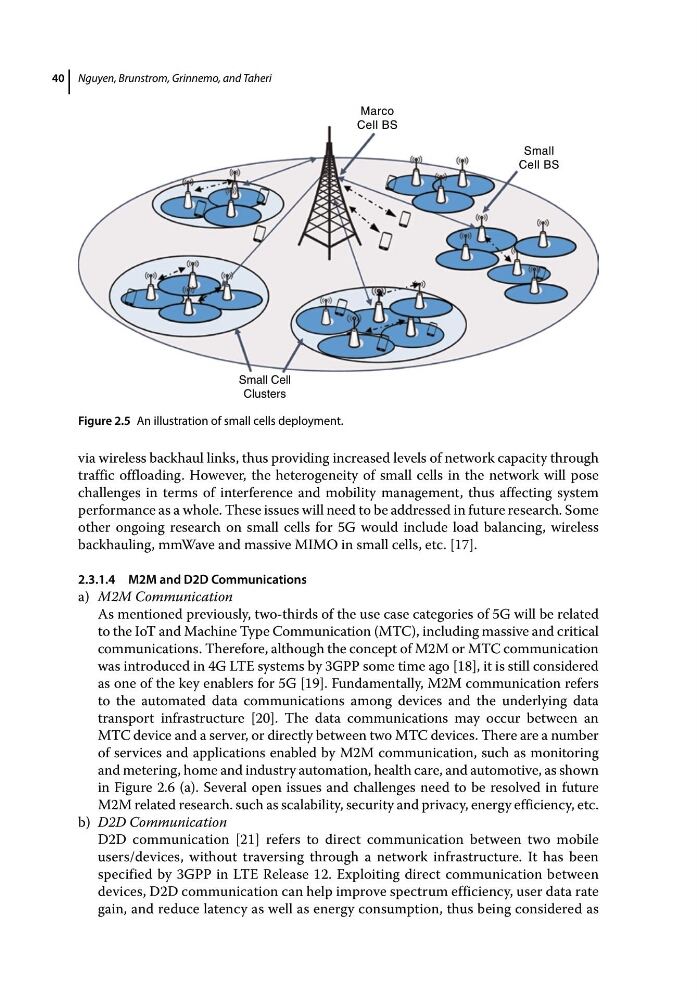
via wireless backhaul links, thus providing increased levels of network capacity through
traffic offloading. However, the heterogeneity of small cells in the network will pose
challenges in terms of interference and mobility management, thus affecting system
performance as a whole. These issues will need to be addressed in future research. Some
other ongoing research on small cells for 5G would include load balancing, wireless
backhauling, mmWave and massive MIMO in small cells, etc. [17].
2.3.1.4 M2M and D2D Communications
a) M2M Communication
As mentioned previously, two‐thirds of the use case categories of 5G will be related
to the IoT and Machine Type Communication (MTC), including massive and critical
communications. Therefore, although the concept of M2M or MTC communication
was introduced in 4G LTE systems by 3GPP some time ago [18], it is still considered
as one of the key enablers for 5G [19]. Fundamentally, M2M communication refers
to the automated data communications among devices and the underlying data
transport infrastructure [20]. The data communications may occur between an
MTC device and a server, or directly between two MTC devices. There are a number
of services and applications enabled by M2M communication, such as monitoring
and metering, home and industry automation, health care, and automotive, as shown
in Figure 2.6 (a). Several open issues and challenges need to be resolved in future
M2M related research. such as scalability, security and privacy, energy efficiency, etc.
b) D2D Communication
D2D communication [21] refers to direct communication between two mobile
users/devices, without traversing through a network infrastructure. It has been
specified by 3GPP in LTE Release 12. Exploiting direct communication between
devices, D2D communication can help improve spectrum efficiency, user data rate
gain, and reduce latency as well as energy consumption, thus being considered as
Marco
Cell BS
Small
Cell BS
Small Cell
Clusters
Figure 2.5 An illustration of small cells deployment.
40
via wireless backhaul links, thus providing increased levels of network capacity through
traffic offloading. However, the heterogeneity of small cells in the network will pose
challenges in terms of interference and mobility management, thus affecting system
performance as a whole. These issues will need to be addressed in future research. Some
other ongoing research on small cells for 5G would include load balancing, wireless
backhauling, mmWave and massive MIMO in small cells, etc. [17].
2.3.1.4 M2M and D2D Communications
a) M2M Communication
As mentioned previously, two‐thirds of the use case categories of 5G will be related
to the IoT and Machine Type Communication (MTC), including massive and critical
communications. Therefore, although the concept of M2M or MTC communication
was introduced in 4G LTE systems by 3GPP some time ago [18], it is still considered
as one of the key enablers for 5G [19]. Fundamentally, M2M communication refers
to the automated data communications among devices and the underlying data
transport infrastructure [20]. The data communications may occur between an
MTC device and a server, or directly between two MTC devices. There are a number
of services and applications enabled by M2M communication, such as monitoring
and metering, home and industry automation, health care, and automotive, as shown
in Figure 2.6 (a). Several open issues and challenges need to be resolved in future
M2M related research. such as scalability, security and privacy, energy efficiency, etc.
b) D2D Communication
D2D communication [21] refers to direct communication between two mobile
users/devices, without traversing through a network infrastructure. It has been
specified by 3GPP in LTE Release 12. Exploiting direct communication between
devices, D2D communication can help improve spectrum efficiency, user data rate
gain, and reduce latency as well as energy consumption, thus being considered as
Marco
Cell BS
Small
Cell BS
Small Cell
Clusters
Figure 2.5 An illustration of small cells deployment.