

Nguyen, Brunstrom, Grinnemo, and Taheri
34
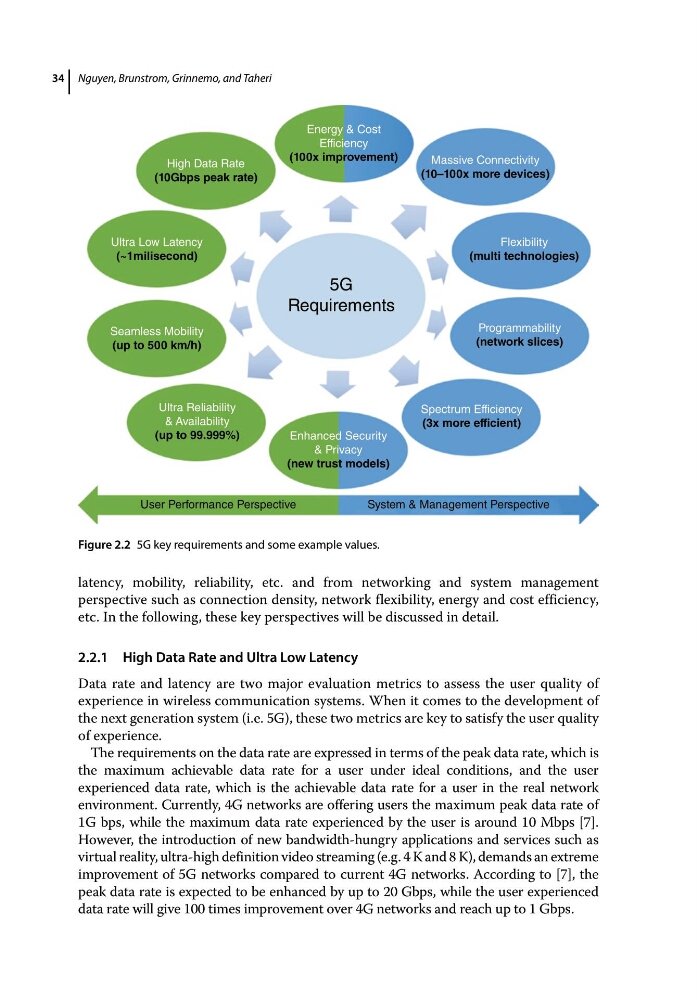
latency, mobility, reliability, etc. and from networking and system management
perspective such as connection density, network flexibility, energy and cost efficiency,
etc. In the following, these key perspectives will be discussed in detail.
2.2.1 High Data Rate and Ultra Low Latency
Data rate and latency are two major evaluation metrics to assess the user quality of
experience in wireless communication systems. When it comes to the development of
the next generation system (i.e. 5G), these two metrics are key to satisfy the user quality
of experience.
The requirements on the data rate are expressed in terms of the peak data rate, which is
the maximum achievable data rate for a user under ideal conditions, and the user
experienced data rate, which is the achievable data rate for a user in the real network
environment. Currently, 4G networks are offering users the maximum peak data rate of
1G bps, while the maximum data rate experienced by the user is around 10 Mbps [7].
However, the introduction of new bandwidth‐hungry applications and services such as
virtual reality, ultra‐high definition video streaming (e.g. 4 K and 8 K), demands an extreme
improvement of 5G networks compared to current 4G networks. According to [7], the
peak data rate is expected to be enhanced by up to 20 Gbps, while the user experienced
data rate will give 100 times improvement over 4G networks and reach up to 1 Gbps.
Energy & Cost
Efficiency
(100x improvement)
High Data Rate
(10Gbps peak rate)
Ultra Low Latency
(~1milisecond)
Massive Connectivity
(10–100x more devices)
Flexibility
(multi technologies)
Seamless Mobility
(up to 500 km/h)
Ultra Reliability
& Availability
(up to 99.999%)
Enhanced Security
& Privacy
(new trust models)
User Performance Perspective
S ystem & Management Perspective
Spectrum Efficiency
(3x more efficient)
Programmability
(network slices)
5G
Requirements
Figure 2.2 5G key requirements and some example values.
34
latency, mobility, reliability, etc. and from networking and system management
perspective such as connection density, network flexibility, energy and cost efficiency,
etc. In the following, these key perspectives will be discussed in detail.
2.2.1 High Data Rate and Ultra Low Latency
Data rate and latency are two major evaluation metrics to assess the user quality of
experience in wireless communication systems. When it comes to the development of
the next generation system (i.e. 5G), these two metrics are key to satisfy the user quality
of experience.
The requirements on the data rate are expressed in terms of the peak data rate, which is
the maximum achievable data rate for a user under ideal conditions, and the user
experienced data rate, which is the achievable data rate for a user in the real network
environment. Currently, 4G networks are offering users the maximum peak data rate of
1G bps, while the maximum data rate experienced by the user is around 10 Mbps [7].
However, the introduction of new bandwidth‐hungry applications and services such as
virtual reality, ultra‐high definition video streaming (e.g. 4 K and 8 K), demands an extreme
improvement of 5G networks compared to current 4G networks. According to [7], the
peak data rate is expected to be enhanced by up to 20 Gbps, while the user experienced
data rate will give 100 times improvement over 4G networks and reach up to 1 Gbps.
Energy & Cost
Efficiency
(100x improvement)
High Data Rate
(10Gbps peak rate)
Ultra Low Latency
(~1milisecond)
Massive Connectivity
(10–100x more devices)
Flexibility
(multi technologies)
Seamless Mobility
(up to 500 km/h)
Ultra Reliability
& Availability
(up to 99.999%)
Enhanced Security
& Privacy
(new trust models)
User Performance Perspective
S ystem & Management Perspective
Spectrum Efficiency
(3x more efficient)
Programmability
(network slices)
5G
Requirements
Figure 2.2 5G key requirements and some example values.