

Evolution of Cellular Systems 25
In the framework of 4G systems, both the air interface and the radio access network are
being improved or redefined, but so far the core network architecture, that is, the EPC, is
not undergoing major changes from the previously standardized SAE architecture.
Therefore, in this section, an overview of the E‐UTRAN architecture and functionalities
is given, which are defined for the LTE‐Advanced systems and the main EPC node functionalities, shared by Releases 8, 9 and 10.
Enhanced Node B is the core part of the E‐UTRAN architecture. It provides the air
interface towards the UE. Each eNB is considered as the logical component that serves
one or more several E‐UTRAN cells. The target of this technology is to increase coverage, higher data rates, better QoS performance and fairness for the users. The EPC is a
flat all‐IP based core network. It can be accessed through 3GPP radio access, which
allows the handover procedure. The Mobility Management Entity (MME), Serving
Gateway (S‐GW), and Packet Data Network Gateway (PDN‐GW) work in a similar way
to the LTE network architecture [26].
1.7.3 Beyond 3G and 4G Cellular Systems Security
Fourth generation cellular networks promise to provide higher user data rates, lower
latency and a complete internet protocol (IP)‐based network architecture. The major
difference between the 3G and 4G cellular networks is that 4G operates entirely on IP
protocol and architecture. For this reason, WiMAX is also considered as part of 4G
networks. While discussing beyond 3G technologies, the major underlying technology
in use is the LTE. Even though a similarity can be drawn between LTE and WiMAX,
because of the IP‐based protocol and architecture, they differ from each other in network architecture and security. The all IP‐based infrastructure brings up increased
security issues compared with the previous generation cellular technologies. For this
Internet
P-GW
MME
EPC
E-UTRAN
MS
MS
MS
MS
Relay Node
eNB
eNB
S-GW
HeNB
HeNB-GW
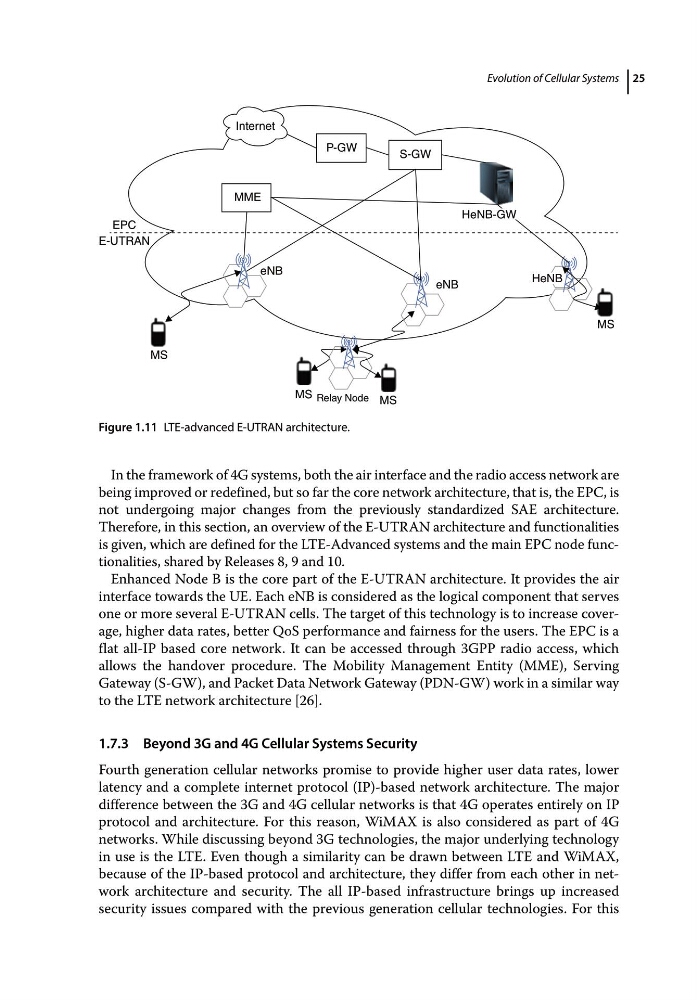
Figure 1.11 LTE‐advanced E‐UTRAN architecture.
In the framework of 4G systems, both the air interface and the radio access network are
being improved or redefined, but so far the core network architecture, that is, the EPC, is
not undergoing major changes from the previously standardized SAE architecture.
Therefore, in this section, an overview of the E‐UTRAN architecture and functionalities
is given, which are defined for the LTE‐Advanced systems and the main EPC node functionalities, shared by Releases 8, 9 and 10.
Enhanced Node B is the core part of the E‐UTRAN architecture. It provides the air
interface towards the UE. Each eNB is considered as the logical component that serves
one or more several E‐UTRAN cells. The target of this technology is to increase coverage, higher data rates, better QoS performance and fairness for the users. The EPC is a
flat all‐IP based core network. It can be accessed through 3GPP radio access, which
allows the handover procedure. The Mobility Management Entity (MME), Serving
Gateway (S‐GW), and Packet Data Network Gateway (PDN‐GW) work in a similar way
to the LTE network architecture [26].
1.7.3 Beyond 3G and 4G Cellular Systems Security
Fourth generation cellular networks promise to provide higher user data rates, lower
latency and a complete internet protocol (IP)‐based network architecture. The major
difference between the 3G and 4G cellular networks is that 4G operates entirely on IP
protocol and architecture. For this reason, WiMAX is also considered as part of 4G
networks. While discussing beyond 3G technologies, the major underlying technology
in use is the LTE. Even though a similarity can be drawn between LTE and WiMAX,
because of the IP‐based protocol and architecture, they differ from each other in network architecture and security. The all IP‐based infrastructure brings up increased
security issues compared with the previous generation cellular technologies. For this
Internet
P-GW
MME
EPC
E-UTRAN
MS
MS
MS
MS
Relay Node
eNB
eNB
S-GW
HeNB
HeNB-GW
Figure 1.11 LTE‐advanced E‐UTRAN architecture.