

Shahabuddin, Rahaman, Rehman, Ahmad, and Khan
14
1.4.5.5 COMP128
COMP128 is technically a hash function, which is the implementation of A3 and A8
algorithms in the GSM standard. It is used to provide authentication and helps
derive the cipher key (A3/8). GSM allows every operator to use their own A3/8
algorithm, and all the systems support this without the need for a transfer between
the networks, even during roaming. However, the operators normally use, for example,
COMP128 design, because it requires certain levels of expertise to make their own
A3/8 algorithm.
1.4.5.6 A5 Algorithm
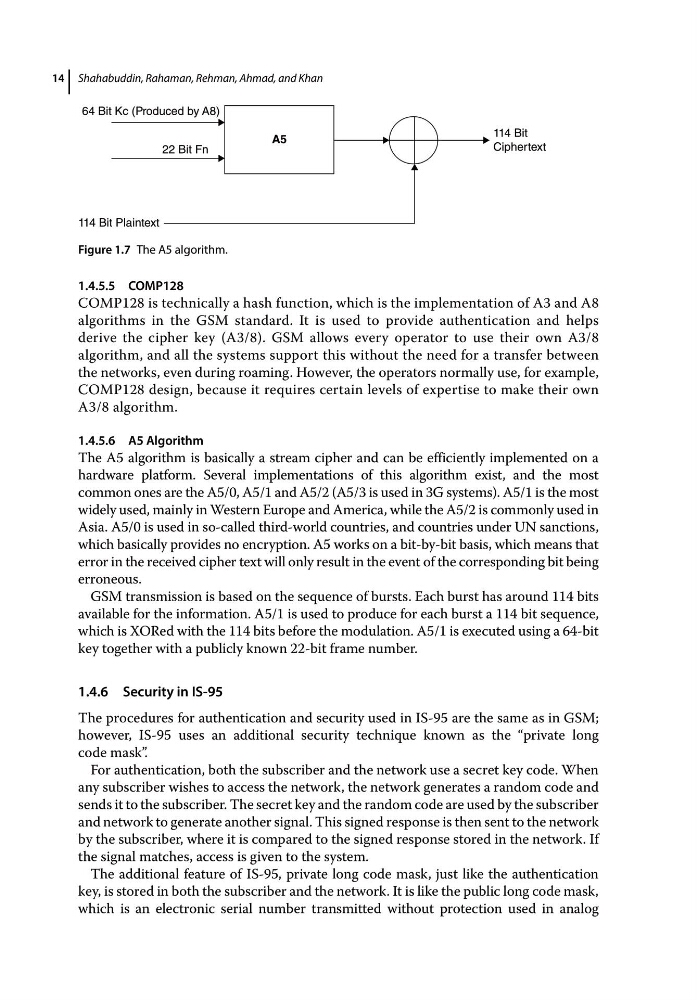
The A5 algorithm is basically a stream cipher and can be efficiently implemented on a
hardware platform. Several implementations of this algorithm exist, and the most
common ones are the A5/0, A5/1 and A5/2 (A5/3 is used in 3G systems). A5/1 is the most
widely used, mainly in Western Europe and America, while the A5/2 is commonly used in
Asia. A5/0 is used in so‐called third‐world countries, and countries under UN sanctions,
which basically provides no encryption. A5 works on a bit‐by‐bit basis, which means that
error in the received cipher text will only result in the event of the corresponding bit being
erroneous.
GSM transmission is based on the sequence of bursts. Each burst has around 114 bits
available for the information. A5/1 is used to produce for each burst a 114 bit sequence,
which is XORed with the 114 bits before the modulation. A5/1 is executed using a 64‐bit
key together with a publicly known 22‐bit frame number.
1.4.6 Security in IS‐95
The procedures for authentication and security used in IS‐95 are the same as in GSM;
however, IS‐95 uses an additional security technique known as the “private long
code mask”.
For authentication, both the subscriber and the network use a secret key code. When
any subscriber wishes to access the network, the network generates a random code and
sends it to the subscriber. The secret key and the random code are used by the subscriber
and network to generate another signal. This signed response is then sent to the network
by the subscriber, where it is compared to the signed response stored in the network. If
the signal matches, access is given to the system.
The additional feature of IS‐95, private long code mask, just like the authentication
key, is stored in both the subscriber and the network. It is like the public long code mask,
which is an electronic serial number transmitted without protection used in analog
114 Bit Plaintext
64 Bit Kc (Produced by A8)
114 Bit
Ciphertext
A5
22 Bit Fn
Figure 1.7 The A5 algorithm.
14
1.4.5.5 COMP128
COMP128 is technically a hash function, which is the implementation of A3 and A8
algorithms in the GSM standard. It is used to provide authentication and helps
derive the cipher key (A3/8). GSM allows every operator to use their own A3/8
algorithm, and all the systems support this without the need for a transfer between
the networks, even during roaming. However, the operators normally use, for example,
COMP128 design, because it requires certain levels of expertise to make their own
A3/8 algorithm.
1.4.5.6 A5 Algorithm
The A5 algorithm is basically a stream cipher and can be efficiently implemented on a
hardware platform. Several implementations of this algorithm exist, and the most
common ones are the A5/0, A5/1 and A5/2 (A5/3 is used in 3G systems). A5/1 is the most
widely used, mainly in Western Europe and America, while the A5/2 is commonly used in
Asia. A5/0 is used in so‐called third‐world countries, and countries under UN sanctions,
which basically provides no encryption. A5 works on a bit‐by‐bit basis, which means that
error in the received cipher text will only result in the event of the corresponding bit being
erroneous.
GSM transmission is based on the sequence of bursts. Each burst has around 114 bits
available for the information. A5/1 is used to produce for each burst a 114 bit sequence,
which is XORed with the 114 bits before the modulation. A5/1 is executed using a 64‐bit
key together with a publicly known 22‐bit frame number.
1.4.6 Security in IS‐95
The procedures for authentication and security used in IS‐95 are the same as in GSM;
however, IS‐95 uses an additional security technique known as the “private long
code mask”.
For authentication, both the subscriber and the network use a secret key code. When
any subscriber wishes to access the network, the network generates a random code and
sends it to the subscriber. The secret key and the random code are used by the subscriber
and network to generate another signal. This signed response is then sent to the network
by the subscriber, where it is compared to the signed response stored in the network. If
the signal matches, access is given to the system.
The additional feature of IS‐95, private long code mask, just like the authentication
key, is stored in both the subscriber and the network. It is like the public long code mask,
which is an electronic serial number transmitted without protection used in analog
114 Bit Plaintext
64 Bit Kc (Produced by A8)
114 Bit
Ciphertext
A5
22 Bit Fn
Figure 1.7 The A5 algorithm.