

Criteria (Regulatory
objectives)
Government regulation
Industry self‐regulation
Consumer or market regulation
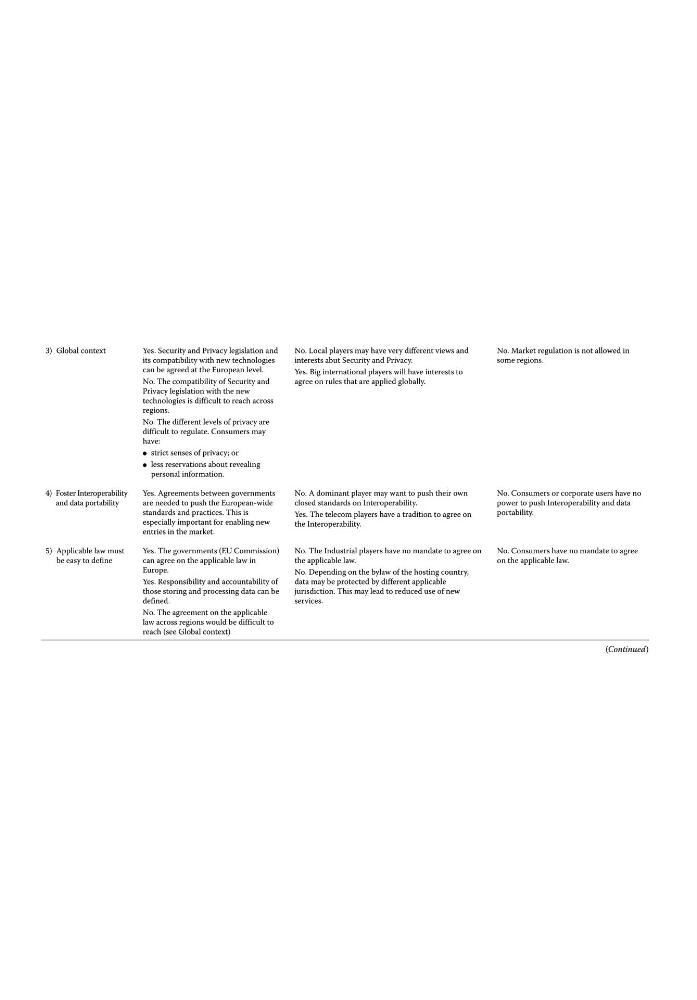
3) Global context
Yes. Security and Privacy legislation and
its compatibility with new technologies
can be agreed at the European level.
No. The compatibility of Security and
Privacy legislation with the new
technologies is difficult to reach across
regions.
No. The different levels of privacy are
difficult to regulate. Consumers may
have:
● strict senses of privacy; or
● less reservations about revealing
personal information.
No. Local players may have very different views and
interests abut Security and Privacy.
Yes. Big international players will have interests to
agree on rules that are applied globally.
No. Market regulation is not allowed in
some regions.
4) Foster Interoperability
and data portability
Yes. Agreements between governments
are needed to push the European‐wide
standards and practices. This is
especially important for enabling new
entries in the market.
No. A dominant player may want to push their own
closed standards on Interoperability.
Yes. The telecom players have a tradition to agree on
the Interoperability.
No. Consumers or corporate users have no
power to push Interoperability and data
portability.
5) Applicable law must
be easy to define
Yes. The governments (EU Commission)
can agree on the applicable law in
Europe.
Yes. Responsibility and accountability of
those storing and processing data can be
defined.
No. The agreement on the applicable
law across regions would be difficult to
reach (see Global context)
No. The Industrial players have no mandate to agree on
the applicable law.
No. Depending on the bylaw of the hosting country,
data may be protected by different applicable
jurisdiction. This may lead to reduced use of new
services.
No. Consumers have no mandate to agree
on the applicable law.
(Continued)
objectives)
Government regulation
Industry self‐regulation
Consumer or market regulation
3) Global context
Yes. Security and Privacy legislation and
its compatibility with new technologies
can be agreed at the European level.
No. The compatibility of Security and
Privacy legislation with the new
technologies is difficult to reach across
regions.
No. The different levels of privacy are
difficult to regulate. Consumers may
have:
● strict senses of privacy; or
● less reservations about revealing
personal information.
No. Local players may have very different views and
interests abut Security and Privacy.
Yes. Big international players will have interests to
agree on rules that are applied globally.
No. Market regulation is not allowed in
some regions.
4) Foster Interoperability
and data portability
Yes. Agreements between governments
are needed to push the European‐wide
standards and practices. This is
especially important for enabling new
entries in the market.
No. A dominant player may want to push their own
closed standards on Interoperability.
Yes. The telecom players have a tradition to agree on
the Interoperability.
No. Consumers or corporate users have no
power to push Interoperability and data
portability.
5) Applicable law must
be easy to define
Yes. The governments (EU Commission)
can agree on the applicable law in
Europe.
Yes. Responsibility and accountability of
those storing and processing data can be
defined.
No. The agreement on the applicable
law across regions would be difficult to
reach (see Global context)
No. The Industrial players have no mandate to agree on
the applicable law.
No. Depending on the bylaw of the hosting country,
data may be protected by different applicable
jurisdiction. This may lead to reduced use of new
services.
No. Consumers have no mandate to agree
on the applicable law.
(Continued)