

Cloud and MEC Security 377
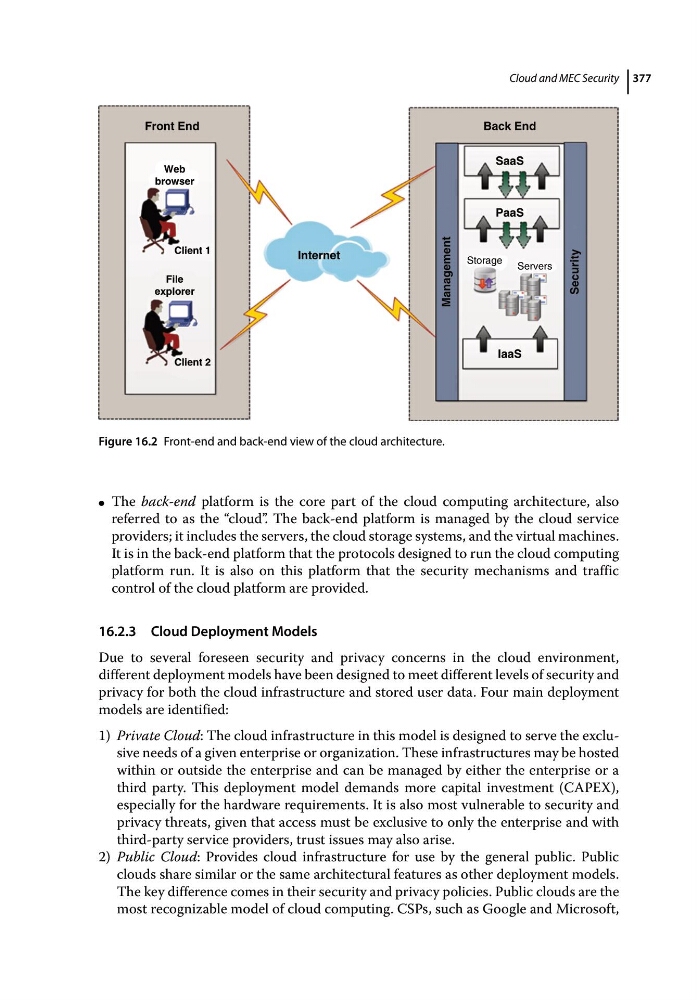
● The back‐end platform is the core part of the cloud computing architecture, also
referred to as the “cloud”. The back‐end platform is managed by the cloud service
providers; it includes the servers, the cloud storage systems, and the virtual machines.
It is in the back‐end platform that the protocols designed to run the cloud computing
platform run. It is also on this platform that the security mechanisms and traffic
control of the cloud platform are provided.
16.2.3 Cloud Deployment Models
Due to several foreseen security and privacy concerns in the cloud environment,
different deployment models have been designed to meet different levels of security and
privacy for both the cloud infrastructure and stored user data. Four main deployment
models are identified:
1) Private Cloud: The cloud infrastructure in this model is designed to serve the exclusive needs of a given enterprise or organization. These infrastructures may be hosted
within or outside the enterprise and can be managed by either the enterprise or a
third party. This deployment model demands more capital investment (CAPEX),
especially for the hardware requirements. It is also most vulnerable to security and
privacy threats, given that access must be exclusive to only the enterprise and with
third‐party service providers, trust issues may also arise.
2) Public Cloud: Provides cloud infrastructure for use by the general public. Public
clouds share similar or the same architectural features as other deployment models.
The key difference comes in their security and privacy policies. Public clouds are the
most recognizable model of cloud computing. CSPs, such as Google and Microsoft,
Internet
Client 1
Web
browser
Front End
Back End
SaaS
PaaS
IaaS
Storage Servers
File
explorer
Client 2
Management
Security
Figure 16.2 Front‐end and back‐end view of the cloud architecture.
● The back‐end platform is the core part of the cloud computing architecture, also
referred to as the “cloud”. The back‐end platform is managed by the cloud service
providers; it includes the servers, the cloud storage systems, and the virtual machines.
It is in the back‐end platform that the protocols designed to run the cloud computing
platform run. It is also on this platform that the security mechanisms and traffic
control of the cloud platform are provided.
16.2.3 Cloud Deployment Models
Due to several foreseen security and privacy concerns in the cloud environment,
different deployment models have been designed to meet different levels of security and
privacy for both the cloud infrastructure and stored user data. Four main deployment
models are identified:
1) Private Cloud: The cloud infrastructure in this model is designed to serve the exclusive needs of a given enterprise or organization. These infrastructures may be hosted
within or outside the enterprise and can be managed by either the enterprise or a
third party. This deployment model demands more capital investment (CAPEX),
especially for the hardware requirements. It is also most vulnerable to security and
privacy threats, given that access must be exclusive to only the enterprise and with
third‐party service providers, trust issues may also arise.
2) Public Cloud: Provides cloud infrastructure for use by the general public. Public
clouds share similar or the same architectural features as other deployment models.
The key difference comes in their security and privacy policies. Public clouds are the
most recognizable model of cloud computing. CSPs, such as Google and Microsoft,
Internet
Client 1
Web
browser
Front End
Back End
SaaS
PaaS
IaaS
Storage Servers
File
explorer
Client 2
Management
Security
Figure 16.2 Front‐end and back‐end view of the cloud architecture.