

Okwuibe, Liyanage, Ahmad, and Ylianttila
376
concept, with big players like NASA, Microsoft, IBM and Oracle all getting on board. At
present, Oracle is in a bid to further the course of the cloud into the next generation of
computing. With the goal of integrating all key IT service layers to the cloud, that is, the
Applications (SaaS), the Platform (PaaS), and the Infrastructure (IaaS), this will become
a key component of the modern cloud computing architecture.
16.2.2 Cloud Computing Architecture
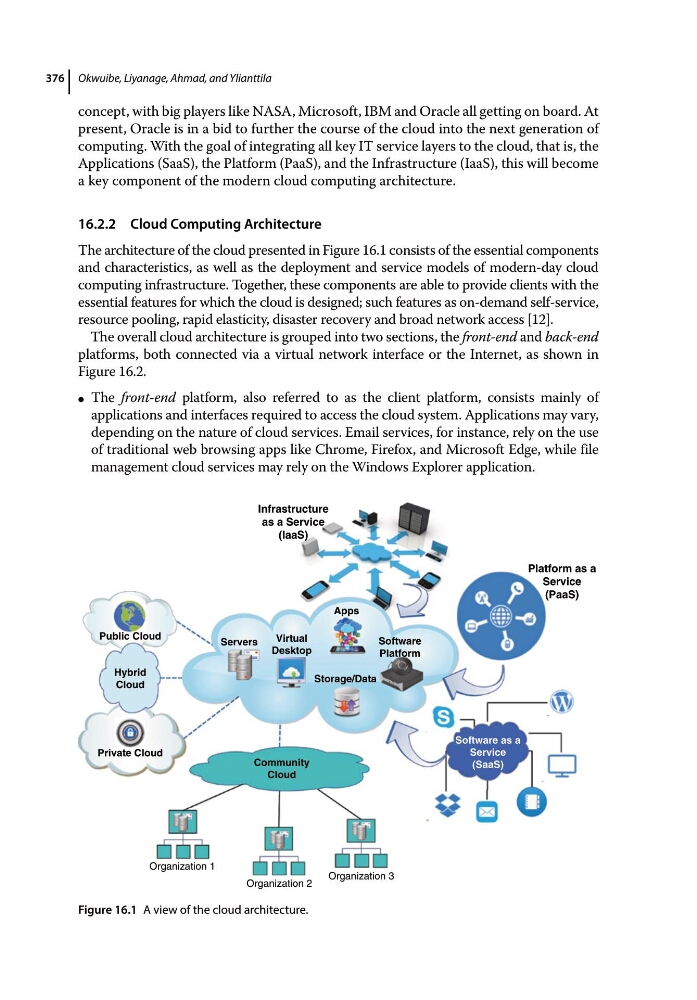
The architecture of the cloud presented in Figure 16.1 consists of the essential components
and characteristics, as well as the deployment and service models of modern‐day cloud
computing infrastructure. Together, these components are able to provide clients with the
essential features for which the cloud is designed; such features as on‐demand self‐service,
resource pooling, rapid elasticity, disaster recovery and broad network access [12].
The overall cloud architecture is grouped into two sections, the front‐end and back‐end
platforms, both connected via a virtual network interface or the Internet, as shown in
Figure 16.2.
● The front‐end platform, also referred to as the client platform, consists mainly of
applications and interfaces required to access the cloud system. Applications may vary,
depending on the nature of cloud services. Email services, for instance, rely on the use
of traditional web browsing apps like Chrome, Firefox, and Microsoft Edge, while file
management cloud services may rely on the Windows Explorer application.
Infrastructure
as a Service
(IaaS)
Apps
Servers
Public Cloud
Private Cloud
Organization 1
Organization 2
Organization 3
Community
Cloud
Hybrid
Cloud
Virtual
Desktop
Software
Platform
Storage/Data
Platform as a
Service
(PaaS)
Software as a
Service
(SaaS)
Figure 16.1 A view of the cloud architecture.
376
concept, with big players like NASA, Microsoft, IBM and Oracle all getting on board. At
present, Oracle is in a bid to further the course of the cloud into the next generation of
computing. With the goal of integrating all key IT service layers to the cloud, that is, the
Applications (SaaS), the Platform (PaaS), and the Infrastructure (IaaS), this will become
a key component of the modern cloud computing architecture.
16.2.2 Cloud Computing Architecture
The architecture of the cloud presented in Figure 16.1 consists of the essential components
and characteristics, as well as the deployment and service models of modern‐day cloud
computing infrastructure. Together, these components are able to provide clients with the
essential features for which the cloud is designed; such features as on‐demand self‐service,
resource pooling, rapid elasticity, disaster recovery and broad network access [12].
The overall cloud architecture is grouped into two sections, the front‐end and back‐end
platforms, both connected via a virtual network interface or the Internet, as shown in
Figure 16.2.
● The front‐end platform, also referred to as the client platform, consists mainly of
applications and interfaces required to access the cloud system. Applications may vary,
depending on the nature of cloud services. Email services, for instance, rely on the use
of traditional web browsing apps like Chrome, Firefox, and Microsoft Edge, while file
management cloud services may rely on the Windows Explorer application.
Infrastructure
as a Service
(IaaS)
Apps
Servers
Public Cloud
Private Cloud
Organization 1
Organization 2
Organization 3
Community
Cloud
Hybrid
Cloud
Virtual
Desktop
Software
Platform
Storage/Data
Platform as a
Service
(PaaS)
Software as a
Service
(SaaS)
Figure 16.1 A view of the cloud architecture.