

Lohan, Alén-Savikko, Chen, Järvinen, Leppäkoski, Kuusniemi, and Korpisaari
290
receiver, leading to significant improvements in the time‐to‐first‐fix and signal sensitivity. In AGNSS, high sensitivity receivers rely on assistance data, including time,
approximate position, satellite ephemerides, and possibly also code differential GNSS
corrections to increase availability and accuracy [53,74]. In principle, as brought up in
[42], AGNSS works by giving the receiver a hint of which frequency bins to search for
when acquiring the signal. AGNSS and its standardization as well as harmonization are
discussed more deeply in [64].
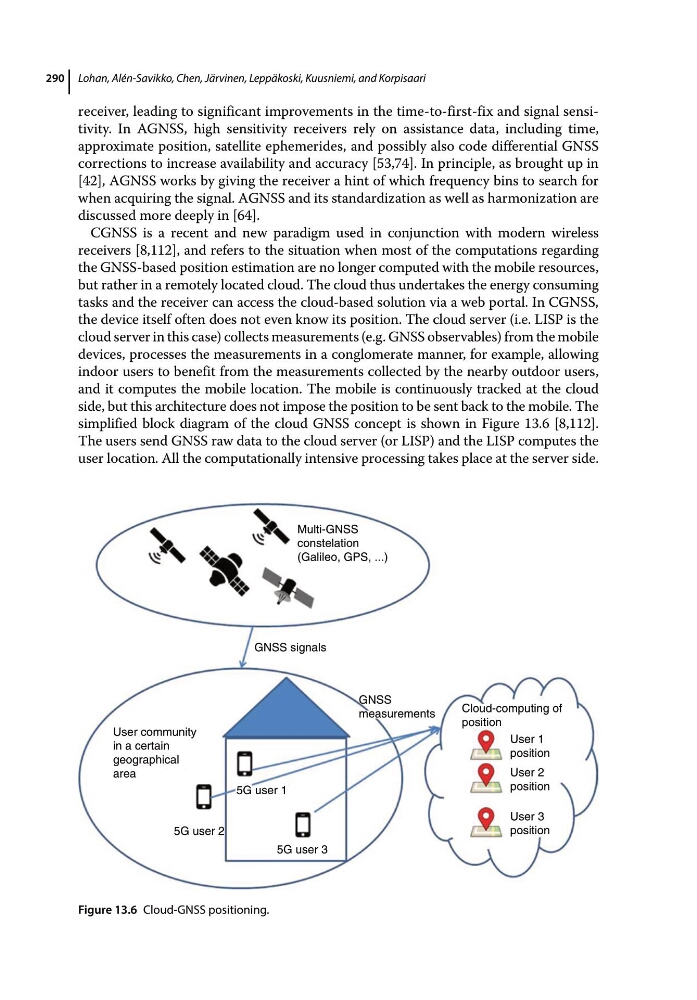
CGNSS is a recent and new paradigm used in conjunction with modern wireless
receivers [8,112], and refers to the situation when most of the computations regarding
the GNSS‐based position estimation are no longer computed with the mobile resources,
but rather in a remotely located cloud. The cloud thus undertakes the energy consuming
tasks and the receiver can access the cloud‐based solution via a web portal. In CGNSS,
the device itself often does not even know its position. The cloud server (i.e. LISP is the
cloud server in this case) collects measurements (e.g. GNSS observables) from the mobile
devices, processes the measurements in a conglomerate manner, for example, allowing
indoor users to benefit from the measurements collected by the nearby outdoor users,
and it computes the mobile location. The mobile is continuously tracked at the cloud
side, but this architecture does not impose the position to be sent back to the mobile. The
simplified block diagram of the cloud GNSS concept is shown in Figure 13.6 [8,112].
The users send GNSS raw data to the cloud server (or LISP) and the LISP computes the
user location. All the computationally intensive processing takes place at the server side.
Multi-GNSS
constelation
(Galileo, GPS, ...)
GNSS signals
GNSS
measurements
Cloud-computing of
position
User community
in a certain
geographical
area
User 1
position
5G user 1
5G user 2
5G user 3
User 2
position
User 3
position
Figure 13.6 Cloud‐GNSS positioning.
290
receiver, leading to significant improvements in the time‐to‐first‐fix and signal sensitivity. In AGNSS, high sensitivity receivers rely on assistance data, including time,
approximate position, satellite ephemerides, and possibly also code differential GNSS
corrections to increase availability and accuracy [53,74]. In principle, as brought up in
[42], AGNSS works by giving the receiver a hint of which frequency bins to search for
when acquiring the signal. AGNSS and its standardization as well as harmonization are
discussed more deeply in [64].
CGNSS is a recent and new paradigm used in conjunction with modern wireless
receivers [8,112], and refers to the situation when most of the computations regarding
the GNSS‐based position estimation are no longer computed with the mobile resources,
but rather in a remotely located cloud. The cloud thus undertakes the energy consuming
tasks and the receiver can access the cloud‐based solution via a web portal. In CGNSS,
the device itself often does not even know its position. The cloud server (i.e. LISP is the
cloud server in this case) collects measurements (e.g. GNSS observables) from the mobile
devices, processes the measurements in a conglomerate manner, for example, allowing
indoor users to benefit from the measurements collected by the nearby outdoor users,
and it computes the mobile location. The mobile is continuously tracked at the cloud
side, but this architecture does not impose the position to be sent back to the mobile. The
simplified block diagram of the cloud GNSS concept is shown in Figure 13.6 [8,112].
The users send GNSS raw data to the cloud server (or LISP) and the LISP computes the
user location. All the computationally intensive processing takes place at the server side.
Multi-GNSS
constelation
(Galileo, GPS, ...)
GNSS signals
GNSS
measurements
Cloud-computing of
position
User community
in a certain
geographical
area
User 1
position
5G user 1
5G user 2
5G user 3
User 2
position
User 3
position
Figure 13.6 Cloud‐GNSS positioning.