

Lohan, Alén-Savikko, Chen, Järvinen, Leppäkoski, Kuusniemi, and Korpisaari
288
maximum entropy, maximum likelihood, as well as various Eigen‐structure methods
such as many versions of the MUSIC (Multiple Signal Classification) algorithms, minimum norm methods, the ESPRIT (Estimation of Signal Parameters via Rotation
Invariance) method, and the weighted subspace fitting method, as discussed in [66].
RSS‐based positioning is another range‐based positioning that relies on the fact that the
RSS is proportional to the distance between the transmitter (e.g. AN) and receiver (e.g.
mobile device). The relationship between RSS and communication distance is known
under the name of the path‐loss model and there are many path‐loss models to characterize the signal propagation. The simplest and most generic one is the one‐slope path‐loss
model below, which shows the RSS in dB in terms of the logarithmic distance [110]:
RSS dB P dB
n
d
m
1
1 0
10 log
(13.1)
where P 1m [dB] is the transmit power at 1 m away from the transmitter (in dB), n is the
path‐loss coefficient and η is a noise term, typically modeled as zero‐mean Gaussian,
10 2
10 0
10 –2
10 –4
0
200
Error std [ns]
400
600
B W /MHz
800
1000
(a)
Incoming signals
Antenna
spacing
Antenna
spacing
Angle of
arrival
θ
Wavefront
T im e d if fe re n c e
(b)
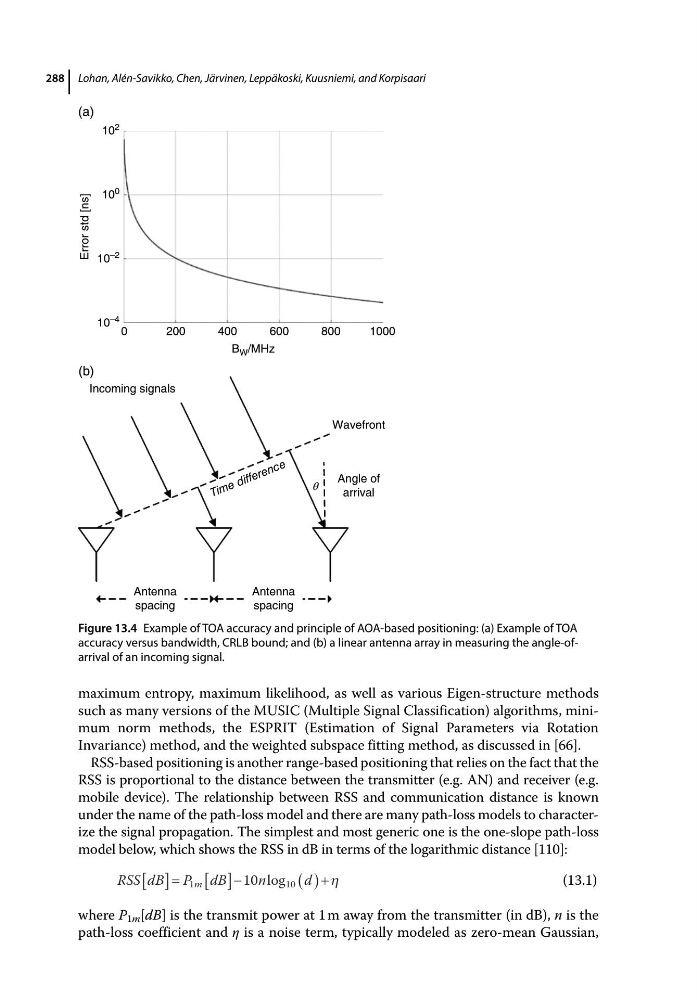
Figure 13.4 Example of TOA accuracy and principle of AOA-based positioning: (a) Example of TOA
accuracy versus bandwidth, CRLB bound; and (b) a linear antenna array in measuring the angle‐of‐
arrival of an incoming signal.
288
maximum entropy, maximum likelihood, as well as various Eigen‐structure methods
such as many versions of the MUSIC (Multiple Signal Classification) algorithms, minimum norm methods, the ESPRIT (Estimation of Signal Parameters via Rotation
Invariance) method, and the weighted subspace fitting method, as discussed in [66].
RSS‐based positioning is another range‐based positioning that relies on the fact that the
RSS is proportional to the distance between the transmitter (e.g. AN) and receiver (e.g.
mobile device). The relationship between RSS and communication distance is known
under the name of the path‐loss model and there are many path‐loss models to characterize the signal propagation. The simplest and most generic one is the one‐slope path‐loss
model below, which shows the RSS in dB in terms of the logarithmic distance [110]:
RSS dB P dB
n
d
m
1
1 0
10 log
(13.1)
where P 1m [dB] is the transmit power at 1 m away from the transmitter (in dB), n is the
path‐loss coefficient and η is a noise term, typically modeled as zero‐mean Gaussian,
10 2
10 0
10 –2
10 –4
0
200
Error std [ns]
400
600
B W /MHz
800
1000
(a)
Incoming signals
Antenna
spacing
Antenna
spacing
Angle of
arrival
θ
Wavefront
T im e d if fe re n c e
(b)
Figure 13.4 Example of TOA accuracy and principle of AOA-based positioning: (a) Example of TOA
accuracy versus bandwidth, CRLB bound; and (b) a linear antenna array in measuring the angle‐of‐
arrival of an incoming signal.