

5G Positioning: Security and Privacy Aspects 285
cooperative positioning. This type of positioning can be implemented in both network‐
centric and mobile‐centric approaches.
On the other hand, in cell‐centric communication architectures (Figure 13.1 (d)), the
mobile devices always communicate with one or several Access Nodes (ANs) that serve
their geographical area. In a device‐centric architecture, (Figure 13.2 (e)), the mobile
devices can communicate with either only between themselves or both between themselves and with the ANs. Thus, in communication architectures, device‐centric or
cooperative communications refer to the same architecture; also such architecture is
also referred to as D2D or Machine‐to‐Machine (M2M) architecture.
13.4 Brief Overview of 5G Positioning Mechanisms
The key features of the 5G physical layer include a ultra‐dense network of ANs, large
receiver bandwidths, receive beamforming with large antenna arrays (massive MIMO),
and support of device‐centric architectures [10,52,75]. It is also expected that the 5G
receivers will operate to high carrier frequencies, such as mm‐wave communications
ranging from 30 GHz to 300 GHz, and will always be under Line Of Sight (LOS) conditions with at least two transmitters or ANs, due to the expected high density of the ANs
[52,70]. The ubiquitous LOS presence, the high density of the ANs and the large available bandwidths make 5G an ideal system to achieve sub‐meter level positioning accuracy, as the positioning accuracy is directly related to the size of the available bandwidth
and the probability of LOS conditions [10,70]. The current 5G white papers do not
Cell-centric
communication
Device-centric
communication
Cooperative
positioning (device-centric or
network-centric)
Cell or network-centric
positioning
Device-centric
positioning
Network computes the
device position, based on
device measurements or
signalling
Device computes its
position, based on
network
measurements or
signalling
M e a s u re m e n ts ;
s ig n a ll in g
M
e
a
s
u
r
e
m
e
n
ts
;
s
ig
n
a
ll
in
g
P
o
s
it
io
n
e
s
ti
m
a
te
(a)
(b)
(c)
(e)
(d)
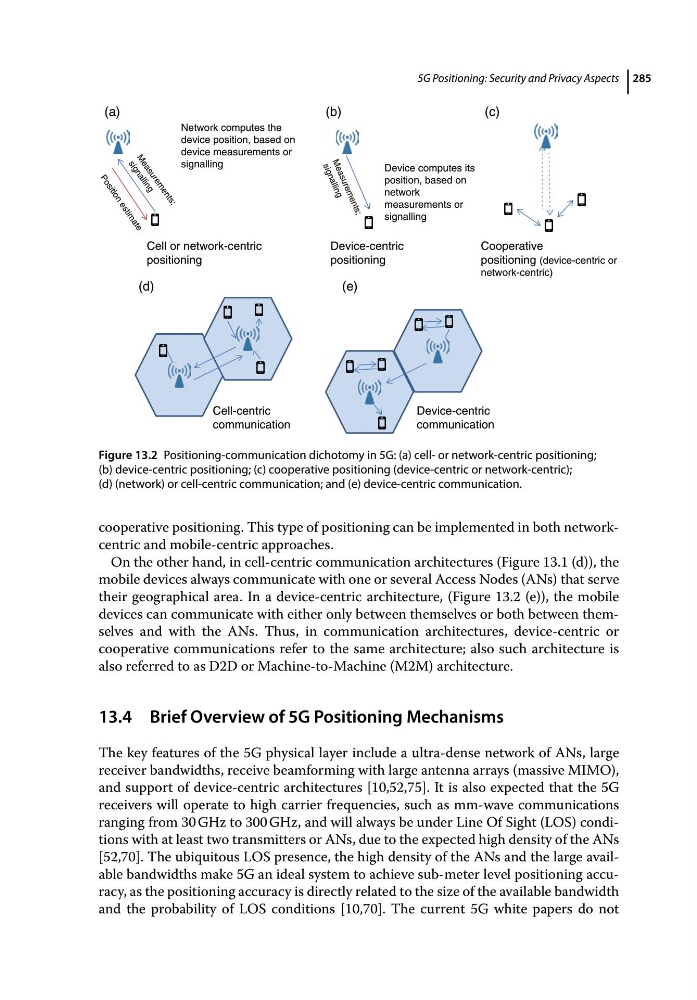
Figure 13.2 Positioning‐communication dichotomy in 5G: (a) cell‐ or network‐centric positioning;
(b) device‐centric positioning; (c) cooperative positioning (device‐centric or network‐centric);
(d) (network) or cell‐centric communication; and (e) device‐centric communication.
cooperative positioning. This type of positioning can be implemented in both network‐
centric and mobile‐centric approaches.
On the other hand, in cell‐centric communication architectures (Figure 13.1 (d)), the
mobile devices always communicate with one or several Access Nodes (ANs) that serve
their geographical area. In a device‐centric architecture, (Figure 13.2 (e)), the mobile
devices can communicate with either only between themselves or both between themselves and with the ANs. Thus, in communication architectures, device‐centric or
cooperative communications refer to the same architecture; also such architecture is
also referred to as D2D or Machine‐to‐Machine (M2M) architecture.
13.4 Brief Overview of 5G Positioning Mechanisms
The key features of the 5G physical layer include a ultra‐dense network of ANs, large
receiver bandwidths, receive beamforming with large antenna arrays (massive MIMO),
and support of device‐centric architectures [10,52,75]. It is also expected that the 5G
receivers will operate to high carrier frequencies, such as mm‐wave communications
ranging from 30 GHz to 300 GHz, and will always be under Line Of Sight (LOS) conditions with at least two transmitters or ANs, due to the expected high density of the ANs
[52,70]. The ubiquitous LOS presence, the high density of the ANs and the large available bandwidths make 5G an ideal system to achieve sub‐meter level positioning accuracy, as the positioning accuracy is directly related to the size of the available bandwidth
and the probability of LOS conditions [10,70]. The current 5G white papers do not
Cell-centric
communication
Device-centric
communication
Cooperative
positioning (device-centric or
network-centric)
Cell or network-centric
positioning
Device-centric
positioning
Network computes the
device position, based on
device measurements or
signalling
Device computes its
position, based on
network
measurements or
signalling
M e a s u re m e n ts ;
s ig n a ll in g
M
e
a
s
u
r
e
m
e
n
ts
;
s
ig
n
a
ll
in
g
P
o
s
it
io
n
e
s
ti
m
a
te
(a)
(b)
(c)
(e)
(d)
Figure 13.2 Positioning‐communication dichotomy in 5G: (a) cell‐ or network‐centric positioning;
(b) device‐centric positioning; (c) cooperative positioning (device‐centric or network‐centric);
(d) (network) or cell‐centric communication; and (e) device‐centric communication.