

IoT Security 253
If the system is manipulated, it may provide incorrect sensor information (data), which
will impact analytics significantly. If an attacker gains control of a system, IoT devices
operating under that system may become a member of a botnet and perform operations
including email spams, carrying out DDoS attack, bitcoin mining, click fraud, or gain
access to information and issue misleading commands.
11.3.2 Research Motivation
Diverse industries have been using sensors and robots for years, but their control
systems often remain deliberately isolated to avoid any attacks. Performing data mining
on data collected from sensors and robots in the industrial environment helps to detect
the anomalies before they occur. The collected data should be made available across
each site to perform data mining and classification. Therefore, we introduce a mobile
network cloud platform that collects data from IoT robots, and performs data mining
and data analysis to find malicious robots and isolate them.
In order to perform efficient intrusion detection, we introduce a platform comprising
of two main parts: LRC and IoT service provider that is a MVNO. Once the attack is
detected in a MVNO, an IoT orchestrator is used to distribute the malicious pattern and
information on a malicious robot to other MVNOs, so they can also retaliate to the
malicious intent without re‐analyzing the same kind of robots. This capability enhances
the scalability of the proposed platform and makes it an efficient distributed security
framework. Therefore, the proposed platform is also a distributed mitigation strategy
for malicious robots to prevent its malicious intent to all nearby MVNOs. LRC would
directly interact with all connected robots for various functions such as local privacy,
security and monitoring, local hardware control, local software manager and local
application, etc.; while in the proposed architecture, LRC concentrates only on local
security and monitoring.
Apart from robots that are working in an industrial environment, the flying robots,
so‐called drones, are increasingly used in the service industry, for example, postal delivery, vaccine delivery, remote surveillance and inspection of terrain for radio network
planning, etc. The regulatory authorities have been allocating bands for their operation,
but who controls where the drones can fly, what they can do and what forbids them are
Service disruption
• Disable surveillance cameras
• Take traffic lights out of
service
Gain access to
information
• IoTdevice location tracking
• Sensitive data theft, e.g.
dashboard camera videos
Sabotage and
destruction of system
• SIM card theft
• Device theft
Gain control of system
• Become member of Botnet
• Generate e-mail spam
• Perform DDoS from Things
• Perform bitcoin mining
• Perform click fraud
• Gain access to protected
areas (e.g. cars)
Manipulate system
• Provide wrong sensor
information
• Show wrong data
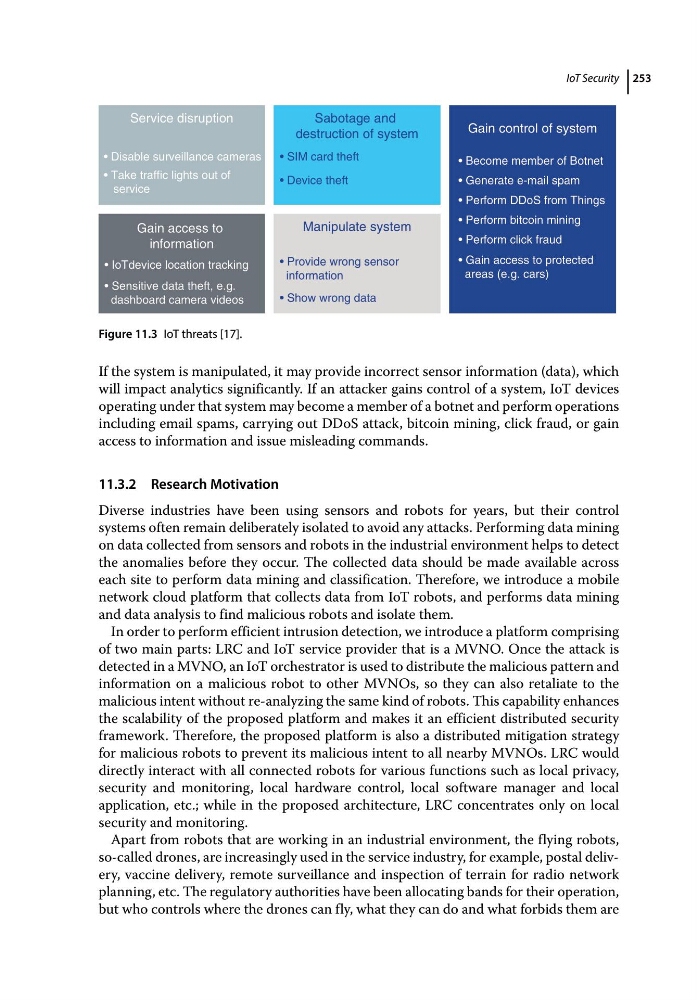
Figure 11.3 IoT threats [17].
If the system is manipulated, it may provide incorrect sensor information (data), which
will impact analytics significantly. If an attacker gains control of a system, IoT devices
operating under that system may become a member of a botnet and perform operations
including email spams, carrying out DDoS attack, bitcoin mining, click fraud, or gain
access to information and issue misleading commands.
11.3.2 Research Motivation
Diverse industries have been using sensors and robots for years, but their control
systems often remain deliberately isolated to avoid any attacks. Performing data mining
on data collected from sensors and robots in the industrial environment helps to detect
the anomalies before they occur. The collected data should be made available across
each site to perform data mining and classification. Therefore, we introduce a mobile
network cloud platform that collects data from IoT robots, and performs data mining
and data analysis to find malicious robots and isolate them.
In order to perform efficient intrusion detection, we introduce a platform comprising
of two main parts: LRC and IoT service provider that is a MVNO. Once the attack is
detected in a MVNO, an IoT orchestrator is used to distribute the malicious pattern and
information on a malicious robot to other MVNOs, so they can also retaliate to the
malicious intent without re‐analyzing the same kind of robots. This capability enhances
the scalability of the proposed platform and makes it an efficient distributed security
framework. Therefore, the proposed platform is also a distributed mitigation strategy
for malicious robots to prevent its malicious intent to all nearby MVNOs. LRC would
directly interact with all connected robots for various functions such as local privacy,
security and monitoring, local hardware control, local software manager and local
application, etc.; while in the proposed architecture, LRC concentrates only on local
security and monitoring.
Apart from robots that are working in an industrial environment, the flying robots,
so‐called drones, are increasingly used in the service industry, for example, postal delivery, vaccine delivery, remote surveillance and inspection of terrain for radio network
planning, etc. The regulatory authorities have been allocating bands for their operation,
but who controls where the drones can fly, what they can do and what forbids them are
Service disruption
• Disable surveillance cameras
• Take traffic lights out of
service
Gain access to
information
• IoTdevice location tracking
• Sensitive data theft, e.g.
dashboard camera videos
Sabotage and
destruction of system
• SIM card theft
• Device theft
Gain control of system
• Become member of Botnet
• Generate e-mail spam
• Perform DDoS from Things
• Perform bitcoin mining
• Perform click fraud
• Gain access to protected
areas (e.g. cars)
Manipulate system
• Provide wrong sensor
information
• Show wrong data
Figure 11.3 IoT threats [17].