

Monshizadeh and Khatri
252
update, etc. An attacker can exploit IoT devices and place orders, modify their functionality, modify their operations or inject a malicious code and devices that can act
as a bot and participate in carrying out a distributed DoS (DDoS) attack;
8) Retail sector: services in the retail sector are smart payment and smart stores. The
stores will be automated and tailored to meet customers’ demand based on consumption (collected analytics) and will offer smart payment systems. The stores will
have the benefit of satisfied customer service. The potential target for attacker will
be smart payment systems for financial gains. The attack on smart stores will impact
availability of products, as either there would be no products or more products than
customer demand.
IoT devices will be deployed in both low‐priority and critical applications, such as
military, emergency services, remote surgery in healthcare, self‐driving cars and many
others. In general, the attack on IoT service will start with an IoT device initially. IoT
devices may be in remote areas without any human supervision and may be stolen to
modify their functions or steal their information to learn vulnerabilities. The attacker
may exploit vulnerabilities, inject malicious code or steal data, which will result in full
or partial loss of services or revenues for end users or networks. If an attacker makes
multiple IoT devices vulnerable, they can be used to launch a DDoS attack, like the
recent Mirai botnet attack [16]. User awareness is another important element; typically
default passwords are not changed and the attacker can easily enter IoT devices with default
passwords. Therefore, the IoT devices must have strong authentication mechanisms to
prevent unauthorized access.
The IoT threats, as mentioned in Figure 11.3, include service disruption, information
theft, device theft, system manipulation and gaining control of the system. Service can
be disrupted by disabling IoT devices or carrying out a DDoS attack on the service
platform. Information theft happens via vulnerable IoT devices or stolen IoT devices.
4.5G Pro and 4.9G
5G
•
•
•
•
Business driver
•
•
•
•
•
•
•
•
•
•
•
•
•
•
•
•
•
•
•
Industry 4.0
Health
Mega cities and military
Predictive health
Public safety and supply
Efficient mega cities
Remote treatment
Intelligent production
Cognitive maintenance
higher productivity
mass individualization
Defragmentation of
communication sysytems
Aging societies - leveraging
remote medical support
2030: 52 million deaths by
non communicable diseases
Public safety, efficient energy
supply and traffic
management for dense urban
population
Sensor connectivity for monitoring
and predictive maintenance
Augmented (AR-supported)
maintenance
Remote diagnostic surveillance
and risk assessment
Early disease forecasting
Mission control for public safety
Video Surveillance
Connected mobility for transport
Public parking and traffic steering
Remote surgeries
Military drones
Industry drones
Intelligent traffic infrastructure
Robot assisted examination and
tele-consultation in 4D and 5D
Autonomous vehicles
Zero latency robot collaboration
Common communication platform
for manufacturing use cases
Environment monitoring
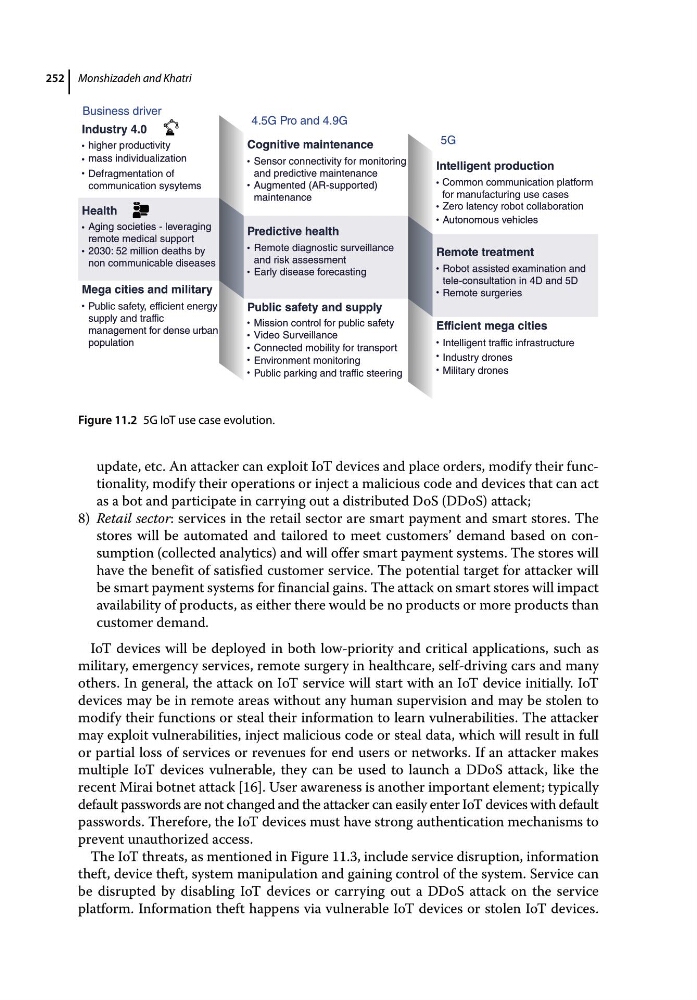
Figure 11.2 5G IoT use case evolution.
252
update, etc. An attacker can exploit IoT devices and place orders, modify their functionality, modify their operations or inject a malicious code and devices that can act
as a bot and participate in carrying out a distributed DoS (DDoS) attack;
8) Retail sector: services in the retail sector are smart payment and smart stores. The
stores will be automated and tailored to meet customers’ demand based on consumption (collected analytics) and will offer smart payment systems. The stores will
have the benefit of satisfied customer service. The potential target for attacker will
be smart payment systems for financial gains. The attack on smart stores will impact
availability of products, as either there would be no products or more products than
customer demand.
IoT devices will be deployed in both low‐priority and critical applications, such as
military, emergency services, remote surgery in healthcare, self‐driving cars and many
others. In general, the attack on IoT service will start with an IoT device initially. IoT
devices may be in remote areas without any human supervision and may be stolen to
modify their functions or steal their information to learn vulnerabilities. The attacker
may exploit vulnerabilities, inject malicious code or steal data, which will result in full
or partial loss of services or revenues for end users or networks. If an attacker makes
multiple IoT devices vulnerable, they can be used to launch a DDoS attack, like the
recent Mirai botnet attack [16]. User awareness is another important element; typically
default passwords are not changed and the attacker can easily enter IoT devices with default
passwords. Therefore, the IoT devices must have strong authentication mechanisms to
prevent unauthorized access.
The IoT threats, as mentioned in Figure 11.3, include service disruption, information
theft, device theft, system manipulation and gaining control of the system. Service can
be disrupted by disabling IoT devices or carrying out a DDoS attack on the service
platform. Information theft happens via vulnerable IoT devices or stolen IoT devices.
4.5G Pro and 4.9G
5G
•
•
•
•
Business driver
•
•
•
•
•
•
•
•
•
•
•
•
•
•
•
•
•
•
•
Industry 4.0
Health
Mega cities and military
Predictive health
Public safety and supply
Efficient mega cities
Remote treatment
Intelligent production
Cognitive maintenance
higher productivity
mass individualization
Defragmentation of
communication sysytems
Aging societies - leveraging
remote medical support
2030: 52 million deaths by
non communicable diseases
Public safety, efficient energy
supply and traffic
management for dense urban
population
Sensor connectivity for monitoring
and predictive maintenance
Augmented (AR-supported)
maintenance
Remote diagnostic surveillance
and risk assessment
Early disease forecasting
Mission control for public safety
Video Surveillance
Connected mobility for transport
Public parking and traffic steering
Remote surgeries
Military drones
Industry drones
Intelligent traffic infrastructure
Robot assisted examination and
tele-consultation in 4D and 5D
Autonomous vehicles
Zero latency robot collaboration
Common communication platform
for manufacturing use cases
Environment monitoring
Figure 11.2 5G IoT use case evolution.