

Liyanage, Ahmad, Okwuibe, Montes de Oca, MAI, Perez, and Itzazelaia
242
10.8 Conclusion
Leveraging SDN and NFV for 5G networks will advance the course of its evolution
in many different dimensions. Mobile users are looking forward to a more user‐
centric network that is energy‐ and cost‐efficient, characterized by resource sharing,
optimization and dynamic control of network policies; with an overall goal of
achieving higher levels of QoS and QoE for end users and more efficient service
models for the providers. Network monitoring in 5G will require a more dynamic
approach than we have in present‐day monitoring techniques. In this respect,
approaches for abstracting certain underlying hardware components of the network
will become paramount to realizing a more dynamic and granular monitoring that
would be much required in 5G networks. SDN and NFV techniques have been seen
as promising enablers for realizing this vision. In this chapter, we have presented
a description of existing monitoring solutions and their limitations. We further
presented a novel monitoring scheme that was proposed in SIGMONA, which is
based on SDN principles. We highlighted the proposed benefits of this approach
such as high scalability and visibility, simplified network monitoring system, automated mitigation actions and lower CAPEX and OPEX. We also discussed the key
limitations of this approach ranging from its inheritance of common vulnerabilities
that come with typical software defined solutions, to other performance and scalability concerns.
Builder
Request
Network Descriptor
Enforcer
Virtual
Network
SDN
Network
Legacy
Network
Topology Viewer
GUI
Consolidated
JSON
Source
JSONs
Nextel APl
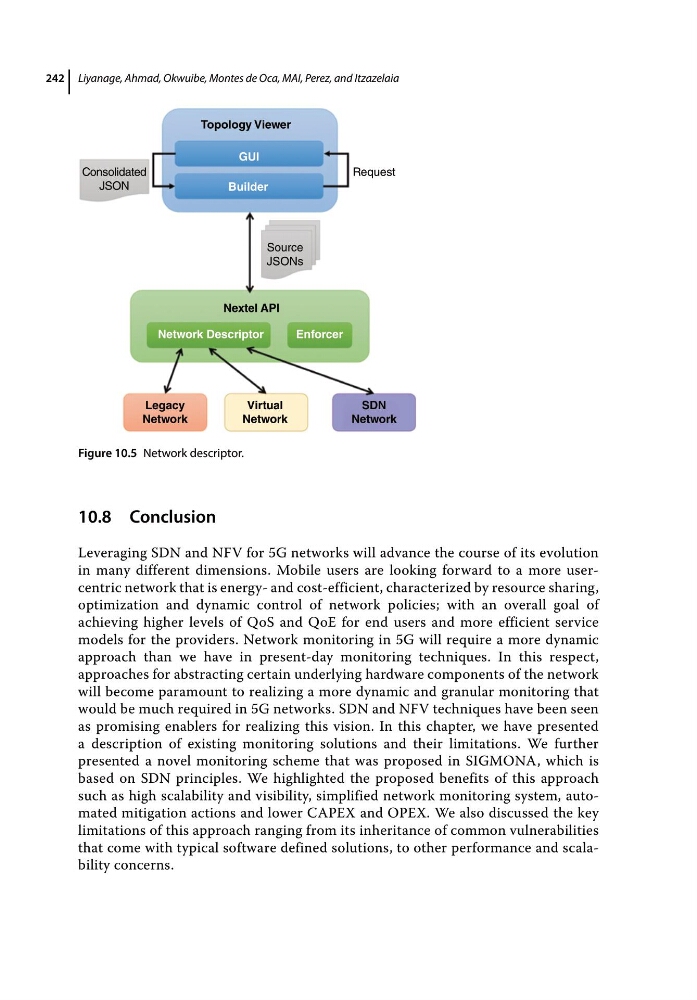
Figure 10.5 Network descriptor.
242
10.8 Conclusion
Leveraging SDN and NFV for 5G networks will advance the course of its evolution
in many different dimensions. Mobile users are looking forward to a more user‐
centric network that is energy‐ and cost‐efficient, characterized by resource sharing,
optimization and dynamic control of network policies; with an overall goal of
achieving higher levels of QoS and QoE for end users and more efficient service
models for the providers. Network monitoring in 5G will require a more dynamic
approach than we have in present‐day monitoring techniques. In this respect,
approaches for abstracting certain underlying hardware components of the network
will become paramount to realizing a more dynamic and granular monitoring that
would be much required in 5G networks. SDN and NFV techniques have been seen
as promising enablers for realizing this vision. In this chapter, we have presented
a description of existing monitoring solutions and their limitations. We further
presented a novel monitoring scheme that was proposed in SIGMONA, which is
based on SDN principles. We highlighted the proposed benefits of this approach
such as high scalability and visibility, simplified network monitoring system, automated mitigation actions and lower CAPEX and OPEX. We also discussed the key
limitations of this approach ranging from its inheritance of common vulnerabilities
that come with typical software defined solutions, to other performance and scalability concerns.
Builder
Request
Network Descriptor
Enforcer
Virtual
Network
SDN
Network
Legacy
Network
Topology Viewer
GUI
Consolidated
JSON
Source
JSONs
Nextel APl
Figure 10.5 Network descriptor.