

Liyanage, Ahmad, Okwuibe, Montes de Oca, MAI, Perez, and Itzazelaia
238
act as packet brokers. Controllers can act to aggregate and correlate distributed meta‐
data (e.g. flow and statistical data). This information can be sent to monitoring and
analysis appliances and applications. In this way, it is possible to obtain adaptive and
optimized monitoring, analysis and mitigation.
10.6 Expected Advantages of Software Defined Monitoring
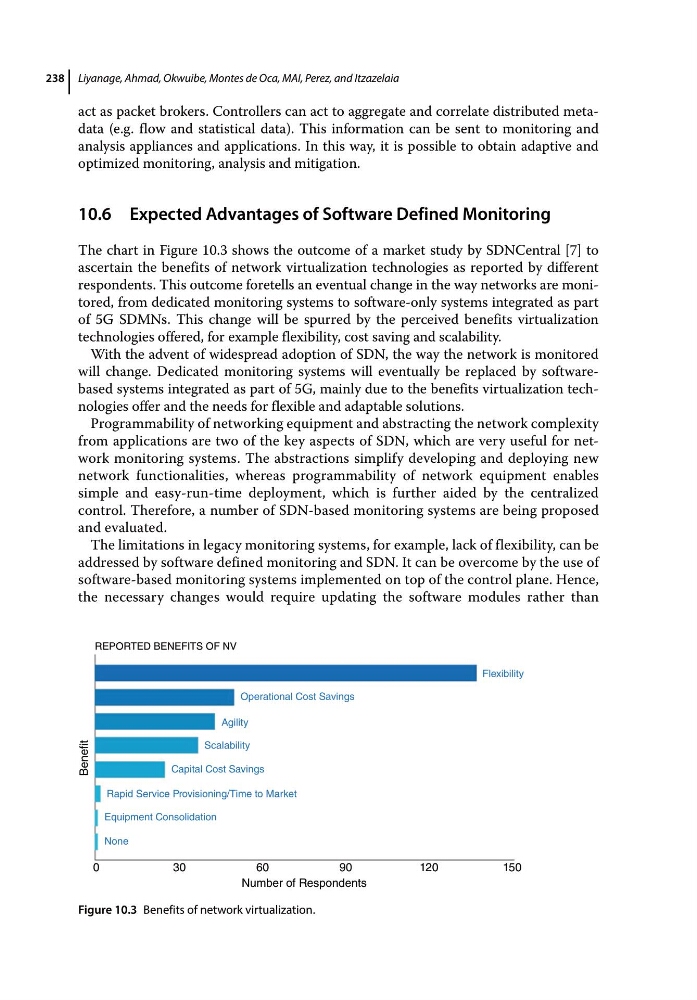
The chart in Figure 10.3 shows the outcome of a market study by SDNCentral [7] to
ascertain the benefits of network virtualization technologies as reported by different
respondents. This outcome foretells an eventual change in the way networks are monitored, from dedicated monitoring systems to software‐only systems integrated as part
of 5G SDMNs. This change will be spurred by the perceived benefits virtualization
technologies offered, for example flexibility, cost saving and scalability.
With the advent of widespread adoption of SDN, the way the network is monitored
will change. Dedicated monitoring systems will eventually be replaced by software‐
based systems integrated as part of 5G, mainly due to the benefits virtualization technologies offer and the needs for flexible and adaptable solutions.
Programmability of networking equipment and abstracting the network complexity
from applications are two of the key aspects of SDN, which are very useful for network monitoring systems. The abstractions simplify developing and deploying new
network functionalities, whereas programmability of network equipment enables
simple and easy‐run‐time deployment, which is further aided by the centralized
control. Therefore, a number of SDN‐based monitoring systems are being proposed
and evaluated.
The limitations in legacy monitoring systems, for example, lack of flexibility, can be
addressed by software defined monitoring and SDN. It can be overcome by the use of
software‐based monitoring systems implemented on top of the control plane. Hence,
the necessary changes would require updating the software modules rather than
REPORTED BENEFITS OF NV
0
3 0
6 0
9 0
1 20
150
Flexibility
Operational Cost Savings
Agility
Scalability
Capital Cost Savings
Rapid Service Provisioning/Time to Market
Equipment Consolidation
None
Number of Respondents
Benefit
Figure 10.3 Benefits of network virtualization.
238
act as packet brokers. Controllers can act to aggregate and correlate distributed meta‐
data (e.g. flow and statistical data). This information can be sent to monitoring and
analysis appliances and applications. In this way, it is possible to obtain adaptive and
optimized monitoring, analysis and mitigation.
10.6 Expected Advantages of Software Defined Monitoring
The chart in Figure 10.3 shows the outcome of a market study by SDNCentral [7] to
ascertain the benefits of network virtualization technologies as reported by different
respondents. This outcome foretells an eventual change in the way networks are monitored, from dedicated monitoring systems to software‐only systems integrated as part
of 5G SDMNs. This change will be spurred by the perceived benefits virtualization
technologies offered, for example flexibility, cost saving and scalability.
With the advent of widespread adoption of SDN, the way the network is monitored
will change. Dedicated monitoring systems will eventually be replaced by software‐
based systems integrated as part of 5G, mainly due to the benefits virtualization technologies offer and the needs for flexible and adaptable solutions.
Programmability of networking equipment and abstracting the network complexity
from applications are two of the key aspects of SDN, which are very useful for network monitoring systems. The abstractions simplify developing and deploying new
network functionalities, whereas programmability of network equipment enables
simple and easy‐run‐time deployment, which is further aided by the centralized
control. Therefore, a number of SDN‐based monitoring systems are being proposed
and evaluated.
The limitations in legacy monitoring systems, for example, lack of flexibility, can be
addressed by software defined monitoring and SDN. It can be overcome by the use of
software‐based monitoring systems implemented on top of the control plane. Hence,
the necessary changes would require updating the software modules rather than
REPORTED BENEFITS OF NV
0
3 0
6 0
9 0
1 20
150
Flexibility
Operational Cost Savings
Agility
Scalability
Capital Cost Savings
Rapid Service Provisioning/Time to Market
Equipment Consolidation
None
Number of Respondents
Benefit
Figure 10.3 Benefits of network virtualization.