

Anamalamudi, Sangi, Alkatheiri, Bin Muhaya, and Liu
144
7.2.2 Interoperability of WiFi with 5G Networks
WiFi Alliance (Wireless Ethernet Compatibility Alliance) is an international, nonprofit
organization that focuses on the manufacturing and interoperability of 802.11 wireless
LAN devices. The widely deployed WiFi hotspots (IEEE 802.11 a/b/g/n) and wide area
cellular networks (2G to 5G networks) open up new opportunities of heterogeneous
connectivity through interoperability between WiFi and cellular networks. With
interoperability, networked mobile device can dynamically use the multiple network
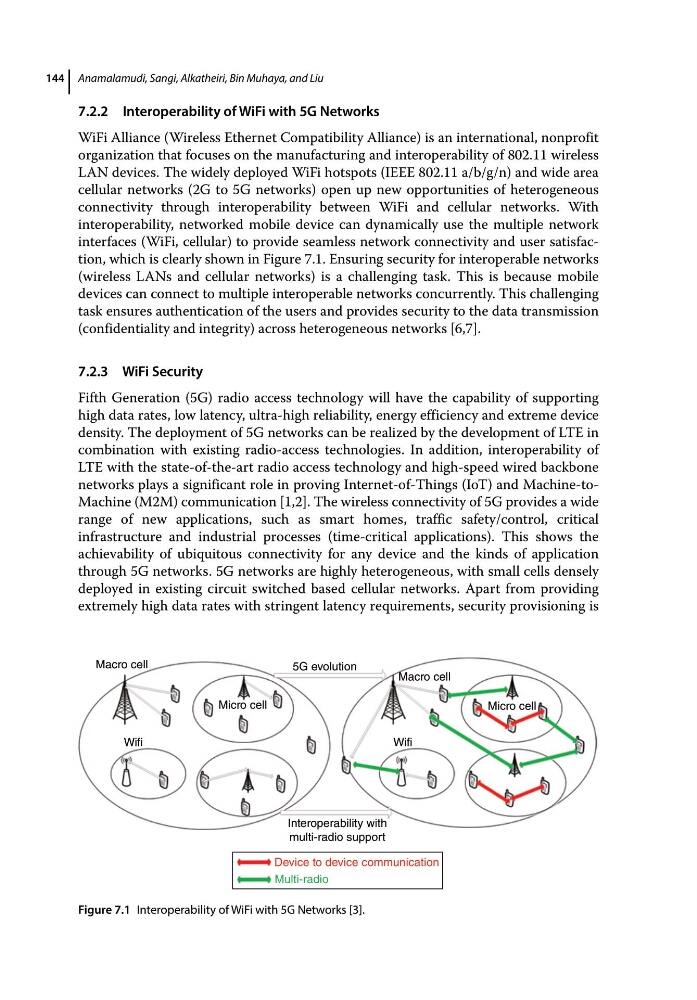
interfaces (WiFi, cellular) to provide seamless network connectivity and user satisfaction, which is clearly shown in Figure 7.1. Ensuring security for interoperable networks
(wireless LANs and cellular networks) is a challenging task. This is because mobile
devices can connect to multiple interoperable networks concurrently. This challenging
task ensures authentication of the users and provides security to the data transmission
(confidentiality and integrity) across heterogeneous networks [6,7].
7.2.3 WiFi Security
Fifth Generation (5G) radio access technology will have the capability of supporting
high data rates, low latency, ultra‐high reliability, energy efficiency and extreme device
density. The deployment of 5G networks can be realized by the development of LTE in
combination with existing radio‐access technologies. In addition, interoperability of
LTE with the state‐of‐the‐art radio access technology and high‐speed wired backbone
networks plays a significant role in proving Internet‐of‐Things (IoT) and Machine‐to‐
Machine (M2M) communication [1,2]. The wireless connectivity of 5G provides a wide
range of new applications, such as smart homes, traffic safety/control, critical
infrastructure and industrial processes (time‐critical applications). This shows the
achievability of ubiquitous connectivity for any device and the kinds of application
through 5G networks. 5G networks are highly heterogeneous, with small cells densely
deployed in existing circuit switched based cellular networks. Apart from providing
extremely high data rates with stringent latency requirements, security provisioning is
Macro cell
Micro cell
Interoperability with
multi-radio support
5G evolution
Wifi
Macro cell
Micro cell
Wifi
Device to device communication
Multi-radio
Figure 7.1 Interoperability of WiFi with 5G Networks [3].
144
7.2.2 Interoperability of WiFi with 5G Networks
WiFi Alliance (Wireless Ethernet Compatibility Alliance) is an international, nonprofit
organization that focuses on the manufacturing and interoperability of 802.11 wireless
LAN devices. The widely deployed WiFi hotspots (IEEE 802.11 a/b/g/n) and wide area
cellular networks (2G to 5G networks) open up new opportunities of heterogeneous
connectivity through interoperability between WiFi and cellular networks. With
interoperability, networked mobile device can dynamically use the multiple network
interfaces (WiFi, cellular) to provide seamless network connectivity and user satisfaction, which is clearly shown in Figure 7.1. Ensuring security for interoperable networks
(wireless LANs and cellular networks) is a challenging task. This is because mobile
devices can connect to multiple interoperable networks concurrently. This challenging
task ensures authentication of the users and provides security to the data transmission
(confidentiality and integrity) across heterogeneous networks [6,7].
7.2.3 WiFi Security
Fifth Generation (5G) radio access technology will have the capability of supporting
high data rates, low latency, ultra‐high reliability, energy efficiency and extreme device
density. The deployment of 5G networks can be realized by the development of LTE in
combination with existing radio‐access technologies. In addition, interoperability of
LTE with the state‐of‐the‐art radio access technology and high‐speed wired backbone
networks plays a significant role in proving Internet‐of‐Things (IoT) and Machine‐to‐
Machine (M2M) communication [1,2]. The wireless connectivity of 5G provides a wide
range of new applications, such as smart homes, traffic safety/control, critical
infrastructure and industrial processes (time‐critical applications). This shows the
achievability of ubiquitous connectivity for any device and the kinds of application
through 5G networks. 5G networks are highly heterogeneous, with small cells densely
deployed in existing circuit switched based cellular networks. Apart from providing
extremely high data rates with stringent latency requirements, security provisioning is
Macro cell
Micro cell
Interoperability with
multi-radio support
5G evolution
Wifi
Macro cell
Micro cell
Wifi
Device to device communication
Multi-radio
Figure 7.1 Interoperability of WiFi with 5G Networks [3].