

Physical Layer Security 131
E h
E h
E g
M
E
J
[ ] [ ] [ ]
2
2
2
1 [18]. In Equation (6.20), the author assumes that the noise plus
the interference is still Gaussian.
6.3 Outage Probability of Secrecy Capacity
of a Jamming Receiver
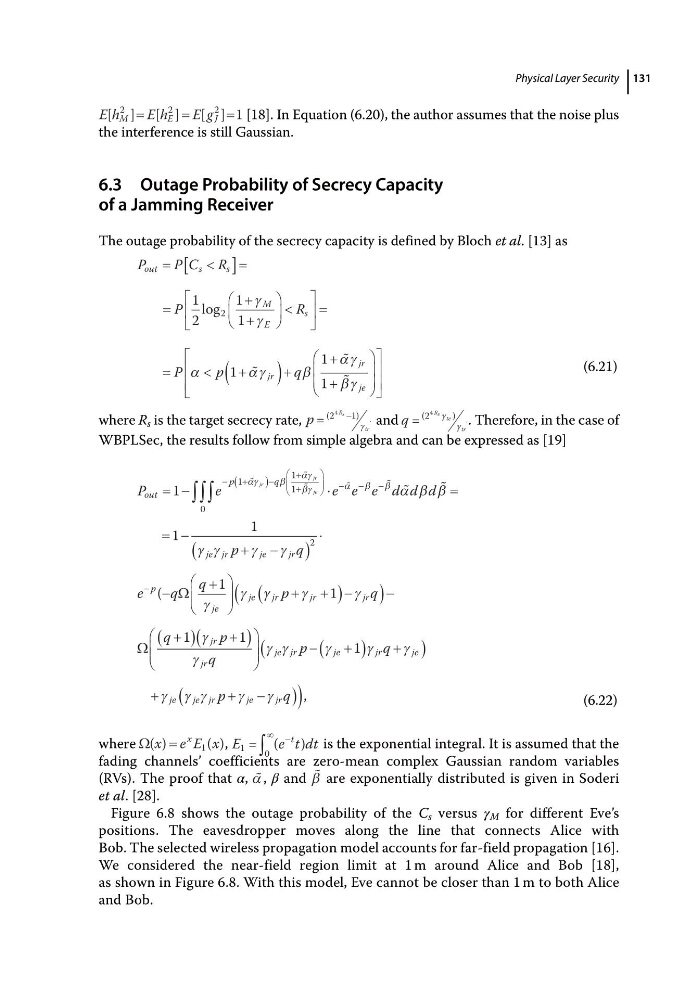
The outage probability of the secrecy capacity is defined by Bloch et al. [13] as
P
P C R
P
R
out
s
s
M
E
s
1
2
1
1
2
log
P
p
q
jr
jr
je
1
1
1
(6.21)
where R s is the target secrecy rate, p
Rs
tr
=
(2
1)
4
and q
Rs
te
tr
=
(2
)
4
. Therefore, in the case of
WBPLSec, the results follow from simple algebra and can be expressed as [19]
P
e
e e e
out
p
q
jr
jr
je
1
0
1
1
1
d d d
1
1
2
je jr
je
jr
p
q
e
q
q
p
q
p
je
je
jr
jr
jr
(
1
1
q
p
q
p
q
jr
jr
je jr
je
jr
je
1
1
1
je
je jr
je
jr
p
q ,
(6.22)
where ( )
x e E x
x 1 ( ), E
e t dt
t
1
0
= (
) is the exponential integral. It is assumed that the
fading channels’ coefficients are zero‐mean complex Gaussian random variables
(RVs). The proof that α, , β and are exponentially distributed is given in Soderi
et al. [28].
Figure 6.8 shows the outage probability of the C s versus γ M for different Eve’s
positions. The eavesdropper moves along the line that connects Alice with
Bob. The selected wireless propagation model accounts for far‐field propagation [16].
We considered the near‐field region limit at 1 m around Alice and Bob [18],
as shown in Figure 6.8. With this model, Eve cannot be closer than 1 m to both Alice
and Bob.
E h
E h
E g
M
E
J
[ ] [ ] [ ]
2
2
2
1 [18]. In Equation (6.20), the author assumes that the noise plus
the interference is still Gaussian.
6.3 Outage Probability of Secrecy Capacity
of a Jamming Receiver
The outage probability of the secrecy capacity is defined by Bloch et al. [13] as
P
P C R
P
R
out
s
s
M
E
s
1
2
1
1
2
log
P
p
q
jr
jr
je
1
1
1
(6.21)
where R s is the target secrecy rate, p
Rs
tr
=
(2
1)
4
and q
Rs
te
tr
=
(2
)
4
. Therefore, in the case of
WBPLSec, the results follow from simple algebra and can be expressed as [19]
P
e
e e e
out
p
q
jr
jr
je
1
0
1
1
1
d d d
1
1
2
je jr
je
jr
p
q
e
q
q
p
q
p
je
je
jr
jr
jr
(
1
1
q
p
q
p
q
jr
jr
je jr
je
jr
je
1
1
1
je
je jr
je
jr
p
q ,
(6.22)
where ( )
x e E x
x 1 ( ), E
e t dt
t
1
0
= (
) is the exponential integral. It is assumed that the
fading channels’ coefficients are zero‐mean complex Gaussian random variables
(RVs). The proof that α, , β and are exponentially distributed is given in Soderi
et al. [28].
Figure 6.8 shows the outage probability of the C s versus γ M for different Eve’s
positions. The eavesdropper moves along the line that connects Alice with
Bob. The selected wireless propagation model accounts for far‐field propagation [16].
We considered the near‐field region limit at 1 m around Alice and Bob [18],
as shown in Figure 6.8. With this model, Eve cannot be closer than 1 m to both Alice
and Bob.