

Physical Layer Security 129
where both
h M
2 and k J
2 follow an exponential distribution, N
N E W
0
0
,
tr
E
N d
S
tr
b
= (
)
0
2
and jr
E
N
J
=
0
. Due to the proposed jamming receiver architecture, the
E J does not undergo any attenuation at the legitimate receiver. Channels are power
limited and it is assumed that P E N
S
is the average transmit power, and P E M
J
J
is the average jamming power when Bob jams M samples over N with M N
< .
Moreover, it is assumed that n M and n E have the same noise spectral density,
that is N 0 .
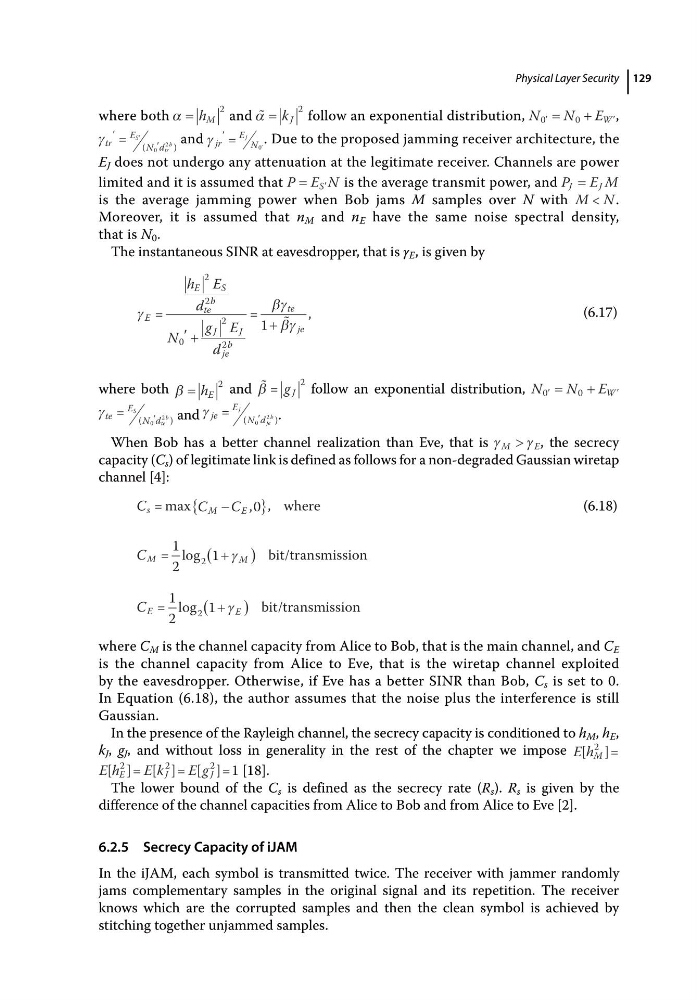
The instantaneous SINR at eavesdropper, that is γ E , is given by
E
E
S
te
b
J
J
je
b
te
je
h E
d
N
g E
d
=
= 1
,
2
2
0
2
2
(6.17)
where both
h E
2 and =
2
g J follow an exponential distribution, N
N E W
0
0
te
E
N d
S
te
b
= (
)
0
2
and je
E
N d
J
je
b
= (
)
0
2 .
When Bob has a better channel realization than Eve, that is M
E , the secrecy
capacity (C s ) of legitimate link is defined as follows for a non‐degraded Gaussian wiretap
channel [4]:
C
C
C
s
M
E
=
,0 ,
max
where
(6.18)
C M
M
=
1
2
1
2
log
bit/transmission
C E
E
=
1
2
1
2
log
bit/transmission
where C M is the channel capacity from Alice to Bob, that is the main channel, and C E
is the channel capacity from Alice to Eve, that is the wiretap channel exploited
by the eavesdropper. Otherwise, if Eve has a better SINR than Bob, C s is set to 0.
In Equation (6.18), the author assumes that the noise plus the interference is still
Gaussian.
In the presence of the Rayleigh channel, the secrecy capacity is conditioned to h M , h E ,
k J , g J , and without loss in generality in the rest of the chapter we impose E h M
[ ] =
2
E h
E k
E g
E
J
J
[ ] = [ ] = [ ] = 1
2
2
2
[18].
The lower bound of the C s is defined as the secrecy rate (R s ). R s is given by the
difference of the channel capacities from Alice to Bob and from Alice to Eve [2].
6.2.5 Secrecy Capacity of iJAM
In the iJAM, each symbol is transmitted twice. The receiver with jammer randomly
jams complementary samples in the original signal and its repetition. The receiver
knows which are the corrupted samples and then the clean symbol is achieved by
stitching together unjammed samples.
where both
h M
2 and k J
2 follow an exponential distribution, N
N E W
0
0
,
tr
E
N d
S
tr
b
= (
)
0
2
and jr
E
N
J
=
0
. Due to the proposed jamming receiver architecture, the
E J does not undergo any attenuation at the legitimate receiver. Channels are power
limited and it is assumed that P E N
S
is the average transmit power, and P E M
J
J
is the average jamming power when Bob jams M samples over N with M N
< .
Moreover, it is assumed that n M and n E have the same noise spectral density,
that is N 0 .
The instantaneous SINR at eavesdropper, that is γ E , is given by
E
E
S
te
b
J
J
je
b
te
je
h E
d
N
g E
d
=
= 1
,
2
2
0
2
2
(6.17)
where both
h E
2 and =
2
g J follow an exponential distribution, N
N E W
0
0
te
E
N d
S
te
b
= (
)
0
2
and je
E
N d
J
je
b
= (
)
0
2 .
When Bob has a better channel realization than Eve, that is M
E , the secrecy
capacity (C s ) of legitimate link is defined as follows for a non‐degraded Gaussian wiretap
channel [4]:
C
C
C
s
M
E
=
,0 ,
max
where
(6.18)
C M
M
=
1
2
1
2
log
bit/transmission
C E
E
=
1
2
1
2
log
bit/transmission
where C M is the channel capacity from Alice to Bob, that is the main channel, and C E
is the channel capacity from Alice to Eve, that is the wiretap channel exploited
by the eavesdropper. Otherwise, if Eve has a better SINR than Bob, C s is set to 0.
In Equation (6.18), the author assumes that the noise plus the interference is still
Gaussian.
In the presence of the Rayleigh channel, the secrecy capacity is conditioned to h M , h E ,
k J , g J , and without loss in generality in the rest of the chapter we impose E h M
[ ] =
2
E h
E k
E g
E
J
J
[ ] = [ ] = [ ] = 1
2
2
2
[18].
The lower bound of the C s is defined as the secrecy rate (R s ). R s is given by the
difference of the channel capacities from Alice to Bob and from Alice to Eve [2].
6.2.5 Secrecy Capacity of iJAM
In the iJAM, each symbol is transmitted twice. The receiver with jammer randomly
jams complementary samples in the original signal and its repetition. The receiver
knows which are the corrupted samples and then the clean symbol is achieved by
stitching together unjammed samples.