

Physical Layer Security 127
system that operates with perfect secrecy if the mutual information between the message
(x S )
N
and the encoder output ( )
x S
N is zero [1]. This can be expressed as
I x
x
S
N
S
N
;
= 0.
(6.12)
Together with the introduction of the wiretap channel, Wyner suggested the utilization
of the weak secrecy, in which the amount of the information leaked about the message
(x S )
N
by the eavesdropper when he observes (y E )
N
, is asymptotically zero [2], that is
lim
;
.
N
S
N
E
N
N
I x
y
1
0
(6.13)
Some applications cannot accept any information leakage and Maurer et al. defined
the strong secrecy as follows [8]:
lim
;
.
N
S
N
E
N
I x
y
0
(6.14)
Strong secrecy is hard to design and weak secrecy preserves a practical interest [21].
The authors recall that the secrecy capacity of the legitimate link is defined as the
maximum rate that is achievable with strong secrecy [3]. The objective of the physical
layer security is to implement a reliable secure communication between Alice and Bob,
at a target secure rate, leaking the least possible number of bits. Moreover, when
the secrecy capacity is equal to zero, Alice can decide not to transmit, thus avoiding
disclosure of any information. Reasonably, the authors selected the outage probability
(P out ) to describe the secrecy capacity in the modified wiretap channel model depicted
in Figure 6.3. P out is defined as the probability that the secrecy capacity is less than a
target secrecy rate R s > 0 [11].
DECODER
INDEX
JAMMING
DATA
1
JAMMED
SAMPLES
REMOVAL
LPF
WATERMARK
EXTRACTION
DEMODULATOR
f c
c W
μ
y M
x S
x S
ˆ
x W
ˆ
AWGN
Quasistatic
Fading
Channel
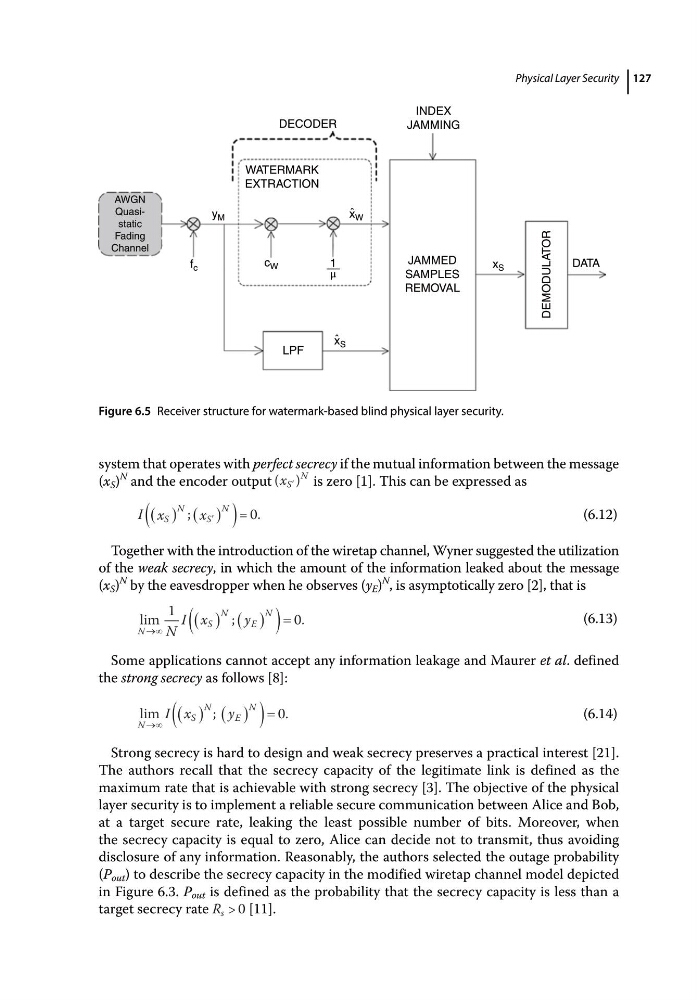
Figure 6.5 Receiver structure for watermark‐based blind physical layer security.
system that operates with perfect secrecy if the mutual information between the message
(x S )
N
and the encoder output ( )
x S
N is zero [1]. This can be expressed as
I x
x
S
N
S
N
;
= 0.
(6.12)
Together with the introduction of the wiretap channel, Wyner suggested the utilization
of the weak secrecy, in which the amount of the information leaked about the message
(x S )
N
by the eavesdropper when he observes (y E )
N
, is asymptotically zero [2], that is
lim
;
.
N
S
N
E
N
N
I x
y
1
0
(6.13)
Some applications cannot accept any information leakage and Maurer et al. defined
the strong secrecy as follows [8]:
lim
;
.
N
S
N
E
N
I x
y
0
(6.14)
Strong secrecy is hard to design and weak secrecy preserves a practical interest [21].
The authors recall that the secrecy capacity of the legitimate link is defined as the
maximum rate that is achievable with strong secrecy [3]. The objective of the physical
layer security is to implement a reliable secure communication between Alice and Bob,
at a target secure rate, leaking the least possible number of bits. Moreover, when
the secrecy capacity is equal to zero, Alice can decide not to transmit, thus avoiding
disclosure of any information. Reasonably, the authors selected the outage probability
(P out ) to describe the secrecy capacity in the modified wiretap channel model depicted
in Figure 6.3. P out is defined as the probability that the secrecy capacity is less than a
target secrecy rate R s > 0 [11].
DECODER
INDEX
JAMMING
DATA
1
JAMMED
SAMPLES
REMOVAL
LPF
WATERMARK
EXTRACTION
DEMODULATOR
f c
c W
μ
y M
x S
x S
ˆ
x W
ˆ
AWGN
Quasistatic
Fading
Channel
Figure 6.5 Receiver structure for watermark‐based blind physical layer security.