

150 Software Networks
at the center of the femtocell. In fact, there is little chance of 4G
antennas completely replacing Wi-Fi antennas. For that to happen, all
computerized devices, printers, PCs, multimedia equipment, etc.,
would need to have a 4G port. Thus, there is a high probability that the
two systems will coexist, with each of them handling those devices
which are most appropriate.
The numerous femtocell products which are coming on the market
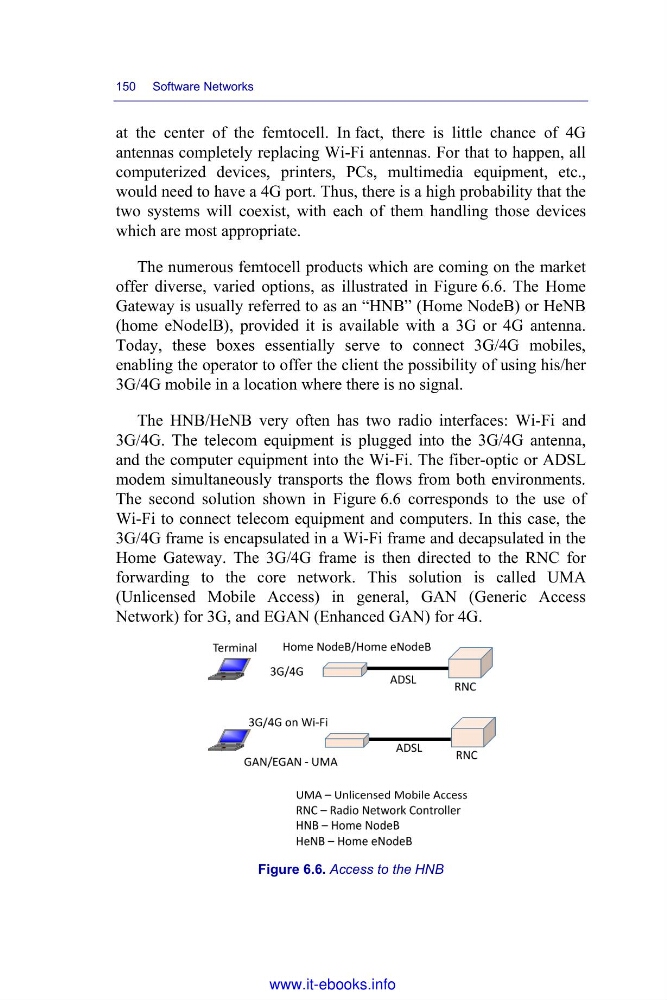
offer diverse, varied options, as illustrated in Figure 6.6. The Home
Gateway is usually referred to as an “HNB” (Home NodeB) or HeNB
(home eNodelB), provided it is available with a 3G or 4G antenna.
Today, these boxes essentially serve to connect 3G/4G mobiles,
enabling the operator to offer the client the possibility of using his/her
3G/4G mobile in a location where there is no signal.
The HNB/HeNB very often has two radio interfaces: Wi-Fi and
3G/4G. The telecom equipment is plugged into the 3G/4G antenna,
and the computer equipment into the Wi-Fi. The fiber-optic or ADSL
modem simultaneously transports the flows from both environments.
The second solution shown in Figure 6.6 corresponds to the use of
Wi-Fi to connect telecom equipment and computers. In this case, the
3G/4G frame is encapsulated in a Wi-Fi frame and decapsulated in the
Home Gateway. The 3G/4G frame is then directed to the RNC for
forwarding to the core network. This solution is called UMA
(Unlicensed Mobile Access) in general, GAN (Generic Access
Network) for 3G, and EGAN (Enhanced GAN) for 4G.
Figure 6.6. Access to the HNB
www.it-ebooks.info
at the center of the femtocell. In fact, there is little chance of 4G
antennas completely replacing Wi-Fi antennas. For that to happen, all
computerized devices, printers, PCs, multimedia equipment, etc.,
would need to have a 4G port. Thus, there is a high probability that the
two systems will coexist, with each of them handling those devices
which are most appropriate.
The numerous femtocell products which are coming on the market
offer diverse, varied options, as illustrated in Figure 6.6. The Home
Gateway is usually referred to as an “HNB” (Home NodeB) or HeNB
(home eNodelB), provided it is available with a 3G or 4G antenna.
Today, these boxes essentially serve to connect 3G/4G mobiles,
enabling the operator to offer the client the possibility of using his/her
3G/4G mobile in a location where there is no signal.
The HNB/HeNB very often has two radio interfaces: Wi-Fi and
3G/4G. The telecom equipment is plugged into the 3G/4G antenna,
and the computer equipment into the Wi-Fi. The fiber-optic or ADSL
modem simultaneously transports the flows from both environments.
The second solution shown in Figure 6.6 corresponds to the use of
Wi-Fi to connect telecom equipment and computers. In this case, the
3G/4G frame is encapsulated in a Wi-Fi frame and decapsulated in the
Home Gateway. The 3G/4G frame is then directed to the RNC for
forwarding to the core network. This solution is called UMA
(Unlicensed Mobile Access) in general, GAN (Generic Access
Network) for 3G, and EGAN (Enhanced GAN) for 4G.
Figure 6.6. Access to the HNB
www.it-ebooks.info