

Degradation Efficacy of Pinus radiata Don Needle Leaf …
91
The mixture was moved quantitatively with a wash bottle of a 500 ml round-bottle
flask and diluted with water until the final volume was 300 ml. The solution was
then refluxed for 3 h, filtered in a glass filter and dried in an oven at 105
◦ C for 12 h.
The crucible was cooled in a desiccator for 15 min and then weighed accurately. The
glass filter containing the lignin was reported as a percentage by weight of the dried
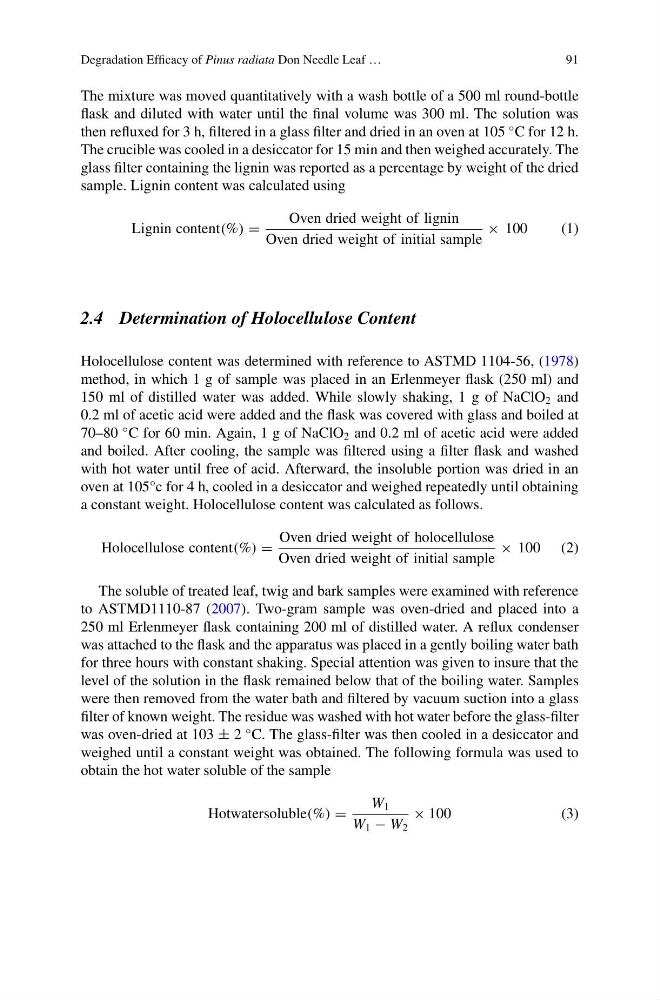
sample. Lignin content was calculated using
Lignin content(%) =
Oven dried weight of lignin
Oven dried weight of initial sample
× 100
(1)
2.4 Determination of Holocellulose Content
Holocellulose content was determined with reference to ASTMD 1104-56, (1978)
method, in which 1 g of sample was placed in an Erlenmeyer flask (250 ml) and
150 ml of distilled water was added. While slowly shaking, 1 g of NaClO 2 and
0.2 ml of acetic acid were added and the flask was covered with glass and boiled at
70–80
◦ C for 60 min. Again, 1 g of NaClO 2 and 0.2 ml of acetic acid were added
and boiled. After cooling, the sample was filtered using a filter flask and washed
with hot water until free of acid. Afterward, the insoluble portion was dried in an
oven at 105°c for 4 h, cooled in a desiccator and weighed repeatedly until obtaining
a constant weight. Holocellulose content was calculated as follows.
Holocellulose content(%) =
Oven dried weight of holocellulose
Oven dried weight of initial sample
× 100 (2)
The soluble of treated leaf, twig and bark samples were examined with reference
to ASTMD1110-87 (2007). Two-gram sample was oven-dried and placed into a
250 ml Erlenmeyer flask containing 200 ml of distilled water. A reflux condenser
was attached to the flask and the apparatus was placed in a gently boiling water bath
for three hours with constant shaking. Special attention was given to insure that the
level of the solution in the flask remained below that of the boiling water. Samples
were then removed from the water bath and filtered by vacuum suction into a glass
filter of known weight. The residue was washed with hot water before the glass-filter
was oven-dried at 103 ± 2
◦ C. The glass-filter was then cooled in a desiccator and
weighed until a constant weight was obtained. The following formula was used to
obtain the hot water soluble of the sample
Hotwatersoluble(%) =
W 1
W 1 − W 2
× 100
(3)
91
The mixture was moved quantitatively with a wash bottle of a 500 ml round-bottle
flask and diluted with water until the final volume was 300 ml. The solution was
then refluxed for 3 h, filtered in a glass filter and dried in an oven at 105
◦ C for 12 h.
The crucible was cooled in a desiccator for 15 min and then weighed accurately. The
glass filter containing the lignin was reported as a percentage by weight of the dried
sample. Lignin content was calculated using
Lignin content(%) =
Oven dried weight of lignin
Oven dried weight of initial sample
× 100
(1)
2.4 Determination of Holocellulose Content
Holocellulose content was determined with reference to ASTMD 1104-56, (1978)
method, in which 1 g of sample was placed in an Erlenmeyer flask (250 ml) and
150 ml of distilled water was added. While slowly shaking, 1 g of NaClO 2 and
0.2 ml of acetic acid were added and the flask was covered with glass and boiled at
70–80
◦ C for 60 min. Again, 1 g of NaClO 2 and 0.2 ml of acetic acid were added
and boiled. After cooling, the sample was filtered using a filter flask and washed
with hot water until free of acid. Afterward, the insoluble portion was dried in an
oven at 105°c for 4 h, cooled in a desiccator and weighed repeatedly until obtaining
a constant weight. Holocellulose content was calculated as follows.
Holocellulose content(%) =
Oven dried weight of holocellulose
Oven dried weight of initial sample
× 100 (2)
The soluble of treated leaf, twig and bark samples were examined with reference
to ASTMD1110-87 (2007). Two-gram sample was oven-dried and placed into a
250 ml Erlenmeyer flask containing 200 ml of distilled water. A reflux condenser
was attached to the flask and the apparatus was placed in a gently boiling water bath
for three hours with constant shaking. Special attention was given to insure that the
level of the solution in the flask remained below that of the boiling water. Samples
were then removed from the water bath and filtered by vacuum suction into a glass
filter of known weight. The residue was washed with hot water before the glass-filter
was oven-dried at 103 ± 2
◦ C. The glass-filter was then cooled in a desiccator and
weighed until a constant weight was obtained. The following formula was used to
obtain the hot water soluble of the sample
Hotwatersoluble(%) =
W 1
W 1 − W 2
× 100
(3)