

Bioremediation of Heavy Metals and Toxic Chemicals …
81
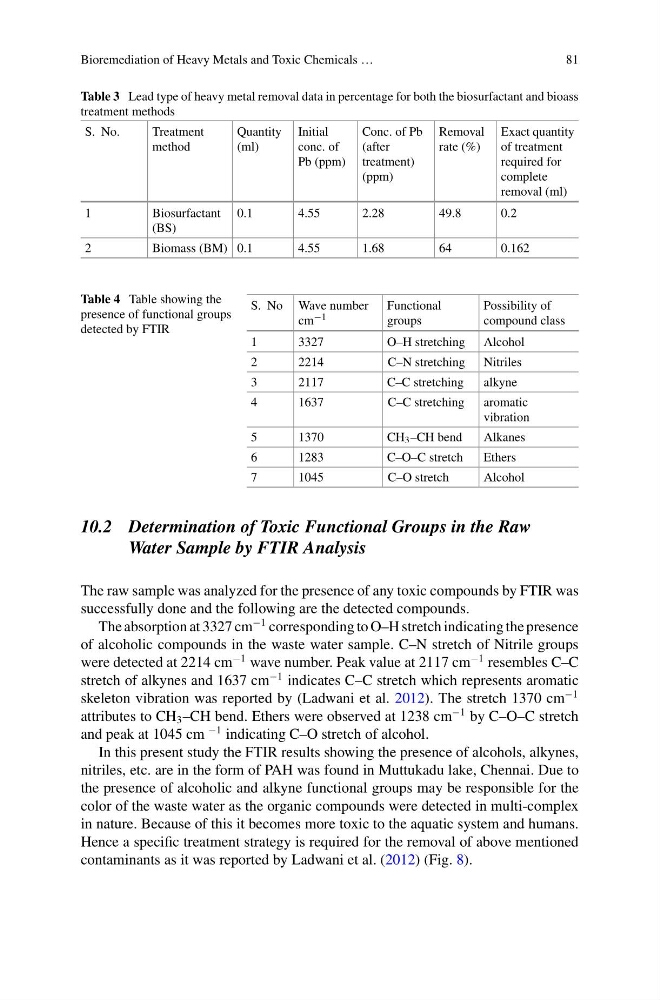
Table 3 Lead type of heavy metal removal data in percentage for both the biosurfactant and bioass
treatment methods
S. No.
Treatment
method
Quantity
(ml)
Initial
conc. of
Pb (ppm)
Conc. of Pb
(after
treatment)
(ppm)
Removal
rate (%)
Exact quantity
of treatment
required for
complete
removal (ml)
1
Biosurfactant
(BS)
0.1
4.55
2.28
49.8
0.2
2
Biomass (BM) 0.1
4.55
1.68
64
0.162
Table 4 Table showing the
presence of functional groups
detected by FTIR
S. No Wave number
cm −1
Functional
groups
Possibility of
compound class
1
3327
O–H stretching Alcohol
2
2214
C–N stretching Nitriles
3
2117
C–C stretching
alkyne
4
1637
C–C stretching
aromatic
vibration
5
1370
CH 3 –CH bend
Alkanes
6
1283
C–O–C stretch
Ethers
7
1045
C–O stretch
Alcohol
10.2 Determination of Toxic Functional Groups in the Raw
Water Sample by FTIR Analysis
The raw sample was analyzed for the presence of any toxic compounds by FTIR was
successfully done and the following are the detected compounds.
The absorption at 3327 cm
−1 corresponding to O–H stretch indicating the presence
of alcoholic compounds in the waste water sample. C–N stretch of Nitrile groups
were detected at 2214 cm
−1 wave number. Peak value at 2117 cm
−1 resembles C–C
stretch of alkynes and 1637 cm
−1 indicates C–C stretch which represents aromatic
skeleton vibration was reported by (Ladwani et al. 2012). The stretch 1370 cm
−1
attributes to CH 3 –CH bend. Ethers were observed at 1238 cm
−1 by C–O–C stretch
and peak at 1045 cm
−1 indicating C–O stretch of alcohol.
In this present study the FTIR results showing the presence of alcohols, alkynes,
nitriles, etc. are in the form of PAH was found in Muttukadu lake, Chennai. Due to
the presence of alcoholic and alkyne functional groups may be responsible for the
color of the waste water as the organic compounds were detected in multi-complex
in nature. Because of this it becomes more toxic to the aquatic system and humans.
Hence a specific treatment strategy is required for the removal of above mentioned
contaminants as it was reported by Ladwani et al. (2012) (Fig. 8).
81
Table 3 Lead type of heavy metal removal data in percentage for both the biosurfactant and bioass
treatment methods
S. No.
Treatment
method
Quantity
(ml)
Initial
conc. of
Pb (ppm)
Conc. of Pb
(after
treatment)
(ppm)
Removal
rate (%)
Exact quantity
of treatment
required for
complete
removal (ml)
1
Biosurfactant
(BS)
0.1
4.55
2.28
49.8
0.2
2
Biomass (BM) 0.1
4.55
1.68
64
0.162
Table 4 Table showing the
presence of functional groups
detected by FTIR
S. No Wave number
cm −1
Functional
groups
Possibility of
compound class
1
3327
O–H stretching Alcohol
2
2214
C–N stretching Nitriles
3
2117
C–C stretching
alkyne
4
1637
C–C stretching
aromatic
vibration
5
1370
CH 3 –CH bend
Alkanes
6
1283
C–O–C stretch
Ethers
7
1045
C–O stretch
Alcohol
10.2 Determination of Toxic Functional Groups in the Raw
Water Sample by FTIR Analysis
The raw sample was analyzed for the presence of any toxic compounds by FTIR was
successfully done and the following are the detected compounds.
The absorption at 3327 cm
−1 corresponding to O–H stretch indicating the presence
of alcoholic compounds in the waste water sample. C–N stretch of Nitrile groups
were detected at 2214 cm
−1 wave number. Peak value at 2117 cm
−1 resembles C–C
stretch of alkynes and 1637 cm
−1 indicates C–C stretch which represents aromatic
skeleton vibration was reported by (Ladwani et al. 2012). The stretch 1370 cm
−1
attributes to CH 3 –CH bend. Ethers were observed at 1238 cm
−1 by C–O–C stretch
and peak at 1045 cm
−1 indicating C–O stretch of alcohol.
In this present study the FTIR results showing the presence of alcohols, alkynes,
nitriles, etc. are in the form of PAH was found in Muttukadu lake, Chennai. Due to
the presence of alcoholic and alkyne functional groups may be responsible for the
color of the waste water as the organic compounds were detected in multi-complex
in nature. Because of this it becomes more toxic to the aquatic system and humans.
Hence a specific treatment strategy is required for the removal of above mentioned
contaminants as it was reported by Ladwani et al. (2012) (Fig. 8).