

Bioremediation of Heavy Metals and Toxic Chemicals …
79
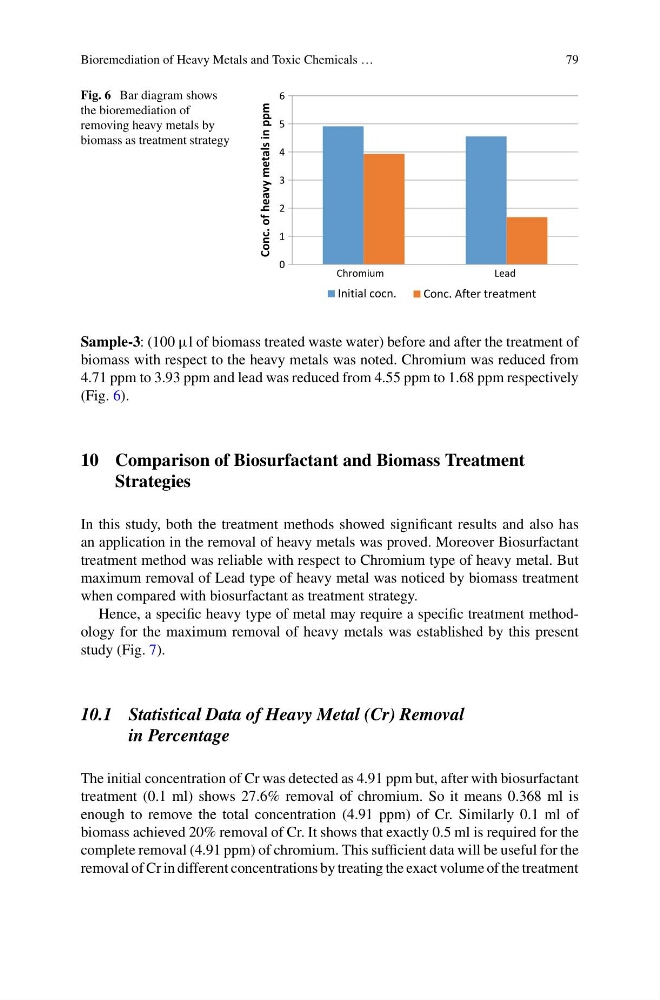
Fig. 6 Bar diagram shows
the bioremediation of
removing heavy metals by
biomass as treatment strategy
0
1
2
3
4
5
6
Chromium
Lead
Conc. of heavy metals in ppm
Initial cocn.
Conc. After treatment
Sample-3: (100 µl of biomass treated waste water) before and after the treatment of
biomass with respect to the heavy metals was noted. Chromium was reduced from
4.71 ppm to 3.93 ppm and lead was reduced from 4.55 ppm to 1.68 ppm respectively
(Fig. 6).
10 Comparison of Biosurfactant and Biomass Treatment
Strategies
In this study, both the treatment methods showed significant results and also has
an application in the removal of heavy metals was proved. Moreover Biosurfactant
treatment method was reliable with respect to Chromium type of heavy metal. But
maximum removal of Lead type of heavy metal was noticed by biomass treatment
when compared with biosurfactant as treatment strategy.
Hence, a specific heavy type of metal may require a specific treatment methodology for the maximum removal of heavy metals was established by this present
study (Fig. 7).
10.1 Statistical Data of Heavy Metal (Cr) Removal
in Percentage
The initial concentration of Cr was detected as 4.91 ppm but, after with biosurfactant
treatment (0.1 ml) shows 27.6% removal of chromium. So it means 0.368 ml is
enough to remove the total concentration (4.91 ppm) of Cr. Similarly 0.1 ml of
biomass achieved 20% removal of Cr. It shows that exactly 0.5 ml is required for the
complete removal (4.91 ppm) of chromium. This sufficient data will be useful for the
removal of Cr in different concentrations by treating the exact volume of the treatment
79
Fig. 6 Bar diagram shows
the bioremediation of
removing heavy metals by
biomass as treatment strategy
0
1
2
3
4
5
6
Chromium
Lead
Conc. of heavy metals in ppm
Initial cocn.
Conc. After treatment
Sample-3: (100 µl of biomass treated waste water) before and after the treatment of
biomass with respect to the heavy metals was noted. Chromium was reduced from
4.71 ppm to 3.93 ppm and lead was reduced from 4.55 ppm to 1.68 ppm respectively
(Fig. 6).
10 Comparison of Biosurfactant and Biomass Treatment
Strategies
In this study, both the treatment methods showed significant results and also has
an application in the removal of heavy metals was proved. Moreover Biosurfactant
treatment method was reliable with respect to Chromium type of heavy metal. But
maximum removal of Lead type of heavy metal was noticed by biomass treatment
when compared with biosurfactant as treatment strategy.
Hence, a specific heavy type of metal may require a specific treatment methodology for the maximum removal of heavy metals was established by this present
study (Fig. 7).
10.1 Statistical Data of Heavy Metal (Cr) Removal
in Percentage
The initial concentration of Cr was detected as 4.91 ppm but, after with biosurfactant
treatment (0.1 ml) shows 27.6% removal of chromium. So it means 0.368 ml is
enough to remove the total concentration (4.91 ppm) of Cr. Similarly 0.1 ml of
biomass achieved 20% removal of Cr. It shows that exactly 0.5 ml is required for the
complete removal (4.91 ppm) of chromium. This sufficient data will be useful for the
removal of Cr in different concentrations by treating the exact volume of the treatment