

Biosorption of Ni(II) Using Seeds of Mirabilis Jalapa
63
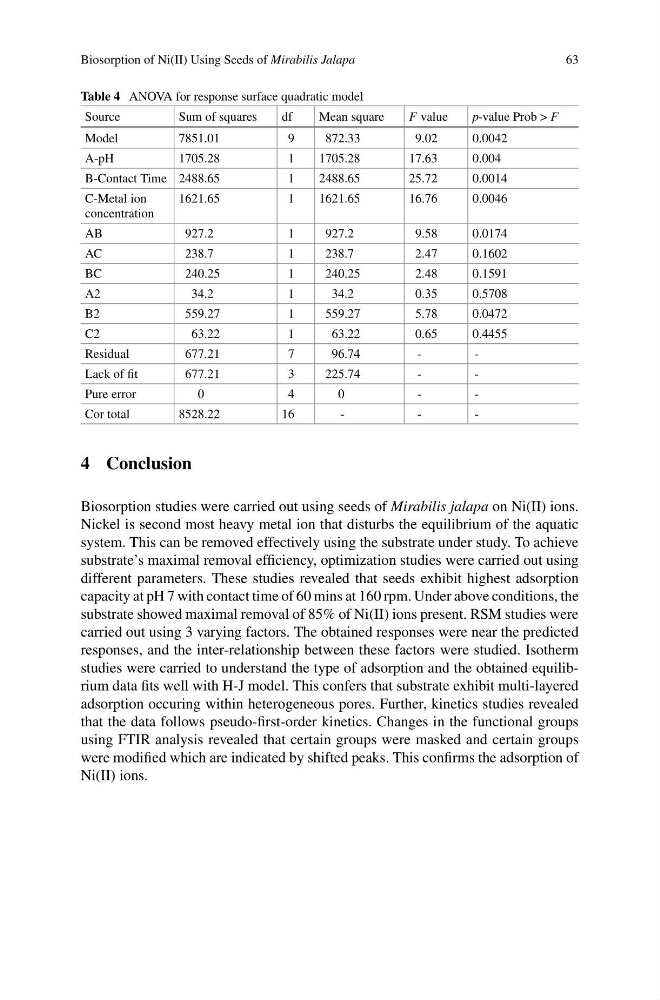
Table 4 ANOVA for response surface quadratic model
Source
Sum of squares
df
Mean square
F value
p-value Prob > F
Model
7851.01
9
872.33
9.02
0.0042
A-pH
1705.28
1
1705.28
17.63
0.004
B-Contact Time 2488.65
1
2488.65
25.72
0.0014
C-Metal ion
concentration
1621.65
1
1621.65
16.76
0.0046
AB
927.2
1
927.2
9.58
0.0174
AC
238.7
1
238.7
2.47
0.1602
BC
240.25
1
240.25
2.48
0.1591
A2
34.2
1
34.2
0.35
0.5708
B2
559.27
1
559.27
5.78
0.0472
C2
63.22
1
63.22
0.65
0.4455
Residual
677.21
7
96.74
-
-
Lack of fit
677.21
3
225.74
-
-
Pure error
0
4
0
-
-
Cor total
8528.22
16
-
-
-
4 Conclusion
Biosorption studies were carried out using seeds of Mirabilis jalapa on Ni(II) ions.
Nickel is second most heavy metal ion that disturbs the equilibrium of the aquatic
system. This can be removed effectively using the substrate under study. To achieve
substrate’s maximal removal efficiency, optimization studies were carried out using
different parameters. These studies revealed that seeds exhibit highest adsorption
capacity at pH 7 with contact time of 60 mins at 160 rpm. Under above conditions, the
substrate showed maximal removal of 85% of Ni(II) ions present. RSM studies were
carried out using 3 varying factors. The obtained responses were near the predicted
responses, and the inter-relationship between these factors were studied. Isotherm
studies were carried to understand the type of adsorption and the obtained equilibrium data fits well with H-J model. This confers that substrate exhibit multi-layered
adsorption occuring within heterogeneous pores. Further, kinetics studies revealed
that the data follows pseudo-first-order kinetics. Changes in the functional groups
using FTIR analysis revealed that certain groups were masked and certain groups
were modified which are indicated by shifted peaks. This confirms the adsorption of
Ni(II) ions.
63
Table 4 ANOVA for response surface quadratic model
Source
Sum of squares
df
Mean square
F value
p-value Prob > F
Model
7851.01
9
872.33
9.02
0.0042
A-pH
1705.28
1
1705.28
17.63
0.004
B-Contact Time 2488.65
1
2488.65
25.72
0.0014
C-Metal ion
concentration
1621.65
1
1621.65
16.76
0.0046
AB
927.2
1
927.2
9.58
0.0174
AC
238.7
1
238.7
2.47
0.1602
BC
240.25
1
240.25
2.48
0.1591
A2
34.2
1
34.2
0.35
0.5708
B2
559.27
1
559.27
5.78
0.0472
C2
63.22
1
63.22
0.65
0.4455
Residual
677.21
7
96.74
-
-
Lack of fit
677.21
3
225.74
-
-
Pure error
0
4
0
-
-
Cor total
8528.22
16
-
-
-
4 Conclusion
Biosorption studies were carried out using seeds of Mirabilis jalapa on Ni(II) ions.
Nickel is second most heavy metal ion that disturbs the equilibrium of the aquatic
system. This can be removed effectively using the substrate under study. To achieve
substrate’s maximal removal efficiency, optimization studies were carried out using
different parameters. These studies revealed that seeds exhibit highest adsorption
capacity at pH 7 with contact time of 60 mins at 160 rpm. Under above conditions, the
substrate showed maximal removal of 85% of Ni(II) ions present. RSM studies were
carried out using 3 varying factors. The obtained responses were near the predicted
responses, and the inter-relationship between these factors were studied. Isotherm
studies were carried to understand the type of adsorption and the obtained equilibrium data fits well with H-J model. This confers that substrate exhibit multi-layered
adsorption occuring within heterogeneous pores. Further, kinetics studies revealed
that the data follows pseudo-first-order kinetics. Changes in the functional groups
using FTIR analysis revealed that certain groups were masked and certain groups
were modified which are indicated by shifted peaks. This confirms the adsorption of
Ni(II) ions.