

Insights into the Status of Heavy Metal Resistant Rhizobacterial …
27
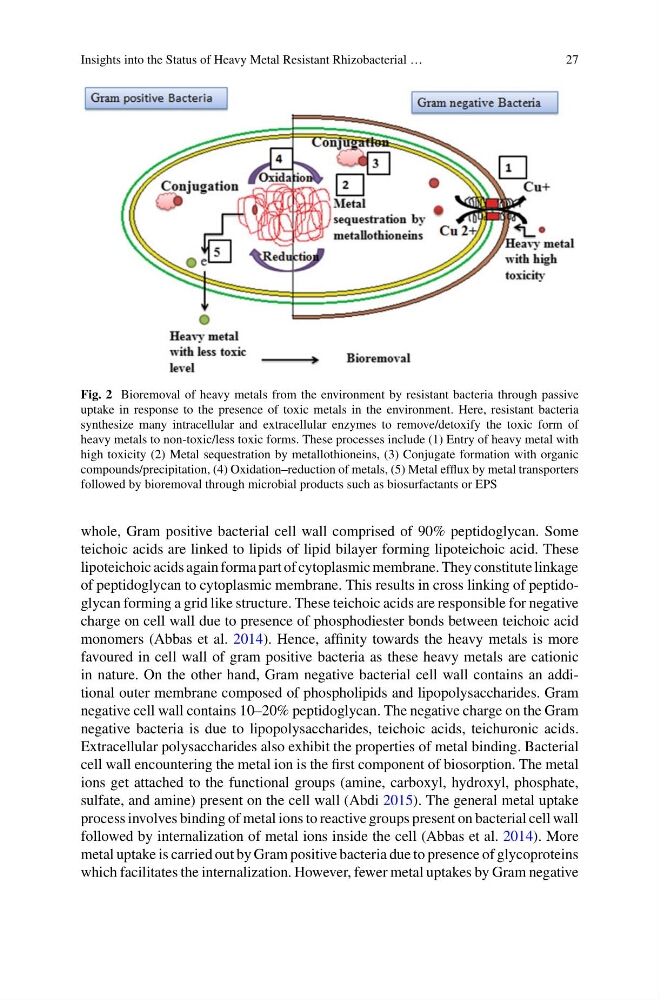
Fig. 2 Bioremoval of heavy metals from the environment by resistant bacteria through passive
uptake in response to the presence of toxic metals in the environment. Here, resistant bacteria
synthesize many intracellular and extracellular enzymes to remove/detoxify the toxic form of
heavy metals to non-toxic/less toxic forms. These processes include (1) Entry of heavy metal with
high toxicity (2) Metal sequestration by metallothioneins, (3) Conjugate formation with organic
compounds/precipitation, (4) Oxidation–reduction of metals, (5) Metal efflux by metal transporters
followed by bioremoval through microbial products such as biosurfactants or EPS
whole, Gram positive bacterial cell wall comprised of 90% peptidoglycan. Some
teichoic acids are linked to lipids of lipid bilayer forming lipoteichoic acid. These
lipoteichoic acids again forma part of cytoplasmic membrane. They constitute linkage
of peptidoglycan to cytoplasmic membrane. This results in cross linking of peptidoglycan forming a grid like structure. These teichoic acids are responsible for negative
charge on cell wall due to presence of phosphodiester bonds between teichoic acid
monomers (Abbas et al. 2014). Hence, affinity towards the heavy metals is more
favoured in cell wall of gram positive bacteria as these heavy metals are cationic
in nature. On the other hand, Gram negative bacterial cell wall contains an additional outer membrane composed of phospholipids and lipopolysaccharides. Gram
negative cell wall contains 10–20% peptidoglycan. The negative charge on the Gram
negative bacteria is due to lipopolysaccharides, teichoic acids, teichuronic acids.
Extracellular polysaccharides also exhibit the properties of metal binding. Bacterial
cell wall encountering the metal ion is the first component of biosorption. The metal
ions get attached to the functional groups (amine, carboxyl, hydroxyl, phosphate,
sulfate, and amine) present on the cell wall (Abdi 2015). The general metal uptake
process involves binding of metal ions to reactive groups present on bacterial cell wall
followed by internalization of metal ions inside the cell (Abbas et al. 2014). More
metal uptake is carried out by Gram positive bacteria due to presence of glycoproteins
which facilitates the internalization. However, fewer metal uptakes by Gram negative
27
Fig. 2 Bioremoval of heavy metals from the environment by resistant bacteria through passive
uptake in response to the presence of toxic metals in the environment. Here, resistant bacteria
synthesize many intracellular and extracellular enzymes to remove/detoxify the toxic form of
heavy metals to non-toxic/less toxic forms. These processes include (1) Entry of heavy metal with
high toxicity (2) Metal sequestration by metallothioneins, (3) Conjugate formation with organic
compounds/precipitation, (4) Oxidation–reduction of metals, (5) Metal efflux by metal transporters
followed by bioremoval through microbial products such as biosurfactants or EPS
whole, Gram positive bacterial cell wall comprised of 90% peptidoglycan. Some
teichoic acids are linked to lipids of lipid bilayer forming lipoteichoic acid. These
lipoteichoic acids again forma part of cytoplasmic membrane. They constitute linkage
of peptidoglycan to cytoplasmic membrane. This results in cross linking of peptidoglycan forming a grid like structure. These teichoic acids are responsible for negative
charge on cell wall due to presence of phosphodiester bonds between teichoic acid
monomers (Abbas et al. 2014). Hence, affinity towards the heavy metals is more
favoured in cell wall of gram positive bacteria as these heavy metals are cationic
in nature. On the other hand, Gram negative bacterial cell wall contains an additional outer membrane composed of phospholipids and lipopolysaccharides. Gram
negative cell wall contains 10–20% peptidoglycan. The negative charge on the Gram
negative bacteria is due to lipopolysaccharides, teichoic acids, teichuronic acids.
Extracellular polysaccharides also exhibit the properties of metal binding. Bacterial
cell wall encountering the metal ion is the first component of biosorption. The metal
ions get attached to the functional groups (amine, carboxyl, hydroxyl, phosphate,
sulfate, and amine) present on the cell wall (Abdi 2015). The general metal uptake
process involves binding of metal ions to reactive groups present on bacterial cell wall
followed by internalization of metal ions inside the cell (Abbas et al. 2014). More
metal uptake is carried out by Gram positive bacteria due to presence of glycoproteins
which facilitates the internalization. However, fewer metal uptakes by Gram negative