

Quorum Sensing Inhibitors as an Alternate …
289
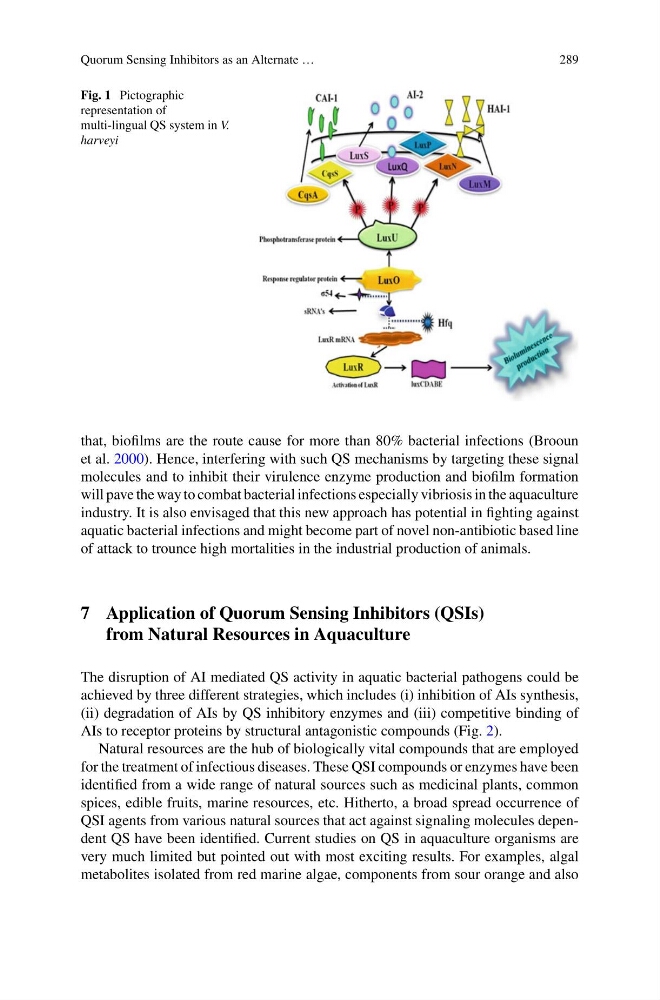
Fig. 1 Pictographic
representation of
multi-lingual QS system in V.
harveyi
that, biofilms are the route cause for more than 80% bacterial infections (Brooun
et al. 2000). Hence, interfering with such QS mechanisms by targeting these signal
molecules and to inhibit their virulence enzyme production and biofilm formation
will pave the way to combat bacterial infections especially vibriosis in the aquaculture
industry. It is also envisaged that this new approach has potential in fighting against
aquatic bacterial infections and might become part of novel non-antibiotic based line
of attack to trounce high mortalities in the industrial production of animals.
7 Application of Quorum Sensing Inhibitors (QSIs)
from Natural Resources in Aquaculture
The disruption of AI mediated QS activity in aquatic bacterial pathogens could be
achieved by three different strategies, which includes (i) inhibition of AIs synthesis,
(ii) degradation of AIs by QS inhibitory enzymes and (iii) competitive binding of
AIs to receptor proteins by structural antagonistic compounds (Fig. 2).
Natural resources are the hub of biologically vital compounds that are employed
for the treatment of infectious diseases. These QSI compounds or enzymes have been
identified from a wide range of natural sources such as medicinal plants, common
spices, edible fruits, marine resources, etc. Hitherto, a broad spread occurrence of
QSI agents from various natural sources that act against signaling molecules dependent QS have been identified. Current studies on QS in aquaculture organisms are
very much limited but pointed out with most exciting results. For examples, algal
metabolites isolated from red marine algae, components from sour orange and also
289
Fig. 1 Pictographic
representation of
multi-lingual QS system in V.
harveyi
that, biofilms are the route cause for more than 80% bacterial infections (Brooun
et al. 2000). Hence, interfering with such QS mechanisms by targeting these signal
molecules and to inhibit their virulence enzyme production and biofilm formation
will pave the way to combat bacterial infections especially vibriosis in the aquaculture
industry. It is also envisaged that this new approach has potential in fighting against
aquatic bacterial infections and might become part of novel non-antibiotic based line
of attack to trounce high mortalities in the industrial production of animals.
7 Application of Quorum Sensing Inhibitors (QSIs)
from Natural Resources in Aquaculture
The disruption of AI mediated QS activity in aquatic bacterial pathogens could be
achieved by three different strategies, which includes (i) inhibition of AIs synthesis,
(ii) degradation of AIs by QS inhibitory enzymes and (iii) competitive binding of
AIs to receptor proteins by structural antagonistic compounds (Fig. 2).
Natural resources are the hub of biologically vital compounds that are employed
for the treatment of infectious diseases. These QSI compounds or enzymes have been
identified from a wide range of natural sources such as medicinal plants, common
spices, edible fruits, marine resources, etc. Hitherto, a broad spread occurrence of
QSI agents from various natural sources that act against signaling molecules dependent QS have been identified. Current studies on QS in aquaculture organisms are
very much limited but pointed out with most exciting results. For examples, algal
metabolites isolated from red marine algae, components from sour orange and also