

250
V. Vijayalekshmi et al.
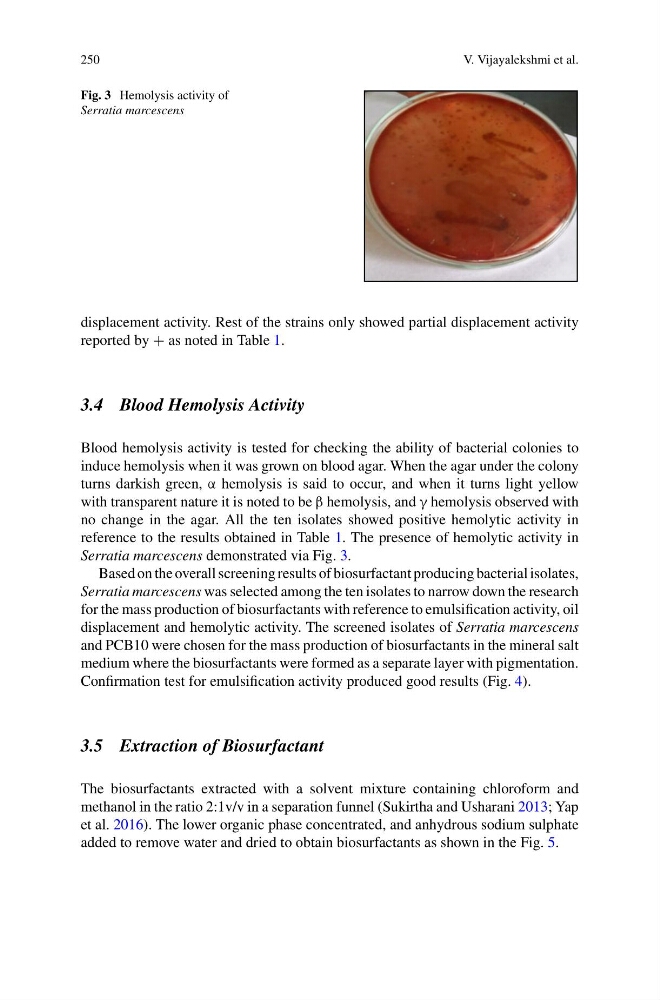
Fig. 3 Hemolysis activity of
Serratia marcescens
displacement activity. Rest of the strains only showed partial displacement activity
reported by + as noted in Table 1.
3.4 Blood Hemolysis Activity
Blood hemolysis activity is tested for checking the ability of bacterial colonies to
induce hemolysis when it was grown on blood agar. When the agar under the colony
turns darkish green, α hemolysis is said to occur, and when it turns light yellow
with transparent nature it is noted to be β hemolysis, and γ hemolysis observed with
no change in the agar. All the ten isolates showed positive hemolytic activity in
reference to the results obtained in Table 1. The presence of hemolytic activity in
Serratia marcescens demonstrated via Fig. 3.
Based on the overall screening results of biosurfactant producing bacterial isolates,
Serratia marcescens was selected among the ten isolates to narrow down the research
for the mass production of biosurfactants with reference to emulsification activity, oil
displacement and hemolytic activity. The screened isolates of Serratia marcescens
and PCB10 were chosen for the mass production of biosurfactants in the mineral salt
medium where the biosurfactants were formed as a separate layer with pigmentation.
Confirmation test for emulsification activity produced good results (Fig. 4).
3.5 Extraction of Biosurfactant
The biosurfactants extracted with a solvent mixture containing chloroform and
methanol in the ratio 2:1v/v in a separation funnel (Sukirtha and Usharani 2013; Yap
et al. 2016). The lower organic phase concentrated, and anhydrous sodium sulphate
added to remove water and dried to obtain biosurfactants as shown in the Fig. 5.
V. Vijayalekshmi et al.
Fig. 3 Hemolysis activity of
Serratia marcescens
displacement activity. Rest of the strains only showed partial displacement activity
reported by + as noted in Table 1.
3.4 Blood Hemolysis Activity
Blood hemolysis activity is tested for checking the ability of bacterial colonies to
induce hemolysis when it was grown on blood agar. When the agar under the colony
turns darkish green, α hemolysis is said to occur, and when it turns light yellow
with transparent nature it is noted to be β hemolysis, and γ hemolysis observed with
no change in the agar. All the ten isolates showed positive hemolytic activity in
reference to the results obtained in Table 1. The presence of hemolytic activity in
Serratia marcescens demonstrated via Fig. 3.
Based on the overall screening results of biosurfactant producing bacterial isolates,
Serratia marcescens was selected among the ten isolates to narrow down the research
for the mass production of biosurfactants with reference to emulsification activity, oil
displacement and hemolytic activity. The screened isolates of Serratia marcescens
and PCB10 were chosen for the mass production of biosurfactants in the mineral salt
medium where the biosurfactants were formed as a separate layer with pigmentation.
Confirmation test for emulsification activity produced good results (Fig. 4).
3.5 Extraction of Biosurfactant
The biosurfactants extracted with a solvent mixture containing chloroform and
methanol in the ratio 2:1v/v in a separation funnel (Sukirtha and Usharani 2013; Yap
et al. 2016). The lower organic phase concentrated, and anhydrous sodium sulphate
added to remove water and dried to obtain biosurfactants as shown in the Fig. 5.